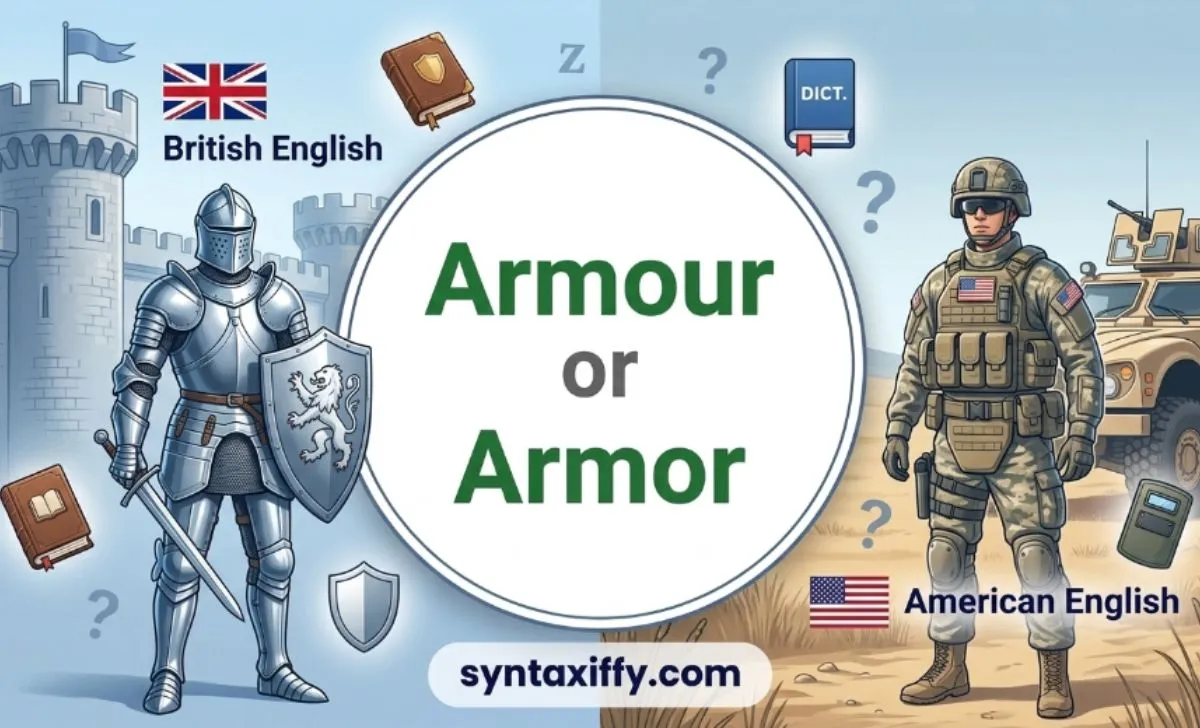
Armour or armor is a common spelling question in English. The simple answer is that both spellings are correct, but they are used in different regions. Armour is the standard spelling in British English, while armor is preferred in American English. They have the same meaning and pronunciation and refer to protective clothing or equipment, such as body armor, plate armor, or vehicle armor.
Many people get confused because they read books, websites, and social media content from both the UK and the US, where different spelling rules are used. This often leads to uncertainty about which spelling is right for academic writing, business communication, or everyday English.
In this guide, you’ll learn the difference between armour and armor, their origin, pronunciation, British vs American spelling rules, common mistakes, real-life examples, and which spelling you should use for your audience. By the end, you’ll be able to choose the correct spelling with confidence.
vehicles. This guide explains the difference, history, pronunciation, usage, and when to use each spelling correctly.
Quick Answer

The difference between armour and armor is only the spelling.
| Word | Used In | Correct? |
| Armour | British English, Australian English, Canadian English (often) | ✅ Yes |
| Armor | American English | ✅ Yes |
Examples
- The knight wore heavy armour before the battle. 🇬🇧
- The soldier inspected his armor before the mission. 🇺🇸
The meaning stays the same in every context, whether you are talking about body armor, plate armor, chainmail, vehicle armor, or ballistic armor.
The Origin of Armour or Armor
The word comes from the Old French word armure, which was influenced by the Latin word armatura, meaning “equipment or weapons.”
As English developed through Middle English, the spelling armour became standard in Britain. Later, American lexicographer Noah Webster promoted simpler spellings during the American spelling reform. As a result, armor became the preferred spelling in the United States.
Today:
- Armour follows traditional British spelling.
- Armor follows American spelling conventions.
- Both appear in major dictionaries like the Oxford English Dictionary, Cambridge Dictionary, Collins Dictionary, Merriam-Webster Dictionary, and Dictionary.com.
British English vs American English Spelling
The spelling difference follows the same pattern as many British and American English words.
| British English | American English |
| Armour | Armor |
| Colour | Color |
| Honour | Honor |
| Humour | Humor |
| Labour | Labor |
| Favourite | Favorite |
| Centre | Center |
| Theatre | Theater |
| Defence | Defense |
| Jewellery | Jewelry |
Comparison
| Feature | Armour | Armor |
| Region | UK, Australia, New Zealand | United States |
| Meaning | Protective equipment | Protective equipment |
| Pronunciation | Same | Same |
| Formal Writing | UK Standard | US Standard |
| Academic Writing | UK Style | US Style |
There is no difference in meaning. Only the regional spelling changes.
Pronunciation of Armour or Armor
Both words are pronounced the same.
IPA (UK): /ˈɑː.mər/
IPA (US): /ˈɑːr.mɚ/
Sounds like: AR-mer
Whether someone says armour or armor, listeners hear nearly the same pronunciation. The difference exists only in writing, not in spoken English.
Why People Confuse Armour or Armor
Many English learners wonder which spelling is correct because both appear online.
Common reasons include:
- British and American spelling differences.
- Reading books from different countries.
- Watching UK and US media.
- Different dictionary preferences.
- International websites using mixed English.
Since both spellings sound identical, people often think one must be incorrect. In reality, each spelling is correct for its regional audience.
Which Spelling Should You Use?
Choose the spelling based on your audience.
| Audience | Recommended Spelling |
| United States | Armor |
| United Kingdom | Armour |
| Australia | Armour |
| New Zealand | Armour |
| International Business | Follow your chosen style guide |
| Academic Writing | Match your institution’s language style |
If your website uses American English, keep using armor throughout the content.
If your content follows British English, use armour consistently.
Consistency matters more than choosing one spelling over the other.
Common Mistakes with Armour or Armor
| Mistake | Correct Version |
| Mixing armour and armor in one article | Choose one style and stay consistent. |
| Thinking one spelling is wrong | Both are correct regionally. |
| Using British spelling in US academic papers | Use armor. |
| Using American spelling in UK publications | Use armour. |
| Assuming pronunciation changes | Both are pronounced the same. |
Armour or Armor in Everyday Examples
- Our security team has ordered new body armor for all officers.
- The museum displayed medieval armour from the 15th century.
News
- The military tested advanced ceramic armor for vehicles.
- The exhibition featured rare European plate armour.
Social Media
- This game has the best fantasy armor design.
- The knight’s armour looks incredibly realistic.
Professional Writing
- Engineers improved the armor plating on the military vehicle.
- Modern protective equipment includes lightweight ballistic armor.
Easy Trick to Remember Armour or Armor
Remember this simple rule:
- U = United Kingdom = Armour
- No U = United States = Armor
If you remember where the letter “U” belongs, you will never confuse these spellings again.
Armour or Armor – Google Trends & Usage Data
Search interest depends largely on country.
| Country | Common Search |
| United States | Armor |
| United Kingdom | Armour |
| Australia | Armour |
| New Zealand | Armour |
| Ireland | Armour |
| Canada | Both (Armor is becoming more common online.) |
The word is especially popular in searches related to:
- Military equipment
- Body armor
- Protective clothing
- Ballistic armor
- Vehicle armor
- Tank armor
- Medieval armor
- Gaming
- History
- Personal protective equipment (PPE)
People also search for related topics like chainmail, steel armor, combat armor, and armor plating.
Comparison Table
| Feature | Armour | Armor |
| Correct Spelling | ✅ Yes | ✅ Yes |
| British English | ✅ Standard | ❌ Rare |
| American English | ❌ Rare | ✅ Standard |
| Meaning | Protective equipment | Protective equipment |
| Pronunciation | Same | Same |
| Formal Usage | UK Style | US Style |
| Academic Usage | UK Institutions | US Institutions |
FAQs
Is armour or armor correct?
Both are correct. Armour is British English, while armor is American English.
What is the difference between armour and armor?
There is no difference in meaning. Only the spelling changes based on regional English.
Is armour used in America?
It may appear occasionally, but armor is the standard American spelling.
Is armor wrong in the UK?
It is understandable, but armour is the preferred British spelling.
Which spelling should I use for international readers?
Choose one variety of English and stay consistent throughout your content.
Do armour and armor have different pronunciations?
No. Both are pronounced almost exactly the same.
Why did American English remove the letter “u”?
American spelling reforms led by Noah Webster simplified many British spellings, including armour → armor.
Conclusion
Conclusion
Both armour and armor are correct spellings of the same word, and the only real difference is the regional variety of English you are using. Armour is the standard spelling in British English, while armor is preferred in American English.
Their meaning, pronunciation, and usage are identical, whether you are talking about body armor, medieval armor, protective equipment, or armored military vehicles. The key to writing professionally is to choose the spelling that matches your audience and use it consistently throughout your content.
If you’re writing for readers in the UK or other Commonwealth countries, use armour. If your audience is in the United States, armor is the better choice. Understanding this simple spelling difference will help you avoid common mistakes, improve your writing, and communicate more clearly in academic, professional, and everyday English.
Read More Blogs:
- Pyjamas or Pajamas: Which Spelling Is Correct?
- Fulfilment or Fulfillment: British vs American English Explained

Hi, I am Bill Walsh, and I write clear and practical grammar blogs on Syntaxiffy.com.
I focus on English grammar, pair of words, and spelling differences to help readers improve their writing skills.