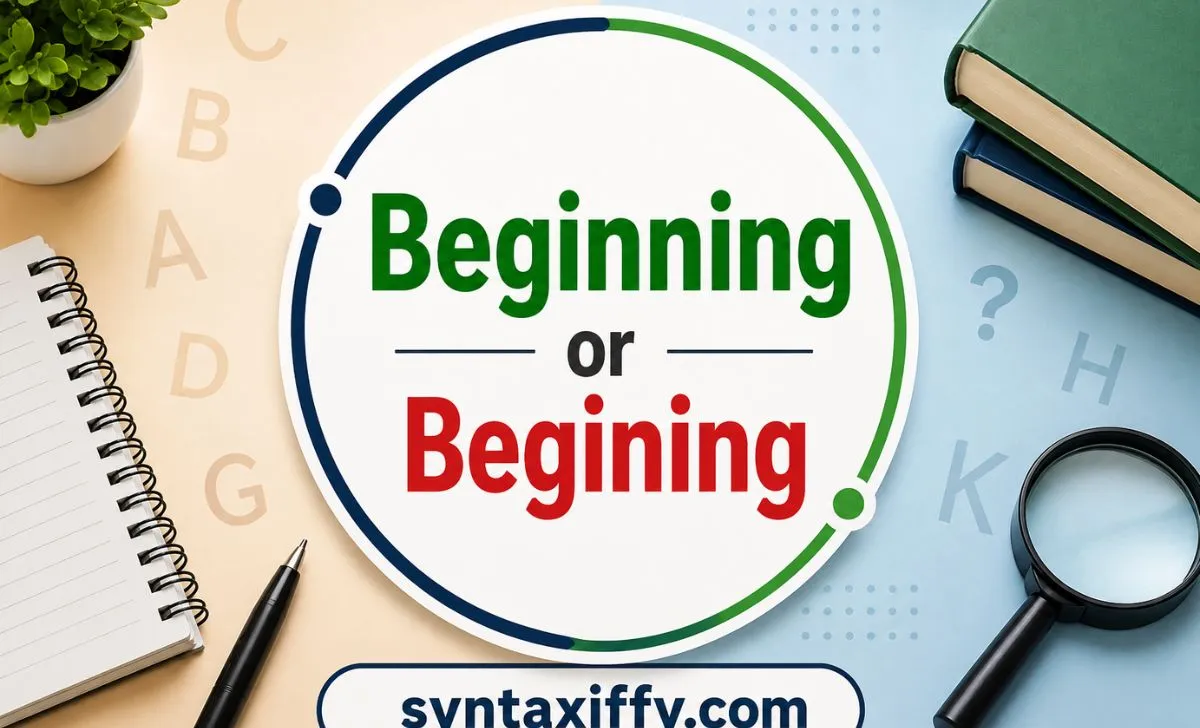
If you are wondering whether “beginning” or “begining” is correct, the answer is beginning. “Begining” is a common misspelling and is not the standard spelling in English.
The confusion happens because the base verb is begin, and learners may forget that the final consonant is doubled before adding -ing. This article explains the spelling rule, word origin, pronunciation, British and American English usage, common mistakes, and easy ways to remember the correct form.
You will also see examples from everyday, academic, professional, and digital writing so you can use beginning confidently.
Quick Answer
Beginning is the correct spelling.
Begining is incorrect in standard English.
The word beginning comes from the verb begin and means the start or first part of something.
| Spelling | Correct? | Example |
| Beginning | ✅ Yes | The beginning of the movie was exciting. |
| Begining | ❌ No | The begining of the movie was exciting. |
The correct spelling has two n’s:
begin + ning = beginning
For example:
- The beginning of the lesson was easy.
- We are beginning a new project.
- She arrived at the beginning of the meeting.
The Origin of Beginning or Begining
The word beginning comes from the verb begin, which has Old English and Germanic roots. The verb has been part of the English language for centuries and has developed into several related forms.
The basic word family includes:
- begin — base verb
- began — past tense
- begun — past participle
- beginning — present participle and gerund
- beginner — a person who starts learning or doing something
The spelling becomes confusing when -ing is added to begin.
The important spelling rule is that a short-vowel, one-syllable verb ending in a single consonant generally doubles that final consonant before -ing.
So:
begin + ing → beginning
The final n is doubled.
This is why begining is incorrect.
British English vs American English Spelling

There is no difference between British English and American English when spelling this word.
Both varieties use:
beginning
The same spelling is standard in American English, British English, Canadian English, Australian English, and other major forms of standard English.
Some English words have different British and American spellings, such as:
- colour / color
- behaviour / behavior
- centre / center
- travelling / traveling
However, beginning is not one of those words.
| English variety | Correct spelling | Incorrect spelling |
| American English | beginning | begining |
| British English | beginning | begining |
| Canadian English | beginning | begining |
| Australian English | beginning | begining |
Therefore, you do not need to change the spelling based on your audience’s country.
Pronunciation of Beginning or Begining
Beginning is pronounced approximately like:
bih-GIN-ing
Its pronunciation is commonly represented in the International Phonetic Alphabet as:
/bɪˈɡɪnɪŋ/
The middle sound contains the doubled n in the spelling, but you do not pronounce two separate n sounds.
For example:
beginning → bih-GIN-ing
The incorrect spelling begining can look almost identical when spoken. This is one reason people often confuse the two forms.
English spelling and pronunciation do not always match perfectly. Therefore, hearing the word alone may not help you remember that it requires two n’s.
Why People Confuse Beginning or Begining
Several factors make this spelling mistake common.
First, the base word is begin.
When people add -ing, they may simply write:
begin + ing = begining
But English spelling rules require the final consonant to be doubled.
Second, the pronunciation does not clearly reveal the spelling.
When you hear beginning, you do not hear two separate n sounds. As a result, learners may forget the second n when writing.
Third, the incorrect form looks natural.
The spelling begining visually resembles other words ending in -ing, so it can appear correct at first glance.
Fourth, typing quickly can cause mistakes.
People may leave out one letter while writing emails, social media posts, school assignments, or professional documents.
Which Spelling Should You Use?
Use beginning regardless of whether you are writing for an American, British, Canadian, or Australian audience.
You should use it in:
- Academic writing
- Business communication
- Emails
- Essays
- Websites
- News writing
- Social media
- Formal documents
- Everyday conversations
If you are writing for a global audience, beginning is also the safest choice because it is the standard spelling across major English varieties.
Avoid begining in professional or academic writing because it is considered a spelling error.
Common Mistakes with Beginning or Begining
Here are some frequent mistakes and their corrections:
| Incorrect | Correct | Example |
| begining | beginning | The beginning was surprising. |
| begining of the year | beginning of the year | We met at the beginning of the year. |
| at the begining | at the beginning | She spoke at the beginning. |
| from the begining | from the beginning | I knew it from the beginning. |
| begining to learn | beginning to learn | He is beginning to learn English. |
A common mistake is forgetting the second n after begin.
Remember:
begin → beginning
Not:
begin → begining
Beginning or Begining in Everyday Examples
The word beginning is extremely common in everyday English.
In Emails
Thank you for your message. I would like to discuss this at the beginning of our meeting.
In Academic Writing
The beginning of the study focuses on basic English grammar.
In Professional Writing
Please submit the report at the beginning of the next business day.
In News Writing
The beginning of the year brought several important changes.
On Social Media
Every new journey has a beginning.
In Everyday Conversation
I missed the beginning of the movie.
In Formal Writing
The beginning of the project required careful planning.
These examples show that beginning can refer to the first part of an event, period, activity, story, process, or journey.
Easy Trick to Remember Beginning or Begining
Use this simple memory trick:
“Begin begins with two n’s when it begins to happen.”
Think of:
BEGIN + ING = BEGINNING
The final n gets doubled:
begin → beginning
You can also remember the phrase:
“The beginning needs two n’s.”
Whenever you write the word, quickly check the middle:
beginning
Count the n’s:
beginni ng?
The easiest visual check is simply:
be + g + i + nn + i + ng
There are two n’s together.
Beginning or Begining – Google Trends & Usage Data
Searches for spelling comparisons such as “beginning or begining” usually come from people checking whether they have spelled the word correctly.
The correct form, beginning, is widely used in English-language content across countries, including the United States, United Kingdom, Canada, Australia, and other English-speaking regions.
The search intent is mainly educational and practical. Users commonly encounter the word while writing:
- School assignments
- Essays
- Emails
- Articles
- Business documents
- Online posts
- English-learning exercises
There is also an important difference between search popularity and correct usage. A misspelled form may appear in search queries because users are unsure about the spelling. That does not make the misspelled version acceptable in standard English.
For accurate writing, dictionaries and established English grammar references consistently support beginning as the standard spelling.
Comparison Table
| Feature | Beginning | Begining |
| Correct spelling | ✅ Yes | ❌ No |
| Standard English | Yes | No |
| Meaning | Start or first part | No standard meaning |
| Base word | Begin | Begin |
| Ending | -ing | -ing |
| Double consonant | nn | n |
| British English | Correct | Incorrect |
| American English | Correct | Incorrect |
| Academic writing | Recommended | Avoid |
| Professional writing | Recommended | Avoid |
The key difference is simple:
Beginning = correct
Begining = misspelling
FAQs
Is “beginning” the correct spelling?
Yes. Beginning is the correct standard English spelling. It contains two n’s.
Is “begining” a word?
No. Begining is generally a misspelling of beginning and should not be used in standard English writing.
Why does beginning have two n’s?
The final consonant of begin is doubled when the -ing suffix is added. Therefore, begin + ing becomes beginning.
Is beginning spelled differently in British English?
No. Both British English and American English use beginning.
What is the difference between begin and beginning?
Begin is the base verb, while beginning can function as a present participle or gerund. It can also be a noun meaning the start or first part of something.
How do you pronounce beginning?
It is pronounced approximately bih-GIN-ing, with the IPA pronunciation /bɪˈɡɪnɪŋ/.
What are the forms of the verb begin?
The main forms are begin, began, begun, beginning, and begins.
Conclusion
The correct spelling is beginning, not begining. The difference is only one letter, but that extra n is essential. The word comes from begin, and when -ing is added, the final consonant is doubled: begin + ing = beginning.
This spelling is the same in both British and American English. Whether you are writing an email, essay, article, social media post, or professional document, always use beginning.
A simple way to remember it is: “The beginning needs two n’s.” With this rule, you can avoid this common English spelling mistake confidently.
Read More Blogs:

Hi, I am Bill Walsh, and I write clear and practical grammar blogs on Syntaxiffy.com.
I focus on English grammar, pair of words, and spelling differences to help readers improve their writing skills.