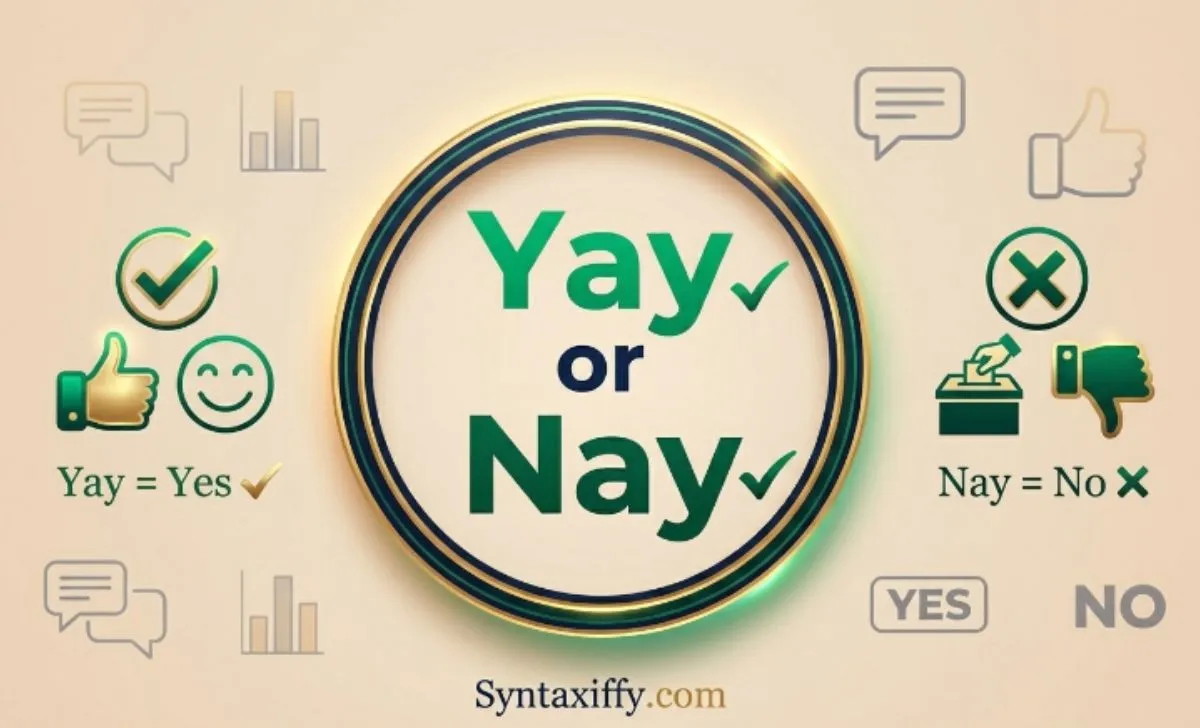
Have you ever seen someone write yay while another person uses nay and wondered what the difference is?
Many people search for yay or nay because both words are common in conversations, social media posts, polls, and everyday communication. Yet they express opposite ideas, which creates confusion.
The truth is simple. Yay is a positive response that shows approval, agreement, or excitement.
Nay is a negative response that shows disagreement, rejection, or objection. Although both words are old, they are still widely used in modern English and online culture.
This guide explains the meaning, history, usage, examples, and common mistakes so you can confidently decide when to say yay and when to say nay.
Yay or Nay – Quick Answer
Yay means yes, approval, or enthusiasm, while nay means no, rejection, or disagreement.
They are not spelling variations of the same word. Instead, they are opposite expressions.
Quick Comparison
| Word | Meaning | Response |
| Yay | Positive | Yes |
| Nay | Negative | No |
Examples
- Yay! We won the game.
- I vote nay on this proposal.
- Most people gave the movie a yay.
- A few members said nay.
The Origin of Yay or Nay
The story behind these words goes back many centuries.
Origin of Nay
Nay comes from Old English and later appeared in Middle English. Historically, it meant “no” or “not.” The word became common in legal discussions, parliamentary voting, and legislative procedures.
For centuries, lawmakers used voice votes by saying:
- Yea
- Nay
This method is still used in many governments today.
Origin of Yay
The word yay is much newer. It developed as an informal expression of happiness, celebration, and enthusiasm. Over time, it became popular in spoken English, text messages, and internet slang.
Why the Confusion Exists
Many people confuse:
- Yay vs Nay
- Yea vs Yay
- Yea vs Nay
The confusion exists because these words sound similar but serve different purposes.
British English vs American English Spelling

Unlike words such as color and colour, yay and nay do not have British and American spelling differences.
People in:
- The United States
- The United Kingdom
- Canada
- Australia
- New Zealand
all use the same spellings.
Comparison Table
| Feature | Yay | Nay |
| American English | ✔ | ✔ |
| British English | ✔ | ✔ |
| Standard English | ✔ | ✔ |
| Different Meaning | Positive | Negative |
| Pronunciation | Similar | Similar |
Examples:
American English:
Yay! School is over.
British English:
The committee voted nay.
The spellings remain the same across regions.
Which Word Should You Use?
Your message determines the choice.
Use “Yay” When You Want to Show:
- Agreement
- Approval
- Excitement
- Celebration
- Positive reaction
- Enthusiasm
Examples:
- Yay! We are going on vacation.
- Everyone gave the idea a yay.
- She answered with an enthusiastic yes.
Use “Nay” When You Want to Show:
- Disapproval
- Rejection
- Objection
- Negative response
- Refusal
- Disagreement
Examples:
- Several members voted nay.
- I must say nay to this suggestion.
- His answer was a clear no.
Common Mistakes with Yay or Nay
People often make several errors.
Mistake 1: Treating Them as Spellings of One Word
Wrong:
- Is yay the American spelling and nay the British spelling?
Correct:
- They are completely different words.
Mistake 2: Confusing Yea with Yay
Wrong:
- Yea! We won.
Correct:
- Yay! We won.
Yea is mainly used in formal voting, while yay expresses happiness.
Mistake 3: Using Nay in Casual Conversations
Wrong:
- Nay! I passed the exam.
Correct:
- Yay! I passed the exam.
Mistake 4: Mixing Positive and Negative Meanings
Wrong:
- Everyone said yay against the proposal.
Correct:
- Everyone voted against the proposal and said nay.
Yay or Nay in Everyday Examples
These words appear in many forms of communication.
Emails
Informal Email
Yay! Thanks for approving the project.
Formal Email
I must respectfully vote nay on this recommendation.
News Articles
News writers often report votes.
Examples:
- The bill passed after a majority voted yay.
- Several lawmakers voted nay.
Social Media
Social media users love these expressions.
Examples:
- Yay! Weekend finally arrived.
- Yay or nay on this outfit?
- Pizza for dinner—yay or nay?
These phrases are common in:
- Online polls
- Hashtags
- Memes
- Digital communication
- Internet culture
Text Messages
Examples:
- Concert tonight? Yay!
- Early meeting tomorrow? Nay.
Business Communication
Professional writing usually avoids “yay,” but “nay” may appear when discussing votes or decisions.
Academic Writing
Academic and formal writing prefer:
- Yes
- No
- Approval
- Rejection
rather than casual expressions.
Yay or Nay in Social Media and Online Culture
Modern English has embraced these words.
People often ask:
- Coffee before bed: yay or nay?
- Crocs with socks: yay or nay?
- Pineapple on pizza: yay or nay?
Online polls frequently use these words because they are simple and engaging.
Memes and casual writing have made the phrase even more popular among younger audiences.
Yay, Yea, Yes, and Nay Compared
Many learners confuse these words.
| Word | Meaning | Common Use |
| Yay | Excitement or approval | Informal |
| Yea | Formal yes vote | Legislative procedure |
| Yes | Standard positive answer | Everyday English |
| Nay | Formal no vote | Parliamentary voting |
Yay or Nay – Google Trends and Usage Data
Search interest for yay or nay remains strong because users often want quick answers.
People from:
- United States
- United Kingdom
- Canada
- Australia
- New Zealand
regularly search:
- Yay meaning
- Nay meaning
- Yay definition
- Nay definition
- Yay vs yea
- Yes vs yay
- No vs nay
- How to use yay
- How to use nay
Social media and online polls have increased the popularity of these expressions.
The phrase “yay or nay” has become part of modern online culture and casual conversation.
Comparison Table

| Feature | Yay | Nay |
| Meaning | Approval | Rejection |
| Emotion | Positive | Negative |
| Similar Word | Yes | No |
| Formality | Informal | More Formal |
| Social Media Usage | Very Common | Common |
| Voting Usage | Sometimes | Common |
| Shows Enthusiasm | Yes | No |
| Shows Objection | No | Yes |
FAQs
Is yay or nay correct?
Both words are correct. They simply have opposite meanings.
What does yay mean?
Yay expresses happiness, excitement, agreement, or approval.
What does nay mean?
Nay means no, disagreement, rejection, or objection.
Is nay old-fashioned?
Yes. It is an older word, but it still appears in voting and formal discussions.
What is the difference between yay and yea?
Yay shows excitement, while yea is a formal affirmative vote.
Can I use yay in professional writing?
Informal emails and conversations may use it, but business and academic writing usually prefer “yes.”
Why do people say “yay or nay”?
People use the phrase when asking for opinions or decisions.
Conclusion
Understanding yay or nay is easier once you know that the two words are opposites rather than spelling variations.
Yay expresses approval, excitement, and agreement, while nay represents rejection, objection, and disagreement.
Their meanings have remained clear throughout the history of English, even though their origins are different.
Today, these expressions appear in conversations, social media, online polls, and even legislative procedures.
They are understood across the United States, the United Kingdom, Canada, Australia, and New Zealand.
The key is to use them according to the message you want to communicate. Choose yay for positive reactions and nay for negative ones, and your meaning will always be clear.
Read More Blogs:
- Payer or Payor:Difference Explained With Easy Examples
- Crain or Crane: Which One Should You Use and Why?

Hi, I am Roy Peter Clark, and I write clear and practical grammar and writing blogs.
On Syntaxiffy.com, I focus on English grammar, style, and writing techniques to help readers improve clarity and communication.