
People often encounter the terms payer or payor in insurance policies, healthcare billing systems, financial contracts, and legal documents.
At first glance, both words look different, but they create confusion because they usually refer to the same concept.
This confusion becomes more noticeable in professional environments such as medical billing, insurance claims processing, and contractual agreements where precise terminology matters.
Understanding the difference between payer and payor helps you write correctly in business communication, avoid legal inconsistency, and interpret financial documents more clearly.
Quick Answer: Payer vs Payor
Both payer and payor mean:
A person, organization, or entity responsible for making a payment.
However:
- Payer → Standard modern English (most commonly used)
- Payor → Specialized legal, insurance, and healthcare terminology
👉 In most writing, payer is the preferred and recommended spelling.
What Does Payer Mean?
A payer is any individual, company, or institution that sends money in exchange for goods, services, or obligations.
It is the standard form used in modern English, business communication, financial writing, and general documentation.
Common Examples of a Payer
- A customer paying for goods or services
- An employer paying salaries
- A tenant paying rent
- A business settling an invoice
- A client paying for consulting services
Example Sentences
- The payer must complete the transaction before the due date.
- The bank verified the identity of the payer.
- The payer received a confirmation after successful payment.
What Does Payor Mean?
A payor carries the same meaning as payer but is used in more specialized or formal systems.
It is commonly found in:
- Legal contracts
- Insurance policies
- Healthcare billing systems
- Government reimbursement frameworks
Common Examples of a Payor
- Health insurance company paying medical claims
- Government agency distributing benefits
- Contractual party responsible for payment obligations
- Insurance provider covering treatment costs
Example Sentences
- The payor approved the reimbursement request.
- The agreement specifies the payor’s financial responsibility.
- The healthcare payor processed the claim successfully.
Why Do Two Spellings Exist? (Origin Explained)
The word originates from the verb “pay”, which comes from Old French and Latin roots.
Historically:
- Payer became the standard English noun form
- Payor developed in legal and financial drafting traditions
Legal language often prefers -or suffixes, such as:
- grantor
- obligor
- mortgagor
- assignor
Because of this pattern, professionals in law and insurance adopted payor to maintain consistency with formal contractual terminology.
Payer vs Payor: Key Differences
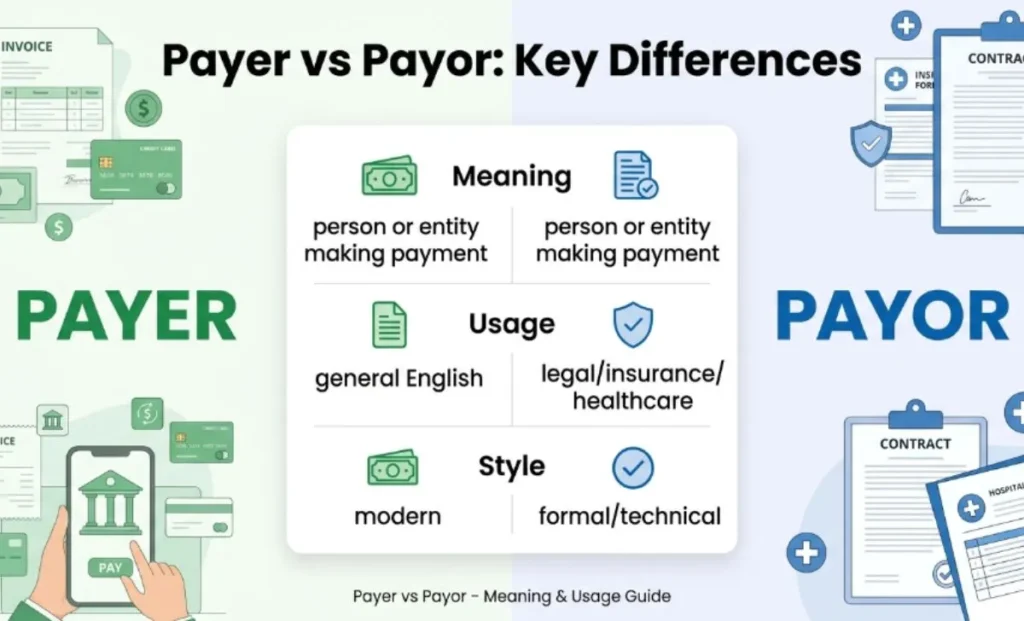
| Feature | Payer | Payor |
|---|---|---|
| Meaning | Person making payment | Same meaning |
| Usage | General English | Specialized industries |
| Business writing | Preferred | Less common |
| Legal documents | Occasionally used | Frequently used |
| Healthcare systems | Common | Very common |
| Insurance industry | Common | Widely used |
| Readability | Easier | More technical |
👉 The meaning never changes — only the context and industry preference differ.
Payer vs Payor in Healthcare (Important Use Case)
Healthcare systems frequently use both terms depending on the context.
A third-party payer system typically includes:
- Private health insurance companies
- Government healthcare programs
- Employer-sponsored insurance plans
Healthcare Example
A patient receives treatment:
- Provider → Hospital or doctor
- Payor/Payer → Insurance company
- Patient → May pay deductible or co-pay
👉 In medical billing systems, payor is still commonly used, especially in claim processing and reimbursement software.
Payer vs Payor in Insurance
Insurance companies often prefer payor in formal documentation because it aligns with legal drafting conventions.
Examples include:
- Primary payor
- Secondary payor
- Insurance payor responsibility clauses
However, customer-facing documents often use payer for simplicity.
Payer vs Payor in Legal Documents
In legal contracts, payor appears more frequently because:
- It aligns with traditional legal suffix patterns (-or)
- It fits formal contractual language
- It is commonly used in liability clauses
Example Clause:
“The payor shall be responsible for all outstanding financial obligations under this agreement.”
Payer vs Payor in Finance & Business
In general business communication, payer is preferred.
Used in:
- Invoicing systems
- Accounts payable/receivable
- Corporate transactions
- Payment gateways
Example:
The payer must complete the payment before goods are released.
Which One Should You Use? (Practical Guide)
✔ Use “Payer” when:
- Writing blogs or articles
- Creating business content
- Writing emails or reports
- Communicating with general audiences
- SEO or marketing content
👉 Best for clarity and readability
✔ Use “Payor” when:
- Drafting legal contracts
- Working in insurance documentation
- Handling healthcare billing systems
- Writing regulatory or formal financial agreements
👉 Best for industry compliance
Common Mistakes to Avoid
❌ Thinking one is incorrect
Both are correct — meaning is identical.
❌ Mixing both in one document
Incorrect:
The payer must submit forms and the payor approves them.
Correct:
Choose one spelling and remain consistent.
❌ Assuming “payor” is British English
Not true. Both British and American English prefer payer in general writing.
Payer vs Payor vs Payee (Clear Concept Map)
To fully understand payment roles:
- Payer / Payor → The one who pays
- Payee → The one who receives payment
- Remitter → The party initiating a transfer (banking context)
👉 This structure is widely used in banking and financial systems.
Real-World Usage Examples
Business Email
Please contact the payer regarding invoice processing.
Insurance Claim
The primary payor has approved the medical claim.
Legal Agreement
The payor agrees to fulfill all payment obligations under this contract.
Healthcare System
The third-party payer processed the reimbursement.
FAQs
Is payer or payor correct?
Both are correct. However, payer is more widely used in modern English.
What is the meaning of payor?
Payor refers to the entity responsible for making a payment, mainly in legal and healthcare contexts.
Is payor outdated?
No. It is still actively used in insurance, legal, and medical systems.
Which is better for writing?
Use payer for general writing and content creation.
Why does healthcare use payor?
Because healthcare systems follow established legal and billing terminology where payor is standard in many legacy systems.
Is there a difference in meaning?
No. Only spelling and industry usage differ.
Conclusion
The difference between payer vs payor is not about meaning — it is about context and industry preference.
- Payer is the modern, widely accepted English spelling
- Payor is a formal variant used in legal, insurance, and healthcare systems
For most writing, especially blogs, business communication, and SEO content, payer is the safest and most effective choice.
Understanding this distinction helps ensure clarity, consistency, and professionalism in both casual and formal writing environments.
Read More Blogs:
- Studder or Stutter: Which Spelling Is Correct?
- Todays or Today’s: Complete Usage Guide with Examples

Hi, I am Roy Peter Clark, and I write clear and practical grammar and writing blogs.
On Syntaxiffy.com, I focus on English grammar, style, and writing techniques to help readers improve clarity and communication.