“Your or you’re” is one of the most common grammar mistakes in English writing. Students, content writers, professionals, and even native speakers often get confused between these two words. The main reason is simple: both words sound exactly the same but have completely different meanings and grammatical roles.
This confusion usually appears in emails, assignments, social media captions, and professional communication. For example, many people incorrectly write “your welcome” instead of “you’re welcome,” which changes the correctness of the sentence.
If you have ever paused while writing sentences like “your idea” or “you’re amazing,” this guide is for you.
In this article, you will learn the clear difference between your and you’re, their grammar rules, homophones concept, Tagalog explanation, real-life examples, common mistakes, memory tricks, and advanced usage tips.
By the end, you will confidently use both words without hesitation in exams, workplace writing, and daily communication.
Your or You’re – Quick Answer
Your = shows possession (something belongs to you)
You’re = contraction of “you are”
👉 Simple test:
If you can replace it with “you are,” then it is you’re.
Quick Meaning Table
| Word | Meaning | Example |
|---|---|---|
| Your | Possession | Your phone is new |
| You’re | You are | You’re very kind |
What Does “Your” Mean?
“Your” is a possessive adjective used to show ownership or belonging.
✔ Definition:
Your = something that belongs to the person being spoken to
✔ Examples:
- Your book is on the table.
- I like your idea.
- Your name is on the list.
- Is this your car?
- Your work is excellent.
✔ Key Point:
Use “your” when talking about things, ideas, or possessions belonging to someone.
What Does “You’re” Mean?
“You’re” is a contraction of “you are.”
✔ Definition:
You’re = you are
✔ Examples:
- You’re very smart.
- You’re late today.
- You’re doing great.
- You’re always kind.
- You’re welcome.
✔ Key Point:
If the sentence makes sense with “you are,” then use you’re.
Your and You’re Homophones
“Your” and “you’re” are called homophones in English grammar.
✔ What are homophones?
Homophones are words that:
- Sound the same
- Have different meanings
- Have different spellings
✔ Why confusion happens:
- Same pronunciation
- Fast typing habits
- Social media writing style
- Lack of grammar practice
✔ Example of mistake:
- ❌ Your very kind
- ✔ You’re very kind
👉 Even though they sound identical, their meanings are completely different.
Your and You’re Difference in Tagalog
In Tagalog (Filipino language), the difference becomes easier to understand through translation.
✔ Your (Possession)
- Tagalog meaning: “iyong” / “sa iyo”
- Used to show ownership
✔ Examples:
- Your book → Iyong libro
- Your house → Iyong bahay
- Your phone → Iyong cellphone
✔ You’re (You are)
- Tagalog meaning: “ikaw ay”
- Used for description or action
✔ Examples:
- You’re smart → Ikaw ay matalino
- You’re late → Ikaw ay nahuhuli
- You’re happy → Ikaw ay masaya
✔ Simple Summary:
- Your = belonging (iyong / sa iyo)
- You’re = description (ikaw ay)
The Origin of Your vs You’re
✔ Your:
- Comes from Old English possessive structure
- Used historically for ownership
- Stable in modern English
✔ You’re:
- Developed as a contraction of “you are”
- Created for faster communication
- Common in spoken and written English
✔ Why confusion exists:
- Pronunciation is identical
- English contraction system
- Informal digital writing habits
British English vs American English Spelling

| Word | Usage Region | Example |
|---|---|---|
| Your | UK & US | Your idea is good |
| You’re | UK & US | You’re right |
👉 Both follow the same grammar rule globally.
When to Use Your or You’re
✔ Use “Your” when:
- Showing ownership
- Talking about something belonging to someone
✔ Examples:
- Your phone is ringing
- Your work is done
- Your opinion matters
✔ Use “You’re” when:
- Meaning “you are”
- Describing actions or states
✔ Examples:
- You’re intelligent
- You’re busy today
- You’re my best friend
Common Mistakes with Your vs You’re
❌ Incorrect → ✔ Correct
- ❌ Your welcome → ✔ You’re welcome
- ❌ You’re book is here → ✔ Your book is here
- ❌ Is this you’re phone? → ✔ Is this your phone?
- ❌ Your amazing → ✔ You’re amazing
Why People Confuse Your and You’re
- Homophones (same sound, different meaning)
- Fast mobile typing
- Social media shortcuts
- Weak grammar foundation
- Lack of practice
Easy Trick to Remember
✔ The “You Are Test”
Replace “you’re” with “you are”:
- You’re smart → You are smart ✔
- Your smart → You are smart ❌
👉 If “you are” fits → use you’re
👉 If not → use your
Your vs You’re in Real Life
Emails:
- Your request has been approved.
- You’re invited to the meeting.
Social Media:
- Your smile looks amazing!
- You’re going to love this post.
Academic Writing:
- Your assignment is complete.
- You’re required to submit documents.
Professional Communication:
- Your application is under review.
- You’re eligible for the program.
Advanced Writing Tip
To avoid mistakes in professional writing:
- Read sentence aloud
- Replace “you’re” with “you are”
- Double-check emails before sending
- Practice daily writing
- Use grammar checking tools
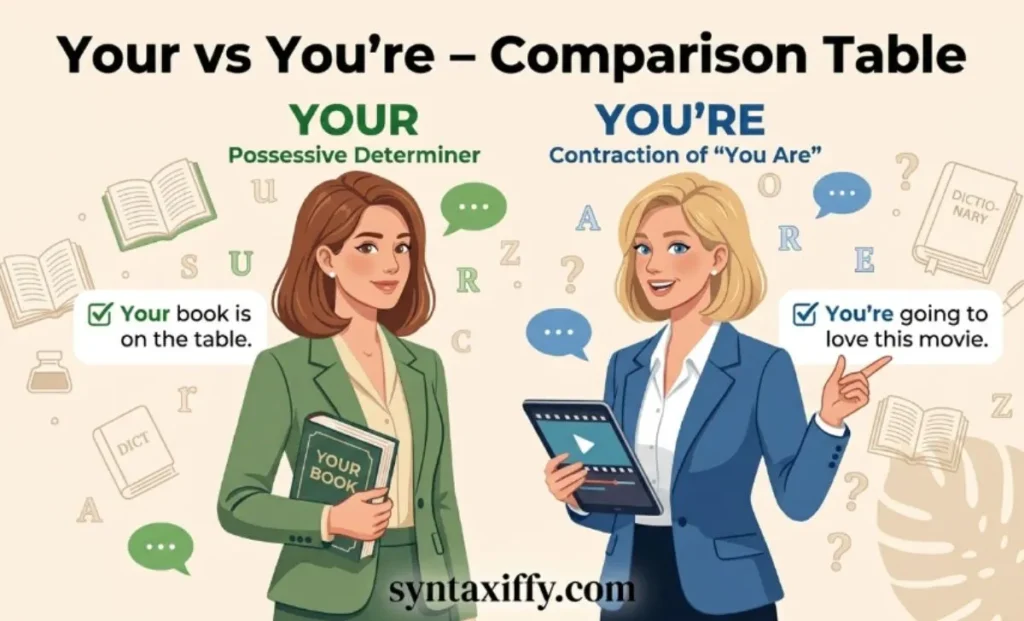
Your vs You’re – Comparison Table
| Feature | Your | You’re |
|---|---|---|
| Type | Possessive adjective | Contraction |
| Meaning | Belonging to you | You are |
| Usage | Ownership | Action/state |
| Example | Your idea is great | You’re right |
FAQs
1. What is the difference between your and you’re?
Your shows possession, while you’re means “you are.”
2. Why do people confuse your and you’re?
Because both words sound the same (homophones) and are often used in fast writing.
3. How can I easily remember your vs you’re?
Use the “you are test.” If “you are” fits, use you’re.
4. Is “your welcome” correct?
No, correct form is “you’re welcome.”
5. Are your and you’re homophones?
Yes, they sound the same but have different meanings and spellings.
6. Can I use your and you’re in formal writing?
Yes, but only with correct grammar usage.
7. What happens if I use wrong one?
It can make your writing look unprofessional or grammatically incorrect.
8. Is you’re always short for you are?
Yes, “you’re” is always a contraction of “you are.”
9. Can your and you’re change meaning of sentence?
Yes, wrong usage completely changes meaning and correctness.
10. Is your only used for people?
No, it is used for anything belonging to “you” (objects, ideas, things).
11. Is you’re used in questions?
Yes, for example: “You’re coming today?”
12. Which one is more commonly used?
Both are common, but “your” is used more often in writing.
13. What is the best trick to avoid mistakes?
Replace “you’re” with “you are” before finalizing sentence.
Conclusion
Understanding the difference between your and you’re is a basic but extremely important grammar skill in English writing. Although both words sound identical, their meanings are completely different.
Your is used for possession, while you’re is a contraction of “you are.” Once you apply the simple substitution method and practice real-life examples, this confusion becomes very easy to eliminate.
Mastering this rule improves your academic writing, professional communication, and social media content quality. Small grammar accuracy leads to a big improvement in overall English fluency.
Read More Blogs:
- Payer or Payor:Difference Explained With Easy Examples
- Hinge or Bumble: Which Dating App Is Better in 2026?

Hi, I am Roy Peter Clark, and I write clear and practical grammar and writing blogs.
On Syntaxiffy.com, I focus on English grammar, style, and writing techniques to help readers improve clarity and communication.