Innie or outie is a question many people search online when they notice differences in belly button appearance. Since most people have an innie navel while others have an outie, curiosity about the cause is common.
Some wonder whether an outie indicates a health issue, while others simply want to understand the difference between the two types.
This topic appears frequently in health education, anatomy discussions, parenting forums, and social media conversations.
Understanding these natural body variations can improve body awareness and health knowledge. In this guide, you’ll learn the meaning, causes, anatomy, and key differences between innie and outie belly buttons.
Quick Answer
An innie is a belly button that curves inward, while an outie protrudes outward from the abdomen. Both are normal variations of human anatomy and usually result from how the umbilical cord healed after birth.
| Type | Appearance |
|---|---|
| Innie | Curves inward |
| Outie | Protrudes outward |
Example: Most people have an innie navel, but some naturally develop an outie belly button.
Difference Between Innie and Outie
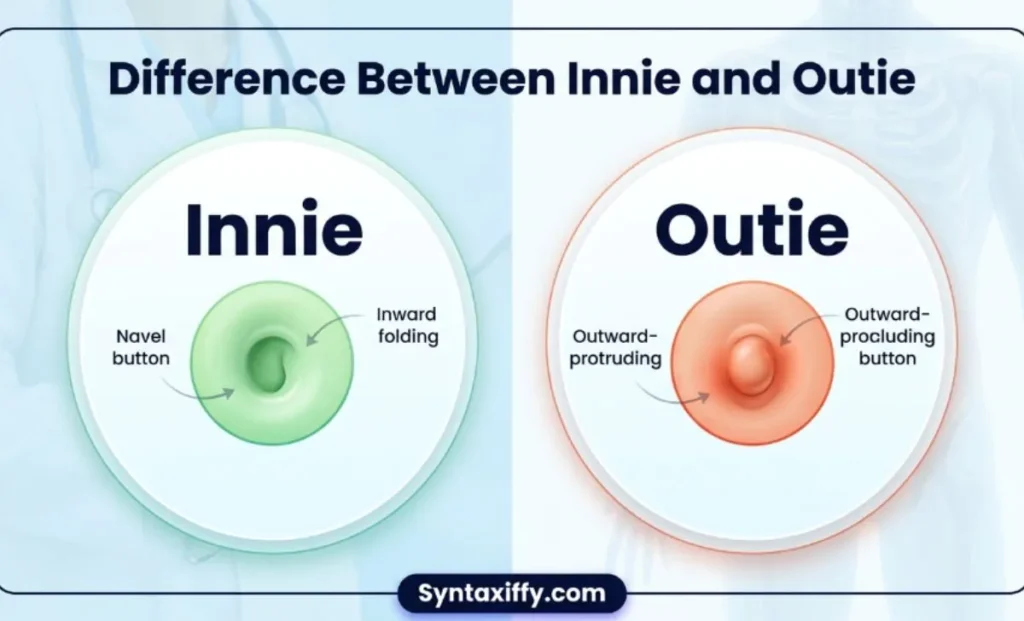
The difference mainly relates to the appearance of the navel after the umbilical cord separates.
Innie Meaning
An innie is a belly button that sits inside the abdomen and forms a small depression.
Outie Meaning
An outie is a belly button that extends outward from the abdominal wall.
From an anatomical perspective, both are normal outcomes of the healing process after birth.
What Causes an Innie or Outie?
Several factors influence the appearance of a belly button.
These include:
- Natural healing after birth.
- Scar tissue formation.
- Connective tissue structure.
- Umbilical ring development.
- Umbilical hernias in some cases.
Contrary to popular belief, doctors do not determine whether someone develops an innie or an outie.
Are Outie Belly Buttons Normal?
Yes. Most outie belly buttons are completely normal and harmless.
An outie does not automatically indicate a health problem. In the majority of cases, it is simply a natural variation in anatomy.
Both innies and outies are considered normal.
Why Do People Confuse Innie or Outie?
Many myths continue to circulate.
For example:
- Some people think doctors create outies.
- Others believe all outies are unhealthy.
- Some assume surgery is necessary.
In reality, belly button shape develops naturally in most individuals.
The Origin of Innie and Outie
The terms “innie” and “outie” are informal expressions used to describe belly button appearance.
Their origins are linked to the anatomical structure of the umbilicus, commonly known as the belly button.
Innie or Outie Comparison Table
| Feature | Innie | Outie |
|---|---|---|
| Appearance | Recessed | Raised |
| Commonness | More Common | Less Common |
| Cause | Natural Healing | Natural Healing or Umbilical Hernia |
| Health Risk | Usually None | Usually None |
| Medical Concern | Rarely | Occasionally |
Which Is More Common?
Innies are much more common.
Approximately 90 percent of people have innie belly buttons, while only a small percentage naturally have outies.
Although outies are less common, they are still considered normal.
Innie or Outie in Babies
Parents often wonder whether their baby’s belly button will become an innie or an outie.
Most belly button shapes develop naturally after the umbilical cord falls off.
Some outies become less noticeable as children grow, although major changes are uncommon.
Can an Outie Become an Innie?
Minor changes may occur during growth and development.
However, significant changes in belly button shape are uncommon.
In some cases, surgery may alter the appearance of an outie.
When Should You See a Doctor?
Most innies and outies do not require medical attention.
However, you should consult a healthcare professional if you notice:
- Pain.
- Swelling.
- Redness.
- Bleeding.
- Fluid discharge.
- Sudden changes in appearance.
These symptoms may indicate an umbilical hernia or another medical condition.
When Should You Use Innie?
Use the word innie when describing a belly button that curves inward.
Examples:
- Health education discussions.
- Anatomy lessons.
- Body awareness conversations.
- Pediatric explanations.
Example sentence:
“Most adults have an innie belly button.”
When Should You Use Outie?
Use the word outie when describing a belly button that protrudes outward.
Examples:
- Physical appearance discussions.
- Healthcare communication.
- Anatomy comparisons.
- Medical observations.
Example sentence:
“His outie became less noticeable with age.”
Innie or Outie Examples
Health Education
The anatomy textbook explained the difference between an innie and an outie.
Healthcare Communication
Parents asked whether an outie required treatment.
Everyday Conversation
My brother has an outie, while I have an innie.
Social Media
People frequently discuss belly button types online.
Innie or Outie in One Sentence
- My sister has an innie, but my brother has an outie.
- Most people have an innie, but outies are also normal.
- Both innies and outies are natural body variations.
- Belly button shape depends on healing and anatomy.
Common Mistakes with Innie or Outie
| Incorrect | Correct |
|---|---|
| Outies are always unhealthy. | Most outies are normal. |
| Doctors determine belly button shape. | Healing determines appearance. |
| Outies always require surgery. | Most do not need treatment. |
| Innies are the only normal type. | Both types are normal. |
| Umbilical cord cutting causes outies. | Anatomy and healing influence shape. |
Why Innie or Outie Still Confuses People in 2026
Online myths and misinformation continue to create confusion.
Topics such as genetics, newborn care, umbilical hernias, and scar tissue often lead to misunderstandings among parents and learners.
Quick Memory Trick
INnie = INside
OUTie = OUTside
If the belly button goes inward, it is an innie.
If it extends outward, it is an outie.
FAQs
What is an innie belly button?
An innie curves inward.
What is an outie belly button?
An outie protrudes outward.
Are outies rare?
They are less common than innies but are still normal.
Can an outie become an innie?
Minor changes may occur, but major changes are uncommon.
Does an outie affect health?
Usually not.
Are innies more common?
Yes. Most people have innie belly buttons.
Why do belly buttons look different?
Differences in healing, tissue structure, and development create variation.
Final Verdict
Neither an innie nor an outie is better.
Both are normal variations of human anatomy. The difference mainly affects appearance and usually has little or no impact on health.
Understanding the causes and anatomy behind belly button shapes can help eliminate myths and promote better awareness of the human body.
Conclusion
Understanding innie or outie belly buttons becomes easier once you know the basics. An innie curves inward, while an outie extends outward, and both are normal results of the healing process after birth.
Most outies are harmless, and neither type is considered better than the other. Remembering the simple inside-versus-outside rule makes it easy to distinguish between the two.

Hi, I am Mary Norris, and I write clear and insightful grammar blogs on Syntaxiffy.com.
On Syntaxiffy.com, I focus on English grammar, usage, and writing accuracy to help readers improve their language skills.