
Todays or today’s is one of the most common punctuation and English grammar questions that writers search online.
Many students, bloggers, content writers, professionals, and English learners are unsure whether they should write “todays” or “today’s” in emails, academic writing, professional writing, business communication, and social media posts.
The confusion usually comes from apostrophe rules and possessive noun forms. A single missing punctuation mark can make a sentence look incorrect and less professional.
The good news is that the rule is simple. In this guide, you’ll learn the difference between todays and today’s, apostrophe usage, grammar rules, examples, common mistakes, and practical tips to improve your writing skills.
Quick Answer
The correct form is today’s with an apostrophe.
Today’s is a singular possessive noun that means “belonging to today” or “related to today.” The word todays without an apostrophe is generally incorrect in standard English.
| Word | Correct? | Meaning |
| Todays | No | Incorrect form |
| Today’s | Yes | Belonging to or relating to today |
Example: Today’s meeting has been postponed.
Difference Between Todays and Today’s
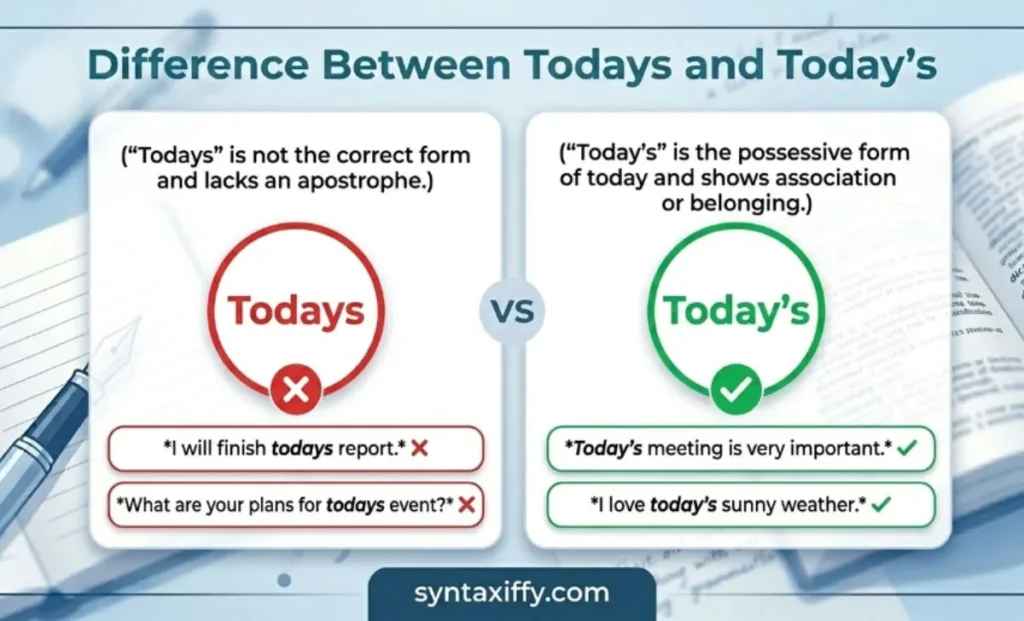
The difference between todays and today’s comes down to apostrophe usage and grammar rules.
Today’s Meaning
Today’s is a possessive noun. The apostrophe shows that something belongs to or is associated with today.
Examples:
- Today’s weather looks great.
- Today’s lesson focuses on punctuation.
- Today’s news is encouraging.
Todays Meaning
The word todays without an apostrophe is generally not accepted in standard English grammar. It is usually considered a punctuation mistake.
Grammar Role
| Word | Grammar Role |
| Today’s | Possessive Noun |
| Todays | Incorrect Form |
Unlike a verb, adjective, or pronoun, today’s functions as a possessive noun phrase.
Why Do People Confuse Todays or Today’s?
People confuse todays or today’s because apostrophes are among the most misunderstood punctuation marks in the English language.
Many writers assume that adding an “s” automatically creates a plural form. However, in this case, the apostrophe is required because the word shows possession.
Real-Life Example
Incorrect: Todays schedule includes three meetings.
Correct: Today’s schedule includes three meetings.
This mistake frequently appears in emails, reports, blog posts, and social media updates.
The Origin of Todays and Today’s
The word today originated from Old English expressions meaning “on this day.”
Over time, English grammar developed possessive forms using apostrophes. The form today’s evolved to indicate something belonging to or associated with the current day.
The version todays never became a standard grammatical form and is generally treated as a punctuation error.
Todays or Today’s Comparison Table
| Feature | Todays | Today’s |
| Meaning | No standard meaning | Belonging to today |
| Grammar Role | Incorrect Form | Possessive Noun |
| Usage | Incorrect | Correct |
| Apostrophe | Missing | Included |
| Memory Tip | Missing punctuation | Shows possession |
| Example | Todays weather | Today’s weather |
When Should You Use Todays?
In standard English writing, you generally should not use todays.
If you write “todays” without an apostrophe, proofreading tools and grammar checkers will usually flag it as an error.
Practical Tips
- Avoid it in academic writing.
- Avoid it in professional writing.
- Avoid it in business communication.
- Correct it during proofreading.
- Replace it with “today’s.”
Examples
Incorrect:
- Todays topic is grammar.
- Todays news is interesting.
- Todays lesson covers punctuation.
When Should You Use Today’s?
Use today’s whenever something belongs to, relates to, or occurs on the current day.
Practical Tips
- Use it in emails.
- Use it in reports.
- Use it in academic writing.
- Use it in professional writing.
- Use it in business communication.
Examples
- Today’s meeting starts at 10 a.m.
- Today’s weather is sunny.
- Today’s lesson focuses on English grammar.
- Today’s discussion covers apostrophe rules.
- Today’s events have been rescheduled.
Today or Today’s Activity
The correct phrase is today’s activity because today’s shows that the activity belongs to today. The phrase today activity is not grammatically correct in standard English.
Examples:
- ✅ Today’s activity is a science experiment.
- ✅ The teacher explained today’s activity before class.
- ❌ Today activity is a science experiment.
Today or Today’s Class
Use today’s class when referring to a class taking place today. The apostrophe and s show possession, meaning the class belongs to today.
Examples:
- ✅ Today’s class starts at 10 a.m.
- ✅ I enjoyed today’s class.
- ❌ Today class starts at 10 a.m.
Today’s Orders or Today’s Order
Both phrases are correct, but they depend on the number of orders.
- Today’s order refers to one order.
- Today’s orders refers to more than one order.
Examples:
- ✅ Today’s order has already been shipped.
- ✅ Today’s orders will be delivered this afternoon.
Today’s Means Today Is
Not always. Today’s usually means belonging to today, not today is.
For example:
- Today’s weather = The weather of today.
- Today’s schedule = The schedule for today.
However, in some informal contractions, today’s may sound like today is, but they are not interchangeable in writing.
Todays or Today’s Examples
Emails
Today’s meeting agenda is attached below.
Academic Writing
Today’s research highlights new developments in language learning.
Professional Writing
Today’s report summarizes quarterly performance.
Business Communication
Today’s presentation will begin shortly.
Social Media
Today’s weather is perfect for outdoor activities.
Everyday Conversations
What’s today’s date?
Today’s World or Today World
The correct phrase is today’s world because today’s describes the world as it exists today. Today world is grammatically incorrect.
Examples:
- ✅ Technology plays an important role in today’s world.
- ✅ Communication is faster in today’s world.
- ❌ Technology plays an important role in today world.
These sections are concise, readable, and can be inserted directly into your blog under relevant H2/H3 headings while targeting those long-tail keywords naturally.
Todays or Today’s in One Sentence
- Although some people write todays, the correct form is today’s.
- Proofreading can help you replace todays with today’s before publishing.
- Writers often confuse todays and today’s, but only today’s follows grammar rules.
- Today’s schedule is full, while todays is considered incorrect.
- Learning the difference between todays and today’s improves writing skills.
Common Mistakes with Todays or Today’s
| Incorrect | Correct |
| Todays weather is nice. | Today’s weather is nice. |
| Todays meeting starts soon. | Today’s meeting starts soon. |
| Todays news is surprising. | Today’s news is surprising. |
| Todays lesson was helpful. | Today’s lesson was helpful. |
| Todays schedule changed. | Today’s schedule changed. |
Why Todays or Today’s Still Confuses Writers in 2026
Even in 2026, apostrophe mistakes remain one of the most common English grammar errors. Many writers understand vocabulary and sentence structure but struggle with punctuation.
The rise of informal communication on social media, messaging apps, and digital platforms has also contributed to confusion.
People often type quickly and skip proofreading, leading to mistakes such as writing “todays” instead of “today’s.”
Students, professionals, and English learners continue searching for this topic because accurate punctuation improves clarity and credibility.
Quick Memory Trick
Remember this simple rule:
If something belongs to today, use today’s.
Think:
Today’s = Today + Possession
The apostrophe shows that something is connected to or belongs to the current day.
Easy Example
Today’s meeting
Today’s weather
Today’s schedule
If the phrase sounds natural with “of today,” use today’s.
FAQs
Is todays correct?
No. Todays without an apostrophe is generally incorrect in standard English.
Is today’s correct?
Yes. Today’s is the correct possessive form.
Why does today’s need an apostrophe?
The apostrophe shows possession or association with the current day.
What does today’s mean?
It means belonging to, occurring on, or relating to today.
Is today’s a possessive noun?
Yes. Today’s functions as a singular possessive noun.
Can I write todays without an apostrophe?
In standard English grammar, no. You should use today’s.
What is an example of today’s?
Today’s weather is beautiful.
Why do people make this mistake?
Because apostrophe rules are often misunderstood and overlooked during proofreading.
Does Today’s Mean Today Is?
No, not in most situations.
Today’s is the possessive form of today, while today is is a complete subject and verb.
Examples:
- ✅ Today’s meeting has been canceled.
- ✅ Today is Monday.
- ❌ Today’s Monday. (Informal speech may shorten it, but formal writing should use “Today is Monday.”)
Conclusion
Understanding todays or today’s is essential for accurate and professional communication.
While many writers mistakenly use todays, the correct form is today’s because it follows English grammar and apostrophe rules.
The apostrophe shows that something belongs to or relates to the current day, such as today’s meeting, today’s weather, or today’s news.
A simple memory trick is to remember that today’s indicates possession. Using the correct form improves writing skills, strengthens proofreading accuracy, and helps you communicate clearly in academic writing, professional writing, business communication, and everyday English.
Read More Blogs:
- Skied or Skiied: Which Spelling Is Correct?
- Scrapping or Scraping? Learn the Correct Usage in English

Hi, I am Mary Norris, and I write clear and insightful grammar blogs on Syntaxiffy.com.
On Syntaxiffy.com, I focus on English grammar, usage, and writing accuracy to help readers improve their language skills.