Vanguard vs Fidelity is one of the most searched comparisons in the investing world because beginners and long-term investors often struggle to choose between them.
Both platforms are trusted leaders in the investment industry, offering low-cost funds, retirement accounts, and brokerage services. However, they differ in fees, fund strategy, and investment style.
People usually search this topic when opening brokerage accounts, planning retirement, or starting long-term investing in the stock market.
The confusion often arises because both companies offer similar services but follow different investment philosophies.
In this article, you will clearly understand the differences, features, pros and cons, and which option may suit your financial goals.
Quick Answer
Vanguard and Fidelity are both top US investment companies, but they differ in strategy.
Vanguard Group focuses on low-cost, passive investing with index funds and ETFs, while Fidelity Investments offers both active and passive investing with more trading tools and flexibility.
Quick Example:
- Vanguard → Best for long-term, buy-and-hold investors
- Fidelity → Best for active investors and flexibility
Difference Between Vanguard vs Fidelity
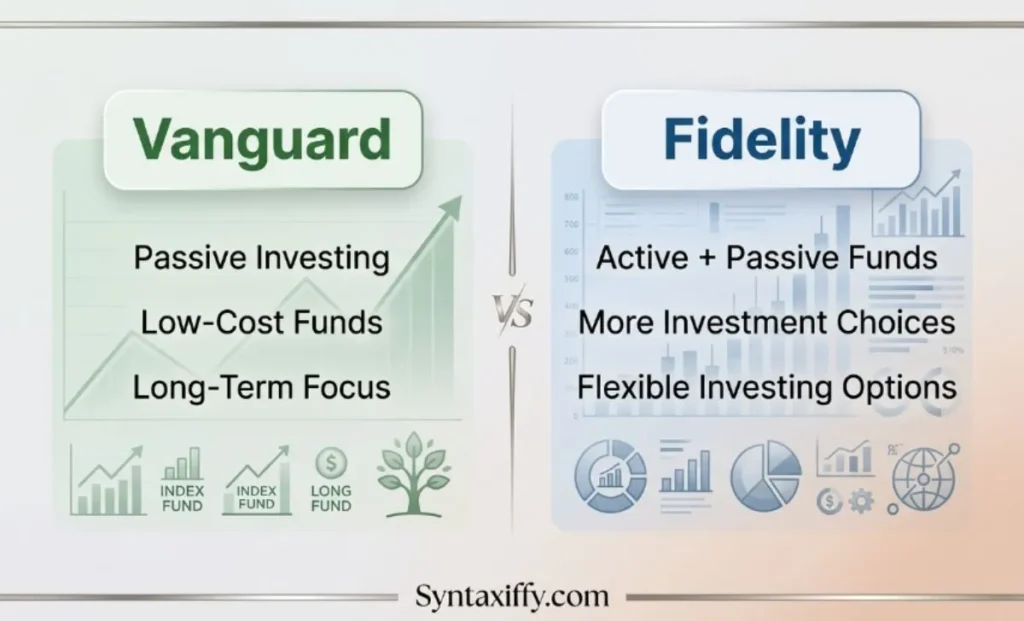
Vanguard follows a passive investing model, meaning it focuses on index funds that track the market. Fidelity, on the other hand, offers both active and passive funds, giving investors more choices.
- Vanguard = Passive, low-cost, long-term focus
- Fidelity = Active + passive, flexible investing options
Simple Examples:
- Vanguard investor buys S&P 500 index fund and holds for years
- Fidelity investor may trade stocks, ETFs, and actively managed funds
Why Do People Confuse Vanguard vs Fidelity?
People confuse both platforms because they offer similar services like brokerage accounts, ETFs, and retirement plans.
In English Language of finance content, both brands appear in the same category, making them look identical.
Real-life example:
A beginner opening an IRA account may see both Vanguard and Fidelity offering similar retirement solutions and assume they are the same type of platform.
Origin of Vanguard vs Fidelity
Vanguard was founded with the idea of low-cost investing and investor ownership structure, which reduced fees for users.
Fidelity started as a mutual fund company and later expanded into full-service brokerage and trading tools.
Both companies shaped modern investment education and helped popularize index investing and retirement planning strategies.
Vanguard vs Fidelity Comparison Table
| Feature | Vanguard | Fidelity |
| Meaning | Low-cost index investing platform | Full-service investment platform |
| Strategy | Passive investing | Active + Passive investing |
| Usage | Long-term wealth building | Trading + long-term investing |
| Fee Structure | Generally lower fees | Competitive but varies |
| Example | Index funds, ETFs | Mutual funds, trading tools |
When Should You Use Vanguard?
Vanguard is best for investors who prefer simplicity and long-term growth.
- Ideal for retirement planning (IRA, 401k)
- Best for passive income investors
- Suitable for beginners who don’t want frequent trading
- Focused on index funds and ETFs
When Should You Use Fidelity?
Fidelity is best for investors who want flexibility and control.
- Ideal for active trading and stock investing
- Offers advanced research tools
- Suitable for both beginners and experienced traders
- Provides strong retirement and brokerage services
Vanguard vs Fidelity Examples
Emails:
- “I opened a Vanguard account for long-term retirement investing.”
Academic Writing:
- “Index investing is commonly associated with Vanguard-style passive strategies.”
Professional Writing:
- “Fidelity provides a diversified investment platform with active trading options.”
Business Communication:
- “Our firm uses Fidelity for portfolio management services.”
Social Media:
- “Just started investing with Vanguard for my future goals.”
Everyday Conversation:
- “I’m deciding between Vanguard and Fidelity for my first investment account.”
Vanguard vs Fidelity in One Sentence
- Vanguard focuses on low-cost passive investing, while Fidelity offers a flexible mix of active and passive investing options.
Common Mistakes with Vanguard vs Fidelity
| Incorrect | Correct |
| Vanguard is a bank | Vanguard is an investment company |
| Fidelity only offers mutual funds | Fidelity offers brokerage and ETFs too |
| They are the same platform | They have different investment strategies |
| Vanguard is for trading | Vanguard is mainly for long-term investing |
| Fidelity is expensive always | Fidelity fees vary by product |
Why Vanguard vs Fidelity Still Confuses Investors in 2026
Even in 2026, investors still struggle with this comparison because both platforms continue to expand their services.
Online financial education is also filled with mixed opinions, making beginners unsure. Additionally, both companies offer similar retirement and brokerage features, which increases confusion.
Quick Memory Trick
- Vanguard = “Buy & Hold Low Cost”
- Fidelity = “Flexible & Active Choice”
Just remember: Vanguard is simple, Fidelity is flexible.
FAQs
1. Is Vanguard better than Fidelity?
It depends on your goal. Vanguard is better for long-term investing, while Fidelity is better for active investing.
2. Which has lower fees?
Vanguard generally has lower expense ratios.
3. Can I use both Vanguard and Fidelity?
Yes, many investors use both for diversification.
4. Is Fidelity good for beginners?
Yes, it offers tools and research for new investors.
5. Does Vanguard allow trading?
Yes, but it focuses more on long-term investing.
6. Which is safer?
Both are highly trusted financial institutions.
7. Which is better for retirement?
Both are excellent for IRA and retirement accounts.
8. Do they offer ETFs?
Yes, both Vanguard and Fidelity offer ETFs.
Conclusion
Vanguard vs Fidelity is not about which is absolutely better, but about which fits your investing style.
Vanguard is ideal for low-cost, long-term investing, while Fidelity provides flexibility, research tools, and active trading options.
Understanding this difference helps you make smarter financial decisions and improves your overall investment strategy.
By choosing the right platform, you can align your financial goals with a strong, consistent investing approach that supports long-term wealth building.
Read More Blogs:
- Indexes or Indices: Which Word Is Correct and When to Use It?
- Ho or Hoe: Meaning and Correct Usage Explained with Examples

Hi, I am Mary Norris, and I write clear and insightful grammar blogs on Syntaxiffy.com.
On Syntaxiffy.com, I focus on English grammar, usage, and writing accuracy to help readers improve their language skills.