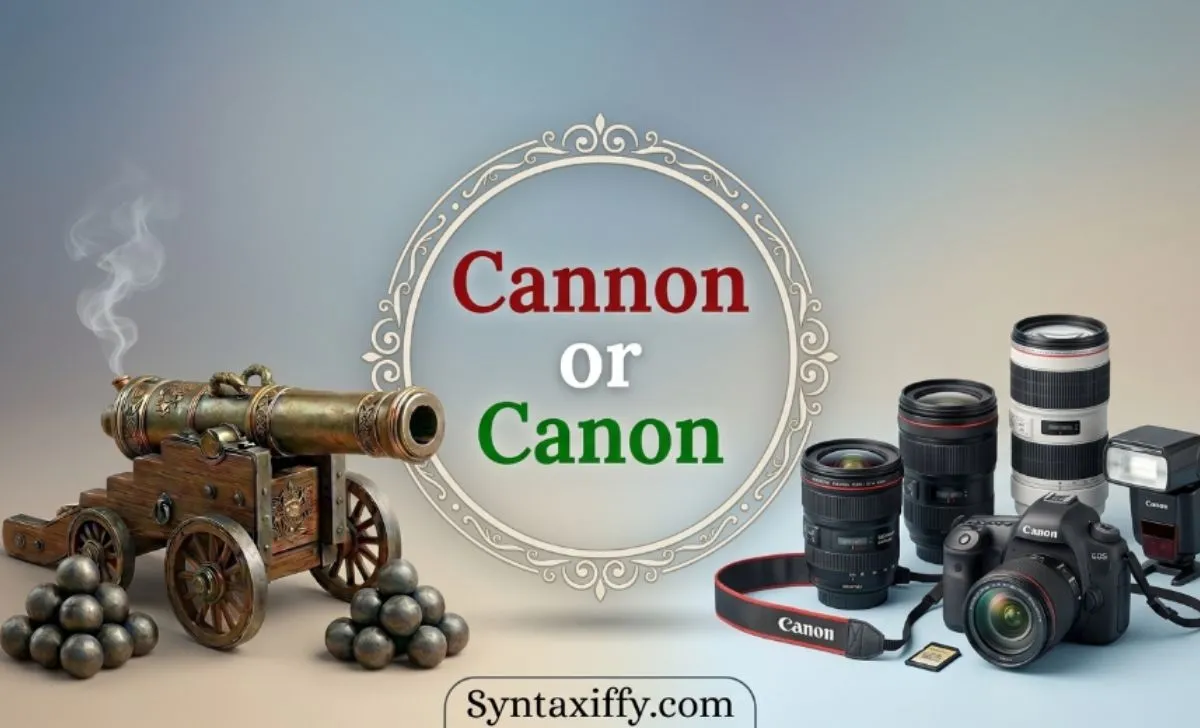
Cannon vs canon is a common English grammar confusion that many learners search for because both words sound the same but have completely different meanings.
This confusion often appears in English Language learning, emails, academic writing, business communication, and even social media posts.
Many students and writers mistakenly mix these words, which can change the meaning of a sentence entirely.
The keyword becomes important in English Grammar because one word refers to a weapon while the other refers to rules or even a camera brand.
In this article, you will learn the clear difference, correct usage, examples, and easy memory tricks to avoid mistakes in Writing Skills and Proofreading.
Quick Answer
“Cannon” refers to a large military weapon used in war, while “canon” refers to a set of rules, accepted standards, or sometimes a brand name.
Although they sound identical, their meanings are completely different in English Grammar and Noun usage.
Example:
- Cannon = The army fired a cannon.
- Canon = This book is part of the literary canon.
| Feature | Cannon | Canon |
| Meaning | Weapon | Rules/Standards |
| Usage | Military context | Academic/General rules |
| Type | Noun | Noun |
Difference Between Cannon vs Canon
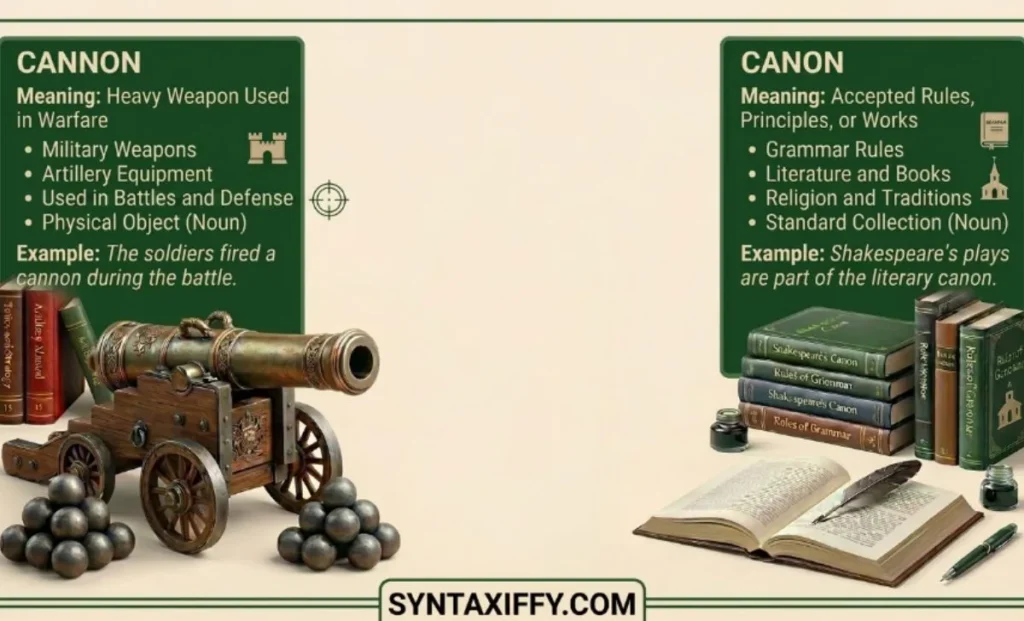
The main difference between cannon and canon lies in meaning and usage context.
- Cannon: A heavy weapon used in warfare (related to Military Weapons and Artillery)
- Canon: A set of rules, principles, or accepted works in a field (Grammar Rules, literature, or religion)
Examples:
- The soldiers loaded the cannon before the battle.
- Shakespeare is part of the literary canon.
Both are nouns but belong to completely different categories in English Language usage.
Why Do People Confuse Cannon vs Canon?
People confuse these words because they are homophones—words that sound the same but have different meanings. In fast speech, “cannon” and “canon” are almost identical, leading to mistakes in Academic Writing, Professional Writing, and online communication.
Example confusion:
- Incorrect: The canon was fired in war.
- Correct: The cannon was fired in war.
The Origin of Cannon vs Canon
- Cannon comes from Latin canna meaning tube or pipe, later used for large guns in warfare.
- Canon comes from Greek kanon, meaning rule or standard, later used in religious and literary contexts.
Over time, both words evolved separately in meaning and usage within English Grammar and Language Learning systems.
Cannon vs Canon Comparison Table
| Feature | Cannon | Canon |
| Meaning | Weapon used in war | Rules, standards, or accepted works |
| Grammar Role | Noun | Noun |
| Usage | Military context | Literature, rules, religion |
| Memory Tip | Think “war weapon” | Think “rules or law” |
| Example | The cannon fired loudly | The literary canon includes classics |
When Should You Use Cannon?
Use cannon when talking about war, military action, or historical weapons.
Practical usage:
- Military reports or history writing
- War-related storytelling
- Describing battlefield equipment
Examples:
- The fortress had a large cannon.
- A cannon blast echoed across the valley.
When Should You Use Canon?
Use canon when referring to rules, standards, or accepted works.
Practical usage:
- Literature studies (literary canon)
- Religious texts or principles
- Official standards or accepted rules
Examples:
- This novel is part of the English literary canon.
- The company follows a strict canon of ethics.
Cannon vs Canon Examples
Emails:
- The document is included in our official canon of policies.
Academic Writing:
- The cannon played a major role in historical warfare.
Professional Writing:
- Our organization follows a strict canon of rules.
Business Communication:
- Safety guidelines are part of the company canon.
Social Media:
- That historical cannon looks amazing in the museum!
Everyday Conversation:
- I learned the difference between cannon and canon today.
Cannon vs Canon in One Sentence
- The cannon fired during the battle while the literary canon includes classic books.
- A cannon is a weapon, but a canon represents rules or accepted works in a field.
Common Mistakes with Cannon vs Canon
| Incorrect | Correct |
| The canon was used in war | The cannon was used in war |
| This cannon is part of literature | This canon is part of literature |
| He fired a canon | He fired a cannon |
| The book is in the cannon | The book is in the canon |
| Canon explosion in battle | Cannon explosion in battle |
Why Cannon vs Canon Still Confuses Writers in 2026
Even in 2026, this confusion continues because both words are frequently used in different contexts like English Language learning, online writing, and academic content.
Spell-check tools sometimes fail to detect context errors, making it harder for learners to understand correct usage in Proofreading.
Quick Memory Trick
- Cannon = war = “boom weapon”
- Canon = rules = “code or standard”
Just remember: Cannon shoots, Canon guides.
FAQs
1. What is the main difference between cannon and canon?
Cannon is a weapon, while canon means rules or standards.
2. Are cannon and canon homophones?
Yes, they sound the same but have different meanings.
3. Is canon used in grammar?
Yes, it refers to accepted rules or standards in language and literature.
4. What is a cannon used for?
It is used in warfare to fire heavy projectiles.
5. Can canon mean a camera brand?
Yes, Canon Inc. is a famous electronics company.
6. Is cannon a noun?
Yes, cannon is a noun.
7. Why do people confuse these words?
Because they sound identical but have different meanings.
8. How can I remember the difference easily?
Cannon = weapon, Canon = rules or standards.
Conclusion
Cannon vs canon is a classic example of homophones in English Grammar that confuse learners in Writing Skills and communication.
The key difference is simple: cannon refers to a weapon, while canon refers to rules, standards, or accepted works.
By practicing examples and using memory tricks, you can easily avoid mistakes in Academic Writing, Business Communication, and everyday usage.
Correct understanding improves clarity, professionalism, and confidence in the English Language.
Read More Blogs:
- Cetaphil or CeraVe: Which Skincare Brand Is Better for Your Skin?
- Grandad vs Granddad: Which One Is More Common in English?

Hi, I am Bill Walsh, and I write clear and practical grammar blogs on Syntaxiffy.com.
I focus on English grammar, pair of words, and spelling differences to help readers improve their writing skills.