Have you ever stopped while writing and wondered whether everyones or everyone’s is the correct form? You are not alone.
Many students, bloggers, professionals, and English learners often search for everyones or everyone’s because the apostrophe creates confusion.
People want to know if everyones is a real word, what everyone’s meaning is, and how apostrophe rules work in English grammar.
Understanding the difference between these forms helps you avoid common grammar mistakes and improve your writing.
Whether you are writing emails, social media posts, academic papers, or business documents, knowing the proper punctuation matters.
This guide explains the meaning, spelling rules, possessive forms, and examples in simple language so you can use the correct word with confidence.
Everyones or Everyone’s – Quick Answer
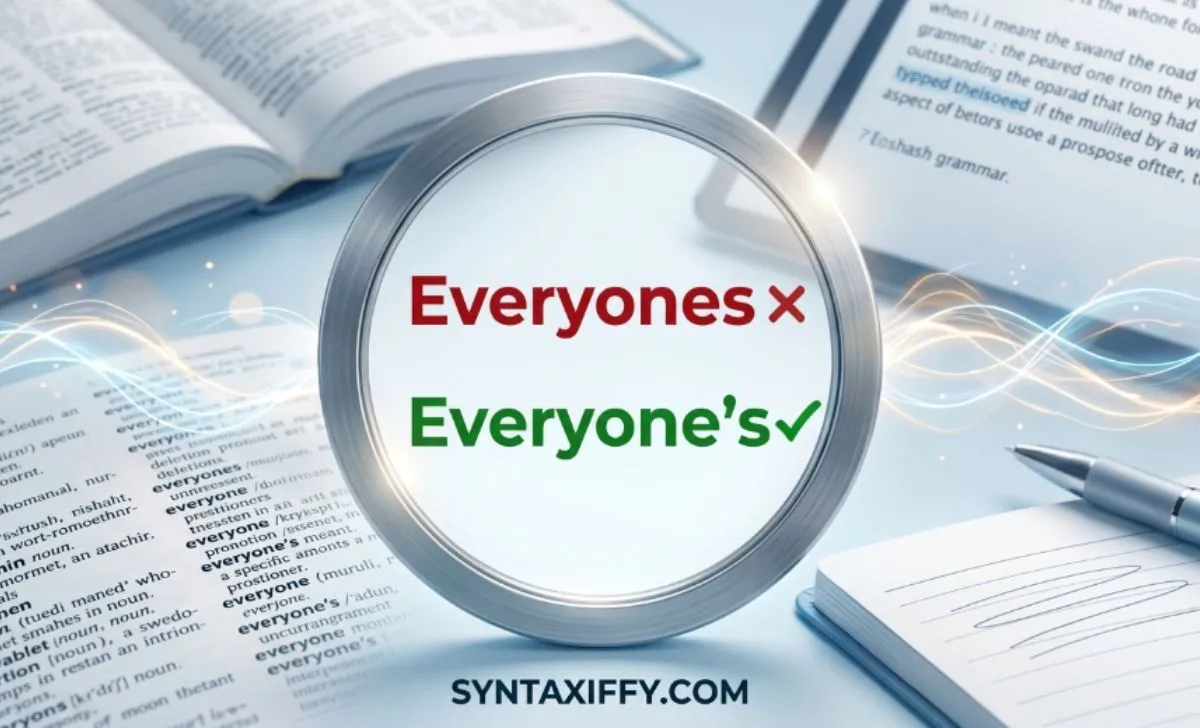
The correct spelling is everyone’s.
Everyones without an apostrophe is considered incorrect in standard English. The apostrophe shows possession or ownership.
Quick Comparison Table
| Word | Correct? | Meaning |
| everyone’s | ✅ Yes | Belonging to everyone |
| everyones | ❌ No | Incorrect spelling |
Examples
- Everyone’s opinion matters.
- Everyone’s responsibility is important.
- Everyone’s safety comes first.
- Everyone’s support helped the project succeed.
In English grammar, everyone is an indefinite pronoun and is treated as singular. Adding an apostrophe and the letter “s” creates the singular possessive form.
The Origin of Everyones or Everyone’s
The word everyone has existed in English for centuries. It combines two words:
- Every
- One
Together, they refer to all people in a group.
Because everyone is a singular pronoun, English punctuation rules require an apostrophe before “s” when showing ownership.
Examples:
- Everyone’s effort was appreciated.
- Everyone’s contribution made a difference.
The form everyones developed mainly because writers forgot the apostrophe. Since many English words become plural by adding “s,” some people assume the same rule applies here. However, everyone does not have a plural form called everyones.
British English vs American English Spelling
Unlike words such as “traveller” and “traveler,” there is no spelling difference between British and American English.
Both countries use:
- Everyone’s ✅
- Everyones ❌
Comparison Table
| English Variant | Correct Form | Incorrect Form |
| American English | everyone’s | everyones |
| British English | everyone’s | everyones |
| Canadian English | everyone’s | everyones |
| Australian English | everyone’s | everyones |
No matter where you live, the apostrophe remains necessary.
Which Spelling Should You Use?
Your audience does not change the answer.
For US Readers
Use:
Everyone’s
Example:
- Everyone’s favorite movie was discussed.
For UK Readers
Use:
Everyone’s
Example:
- Everyone’s attention turned toward the speaker.
For Global Audiences
Use:
Everyone’s
This form is accepted across English-speaking countries and works well in blogs, news articles, and professional communication.
Common Mistakes with Everyones or Everyone’s
Many writers make mistakes because apostrophe usage can be confusing.
Mistake 1
❌ Everyones choice matters.
✅ Everyone’s choice matters.
Mistake 2
❌ Everyones effort helped us.
✅ Everyone’s effort helped us.
Mistake 3
❌ Everyones responsibility is to follow the rules.
✅ Everyone’s responsibility is to follow the rules.
Mistake 4
❌ Everyones success depends on teamwork.
✅ Everyone’s success depends on teamwork.
Why Do These Errors Happen?
Common reasons include:
- Missing apostrophes.
- Confusion about possessive pronouns.
- Lack of knowledge about punctuation marks.
- Typing quickly on social media.
Fortunately, grammar checkers can easily detect these mistakes.
Comparison Table: Everyones vs Everyone’s
| Feature | Everyones | Everyone’s |
| Standard English | No | Yes |
| Contains Apostrophe | No | Yes |
| Shows Ownership | No | Yes |
| Used in Formal Writing | No | Yes |
| Accepted by Grammar Rules | No | Yes |
| Recommended Usage | Never | Always |
Understanding Apostrophe Usage
The apostrophe is one of the most important punctuation marks in English.
When ownership is involved, a singular noun or pronoun usually takes apostrophe + s.
Examples:
- Everyone’s opinion
- Everyone’s attention
- Everyone’s success
- Everyone’s favorite book
- Everyone’s contribution
These examples demonstrate proper English usage and help writers avoid spelling errors.
Is “Everyone” Singular or Plural?
Although everyone refers to many people, grammar treats it as a singular pronoun.
Correct:
- Everyone is happy.
Incorrect:
- Everyone are happy.
Because it is singular, its possessive form becomes:
Everyone’s
This follows standard grammar rules used in schools and professional writing.
Everyones or Everyone’s in Everyday Examples
Understanding grammar rules becomes easier when you see them in real-life situations. Since everyone’s is the correct form, it appears in emails, news articles, social media posts, and formal documents.
The form everyones without an apostrophe is considered a spelling mistake.
In Emails
Professional emails often require proper punctuation and clear language.
Examples:
- Everyone’s feedback is valuable to our team.
- Everyone’s schedule has been updated.
- Everyone’s contribution made this project successful.
Using the correct possessive form helps your message look professional and polished.
In News Writing
Journalists and editors follow strict writing standards. As a result, news reports always use everyone’s.
Examples:
- Everyone’s attention shifted to the latest announcement.
- Everyone’s safety remained the top priority.
- Everyone’s opinion was considered during the meeting.
Incorrect spellings rarely appear in reputable newspapers because editors carefully check grammar.
In Social Media Posts
People often type quickly on social platforms, which leads to punctuation mistakes. Even so, the standard spelling remains the same.
Examples:
- Everyone’s excited about the new movie.
- Everyone’s favorite singer released a new song.
- Everyone’s ready for the weekend.
Although informal writing is more relaxed, using proper English makes posts easier to understand.
In Formal Writing
Academic papers, reports, and business documents require correct grammar and punctuation.
Examples:
- Everyone’s responsibility is clearly defined.
- Everyone’s effort contributed to the company’s growth.
- Everyone’s success depends on teamwork.
Proper apostrophe usage improves readability and creates a professional impression.
Everyones or Everyone’s – Google Trends & Usage Data
Search interest in everyones or everyone’s remains strong because apostrophe-related errors are common among English learners and native speakers alike.
People frequently search:
- Is everyones a word?
- Which is correct, everyones or everyone’s?
- Why does everyone’s have an apostrophe?
- What is everyone’s meaning?
- How do you use everyone’s in a sentence?
- What are common spelling errors in English?
Usage by Country
| Country | Preferred Form |
| United States | everyone’s |
| United Kingdom | everyone’s |
| Canada | everyone’s |
| Australia | everyone’s |
| New Zealand | everyone’s |
| India | everyone’s |
There is no regional spelling variation. English-speaking countries follow the same grammar rules.
Why People Search for This Topic
Several factors create confusion:
- Apostrophe rules can be difficult.
- Many writers forget punctuation marks.
- Social media encourages fast typing.
- English learners often confuse possessive forms and plural forms.
- Spellings without apostrophes may look correct at first glance.
Why Apostrophes Matter
Apostrophes may seem small, but they change meaning and improve clarity.
Compare these examples:
Correct
- Everyone’s choice matters.
- Everyone’s support helped the campaign.
- Everyone’s attention is required.
- Everyone’s favorite song played on the radio.
- Everyone’s effort deserves recognition.
Incorrect
- Everyones choice matters.
- Everyones support helped the campaign.
- Everyones attention is required.
Without the apostrophe, the writing looks incomplete and grammatically incorrect.
Similar Possessive Forms in English
The rule used for everyone’s applies to many other indefinite pronouns.
| Pronoun | Possessive Form |
| everyone | everyone’s |
| somebody | somebody’s |
| anybody | anybody’s |
| nobody | nobody’s |
| everyone else | everyone else’s |
| someone | someone’s |
Examples:
- Somebody’s phone is ringing.
- Anybody’s guess could be correct.
- Nobody’s answer matched the key.
- Someone’s bag is on the chair.
These examples follow the same punctuation principles.
Tips to Remember the Correct Spelling
You can avoid common grammar mistakes by following these simple tips:
Think About Ownership
Ask yourself:
“Does something belong to everyone?”
If the answer is yes, use everyone’s.
Example:
- Everyone’s opinion matters.
Remember the Apostrophe Rule
Possession usually requires apostrophe + s.
Examples:
- John’s car.
- Teacher’s desk.
- Everyone’s responsibility.
Use Grammar Tools
Modern grammar checkers can quickly identify punctuation mistakes and improve your writing.
Read Your Sentence Aloud
Hearing the sentence often makes errors easier to spot.
Example:
- Everyone’s contribution was appreciated.
This sentence sounds natural and follows standard English grammar.
FAQs
Is everyones a real word?
No. Everyones without an apostrophe is not considered correct in standard English.
Which is correct, everyones or everyone’s?
Everyone’s is the correct form because it shows possession.
Why does everyone’s have an apostrophe?
The apostrophe indicates ownership or belonging.
Is everyone singular or plural?
Everyone is an indefinite pronoun that is grammatically singular.
Can I use everyones in formal writing?
No. Formal writing should always use everyone’s.
Does British English spell it differently?
No. British English and American English both use everyone’s.
How do you use everyone’s in a sentence?
Examples include:
- Everyone’s opinion matters.
- Everyone’s effort deserves recognition.
- Everyone’s safety comes first.
What does everyone’s mean?
It means something belongs to or relates to all people in a group.
Conclusion
Understanding the difference between everyones or everyone’s is simple once you know the role of the apostrophe.
The correct form is everyone’s, which represents possession or ownership. The spelling everyones is considered incorrect and should be avoided in professional, academic, and everyday writing.
Fortunately, this rule stays the same in British English, American English, and other varieties of English.
Whether you are writing emails, social media posts, news articles, or business documents, using the correct punctuation helps improve clarity and credibility.
Remember that everyone is a singular pronoun, and its possessive form requires an apostrophe
Mastering this small rule will help you avoid common spelling mistakes and communicate more effectively.
Read More Blogs:

Hi, I am Roy Peter Clark, and I write clear and practical grammar and writing blogs.
On Syntaxiffy.com, I focus on English grammar, style, and writing techniques to help readers improve clarity and communication.