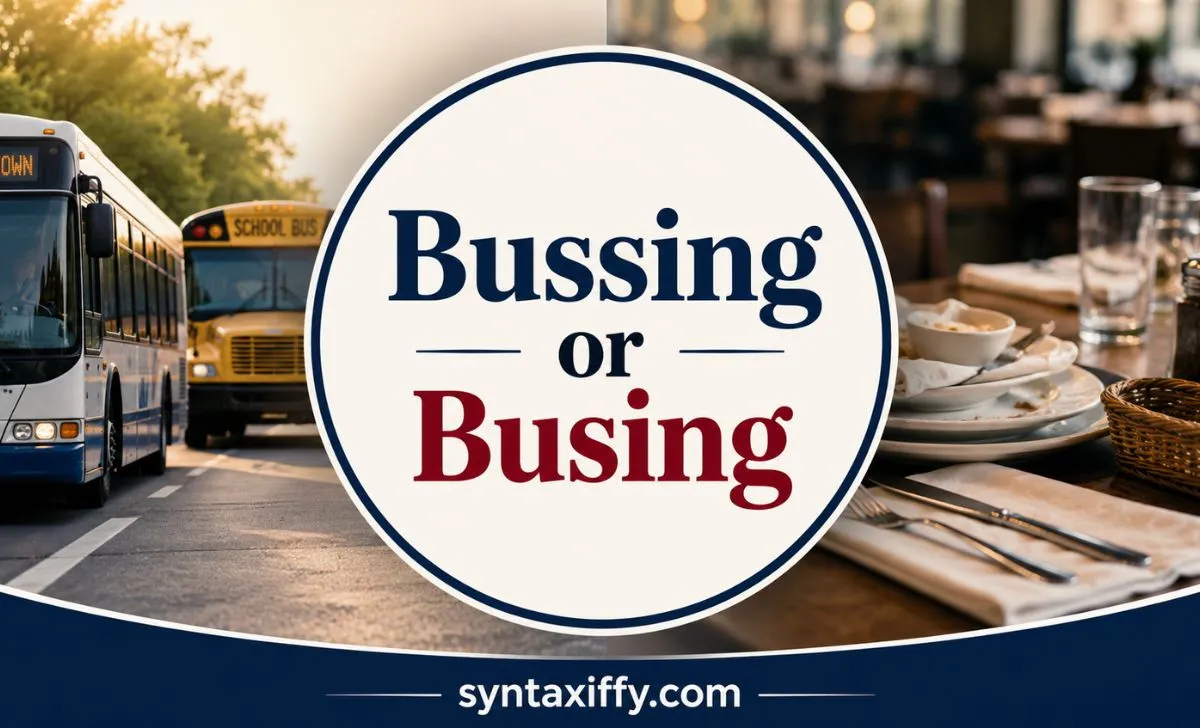
If you are unsure about bussing or busing, both spellings can be correct, but they can have different meanings. Busing usually refers to transporting people by bus, such as taking students to school.
Bussing is commonly used for clearing and resetting tables in a restaurant. However, bussing can also appear as a spelling variant of busing in some transportation contexts. This creates confusion because both forms come from the word bus and are pronounced the same.
In this guide, you will learn their meanings, origins, spelling rules, British and American usage, pronunciation, common mistakes, everyday examples, and the easiest way to remember which form to use.
Quick Answer

The best spelling depends on what you mean.
Busing
Busing usually means transporting people by bus.
The school is busing students to the new campus.
The city is busing passengers between the two stations.
It can also refer to school busing, including the transportation of students as part of a school system.
Bussing
Bussing is commonly used in restaurant English.
The restaurant worker is bussing tables.
Here, bussing means clearing used plates, glasses, and other items from tables and preparing them for new customers.
So the easiest distinction is:
Busing = transporting people by bus.
Bussing = clearing tables in a restaurant.
However, there is an important spelling detail. Some dictionaries recognize bussing as a variant spelling of busing when the verb means transporting people by bus. Merriam-Webster, for example, lists bussing as a variant of busing. (merriam-webster.com)
Therefore, context is essential.
The Origin of Bussing or Busing
Both words come from the noun bus.
The word bus is a shortened form of omnibus, a Latin word meaning “for all.” The English noun bus became associated with public transportation in the 19th century.
The verb bus later developed from the noun.
Today, the verb bus can mean:
- to transport people by bus
- to transport students by school bus
- to clear dishes from a restaurant table
The spelling becomes interesting when -ing is added.
The basic forms are:
bus + ing = busing
and
bus + ing = bussing
Why are there two forms?
English spelling has a long history of consonant doubling. Writers and dictionaries have treated the addition of -ing to bus in more than one way.
Merriam-Webster lists bused/bussing and related forms, while usage references recognize both busing and bussing in transportation contexts. (merriam-webster.com)
Restaurant usage also helped make bussing familiar. The related noun busser refers to a restaurant worker who clears and resets tables.
Thus, modern English has developed several related forms:
- bus
- buses
- bused
- busing
- bussed
- bussing
- busser
The exact spelling can depend on the meaning, style guide, and dictionary.
British English vs American English Spelling

Busing and bussing are both found in English varieties, but American English has especially strong usage of busing in discussions of school transportation and American education.
For restaurant work, bussing tables is widely recognized.
The important point is that this is not a simple British-versus-American spelling pair like color/colour.
| Feature | Busing | Bussing |
| Transportation meaning | Common | Also possible |
| Restaurant table meaning | Possible in some usage | Very common |
| School transportation | Very common | Variant possible |
| Restaurant service | Less clear | Clearer |
| American English | Common | Used |
| British English | Used | Used |
| Base word | Bus | Bus |
| Ending | -ing | -ing |
| Pronunciation | Same | Same |
| Main distinction | Often transportation | Often restaurant work |
In American English, busing is especially common in phrases such as:
school busing
busing students
public-school busing
The word also has a major historical meaning in the United States connected with desegregation busing, when students were transported between schools to help reduce racial segregation.
In restaurant language, however, bussing tables is often the clearest form.
Pronunciation of Bussing or Busing
The two spellings are normally pronounced the same.
Busing is pronounced approximately:
BYOO-zing or BUZ-ing, depending on the pronunciation system and dialect.
Bussing has the same basic pronunciation.
In IPA, busing may be represented as:
/ˈbʌzɪŋ/
and bussing is generally pronounced the same way.
The double s in bussing does not normally create an extra syllable.
For example:
She is busing students to school.
She is bussing tables.
The listener usually cannot tell which spelling you mean.
That is why context is so important.
If you hear someone say:
I am bussing tables.
You understand the meaning from the words around it.
If someone says:
The district is busing students.
The word students makes the transportation meaning clear.
Why People Confuse Bussing or Busing
The main reason for confusion is simple: both forms come from bus and sound the same.
There are several other reasons.
The spelling looks almost identical
The only visible difference is the extra s:
- busing
- bussing
That small difference makes writers unsure about which spelling to choose.
Both can relate to transportation
Busing clearly refers to travel by bus.
But bussing can also be found as a variant spelling for the same transportation verb.
This means that simply memorizing “one s = transportation” is not a complete grammar rule.
Restaurant English creates another meaning
In the restaurant industry, bussing tables has a specific meaning.
A busser clears dirty dishes, glasses, silverware, and other items from tables. The worker may then reset the table for the next guests.
This gives bussing a strong association with restaurants.
The spoken forms are the same
When words sound the same, spelling errors become more common.
This is especially true in:
- emails
- social media
- text messages
- workplace communication
- school assignments
The word has several related forms
English speakers encounter:
- bus
- buses
- bussed
- busing
- bussing
- busser
Seeing all these forms can make the spelling system look more complicated than it is.
Which Spelling Should You Use?
Choose the spelling according to meaning and audience.
For transportation
When writing about transporting people by bus, busing is a clear and widely accepted choice.
The district is busing students to school.
The company is busing workers to the factory.
The city started busing passengers between the terminals.
This is especially useful in American English.
For restaurant work
When you mean clearing tables, bussing is the clearest choice.
The busser is bussing tables.
I spent the evening bussing tables.
This immediately tells the reader that the subject is restaurant service rather than transportation.
For British English and Commonwealth English
English-speaking countries can use different terms for transportation and restaurant work.
For a global audience, clarity matters more than trying to force a regional spelling rule.
If you mean transportation, busing is easy to understand.
If you mean clearing restaurant tables, bussing tables is clear in international English.
For formal writing
If the meaning is transportation, use busing unless your preferred style guide specifically uses bussing.
If the meaning is restaurant work, bussing is a practical choice.
The most important thing is to avoid ambiguity.
Common Mistakes with Bussing or Busing
Mistake 1: Assuming bussing is always wrong
This is incorrect.
Bussing is a legitimate English form and is widely used for restaurant table service.
It can also occur as a variant spelling of busing in transportation contexts.
Mistake 2: Assuming busing is always about transportation
This is also too simple.
Restaurant and workplace usage can vary, but bussing tables is the clearer phrase when discussing restaurant service.
Mistake 3: Writing “busing tables” without context
Consider:
The employee is busing tables.
Some readers may understand this, but others may think the sentence refers to transporting tables by bus.
For restaurant work, write:
The employee is bussing tables.
This removes confusion.
Mistake 4: Writing “bussing students” without context
Because bussing can have multiple uses, it may be clearer to write:
The school is busing students to the campus.
This makes the transportation meaning obvious.
Mistake 5: Confusing busser with bus driver
A busser is a restaurant worker who clears and resets tables.
A bus driver operates a passenger bus.
They are completely different jobs.
Mistake 6: Confusing busing with school busing history
In American history, desegregation busing refers to the transportation of students as part of efforts to integrate public schools.
This is a specific historical and social meaning. It is different from ordinary daily bus transportation.
Bussing or Busing in Everyday Examples
The best way to understand these words is to see them in real situations.
In Emails
For school transportation:
The school will be busing students to the event tomorrow.
For restaurant work:
I will be bussing tables during the evening shift.
In News Writing
Transportation:
The district announced a new plan for busing students.
Historical context:
The city faced protests over desegregation busing.
Restaurant context:
The restaurant is hiring servers and employees for bussing tables.
The surrounding nouns make the intended meaning clear.
In Social Media
A restaurant employee might post:
Bussing tables all night!
A student might post:
Our school is busing us to the competition.
These examples show why context matters.
In Formal Writing
For an academic paper:
School busing played an important role in debates over educational integration.
For a business document:
The company provides busing for employees between the parking area and the main building.
For a restaurant training document:
Staff members must complete bussing duties before resetting each table.
In Everyday Conversation
Are they busing us to the airport?
I worked bussing tables last summer.
The two meanings are easy to distinguish because the objects are different.
Easy Trick to Remember Bussing or Busing
Use this simple memory trick:
Busing = Bus + People
Think:
Busing → Bus → People moving
The school is busing students.
The company is busing workers.
Bussing = Busser + Tables
Think:
Bussing → Busser → Tables
The employee is bussing tables.
This is not a universal spelling rule because bussing can also appear as a variant transportation spelling. But it is an excellent practical trick for avoiding confusion in everyday writing.
Another easy rule is:
People travel → busing
Plates leave the table → bussing
Bussing or Busing – Google Trends & Usage Data
Google Trends measures relative search interest, not the total number of times a word appears in speech or writing. Therefore, Trends data should be used as a guide rather than as proof that one spelling is always more common.
Search interest for these terms can vary because they represent different topics.
Busing often appears in searches connected with:
- school transportation
- public transportation
- bus services
- student transportation
- American education
- desegregation busing
Bussing often appears in searches connected with:
- restaurants
- bussing tables
- busser jobs
- restaurant service
- hospitality
- clearing tables
This means that country alone does not explain the difference.
Context plays a major role.
| Search Context | Likely Term |
| Students traveling to school | Busing |
| Public transportation | Busing |
| Employee transportation | Busing |
| School district transportation | Busing |
| Desegregation history | Busing |
| Restaurant tables | Bussing |
| Clearing dishes | Bussing |
| Restaurant job duties | Bussing |
| Busser responsibilities | Bussing |
| General transportation | Busing |
Merriam-Webster recognizes bussing as a variant of busing, which confirms that the extra s does not automatically make the word incorrect. (merriam-webster.com)
The safest SEO and writing strategy is therefore to cover both spellings and both major meanings instead of declaring one form universally correct.
Comparison Table

| Word | Common Meaning | Example |
| Busing | Transporting people by bus | The school is busing students. |
| Bussing | Clearing restaurant tables | She is bussing tables. |
| Bussing | Variant of busing in some usage | The company is bussing workers. |
| Bus | Vehicle or base verb | The city runs buses. |
| Busser | Restaurant worker | The busser cleared the table. |
| Bussed | Past form of bus | The students were bussed to school. |
| Buses | Plural of bus | Several buses arrived. |
| School busing | Student transportation | School busing serves many students. |
| Desegregation busing | Historical school integration practice | The issue became part of civil rights history. |
| Bussing tables | Clearing and resetting tables | He is bussing tables tonight. |
The key takeaway is:
Busing is the clearest choice for transportation.
Bussing is the clearest choice for restaurant table service.
FAQs
Is bussing or busing correct?
Both can be correct. Busing is commonly used for transporting people by bus, while bussing is commonly used for clearing restaurant tables. Bussing can also be a variant spelling of busing.
Is it bussing or busing tables?
Bussing tables is the clearest and most common form when you mean clearing used dishes and resetting restaurant tables.
Is busing the American spelling?
Busing is widely used in American English, especially for school and public transportation. However, bussing can also be found as a variant.
What does bussing tables mean?
Bussing tables means removing used plates, glasses, silverware, and other items from restaurant tables and preparing the tables for the next customers.
What does busing students mean?
Busing students means transporting students by bus, usually between home and school or between different school locations.
Is bussing a real word?
Yes. Bussing is a real English word. It is widely used for restaurant table service and is also recognized as a variant spelling of busing in some dictionaries.
Is busing a real word?
Yes. Busing is the present participle or gerund form of bus when it means transporting people by bus.
Why does bussing have two s’s?
The double s reflects a spelling pattern used in one form of the verb. More importantly, bussing is strongly established in restaurant language and is also recognized as a variant transportation spelling.
What is a busser?
A busser is a restaurant worker who clears used dishes and helps reset tables. A busser is part of the restaurant’s front-of-house staff.
Is busing related to desegregation?
Yes. In American history, desegregation busing refers to transporting students as part of efforts to reduce racial segregation in public schools.
Conclusion
When choosing between bussing or busing, first ask what the sentence means. Busing is the clearest choice when you mean transporting people by bus, especially students, workers, or passengers.
Bussing is the clearest choice for restaurant work, especially bussing tables. However, bussing can also be found as a variant spelling of busing, so it is not always incorrect in transportation contexts.
The two forms usually sound the same, which is why context matters. For simple, professional writing, use busing for transportation and bussing for restaurant table service.
Read More Blogs:

Hi, I am Mary Norris, and I write clear and insightful grammar blogs on Syntaxiffy.com.
On Syntaxiffy.com, I focus on English grammar, usage, and writing accuracy to help readers improve their language skills.