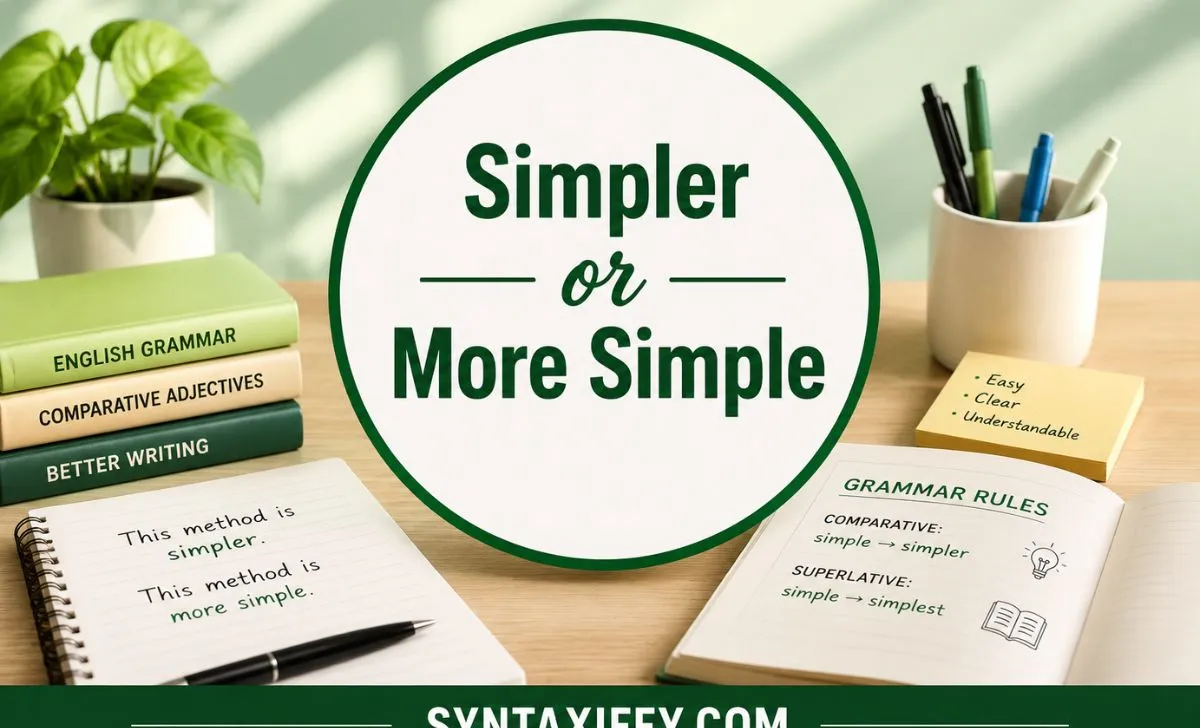
Simpler or more simple is a common English grammar question. The short answer is that both forms can be correct, but “simpler” is usually the more natural and preferred choice. For example, “This method is simpler than the old one” sounds natural and is widely used.
“This method is more simple than the old one” is also possible, but it is less common in normal English. The confusion exists because simple is a two-syllable adjective, and two-syllable adjectives can follow different comparative patterns.
This guide explains the grammar, pronunciation, British and American usage, common mistakes, and practical examples.
Quick Answer
Simpler is the usual comparative form of simple.
Use simpler when you compare two things:
This explanation is simpler than the first one.
The new system is simpler to use.
However, more simple is not automatically grammatically wrong. Major dictionary evidence lists simpler and simplest as the normal forms while also allowing more simple and most simple.
So, for most everyday, academic, and professional writing, simpler is the best choice.
| Form | Example | Use |
| Simple | This rule is simple. | Basic form |
| Simpler | This rule is simpler. | Preferred comparative |
| More simple | This rule is more simple. | Possible, but less common |
| Simplest | This is the simplest rule. | Preferred superlative |
| Most simple | This is the most simple rule. | Possible, but less common |
The safest rule for English learners is:
Use “simpler” when you want the natural comparative form of “simple.”
The Origin of Simpler or More Simple
The word simple has a long history in English. It came into English through Old French and ultimately traces back to the Latin simplex, meaning something that is single, plain, or uncomplicated.
Over time, simple developed several meanings. It can describe something that is:
- Easy to understand
- Easy to do
- Not complicated
- Basic
- Plain
- Without unnecessary parts
The comparative form simpler is created by adding the comparative suffix -er:
simple → simpler
The superlative form is:
simple → simplest
English does not use only one rule for every adjective. Some adjectives take -er, while others normally use more.
For example:
small → smaller
fast → faster
beautiful → more beautiful
important → more important
The adjective simple is one of the two-syllable adjectives that commonly accepts the -er comparative. At the same time, more simple can also occur. Oxford’s learner dictionary specifically lists simpler and simplest while noting that more simple and most simple can also be used.
This is why saying that more simple is always wrong is too strong.
British English vs American English Spelling

There is no British English vs American English spelling difference between simpler and more simple.
Both British English and American English use:
simple → simpler
For example:
British English:
This explanation is simpler than the previous one.
American English:
This explanation is simpler than the previous one.
The same basic comparative pattern is used in both varieties.
| Feature | British English | American English |
| Basic adjective | simple | simple |
| Preferred comparative | simpler | simpler |
| Possible alternative | more simple | more simple |
| Superlative | simplest | simplest |
| Meaning | Same | Same |
| Spelling difference | None | None |
So, if you are writing for readers in the UK, USA, Canada, Australia, or other English-speaking countries, simpler is a safe and natural choice.
The difference is not like colour/color or centre/center. Those are well-known British-American spelling differences. Simpler does not change spelling between the two major varieties.
Pronunciation of Simpler or More Simple
The pronunciation of simpler is approximately:
SIM-plər
In IPA, it is commonly represented as:
/ˈsɪmplər/
The first part sounds like “sim”, and the second part is a weak “pler” sound.
For example:
This way is simpler.
The phrase more simple is pronounced:
more SIM-pl
The main difference is not pronunciation but structure.
Compare:
simpler than before
with:
more simple than before
Both communicate the idea of a greater degree of simplicity, but simpler usually sounds more natural in ordinary speech.
Because simpler is short and familiar, native speakers often choose it without thinking about the grammar rule.
Why People Confuse Simpler or More Simple
People often ask whether to use simpler or more simple because English comparative adjectives do not follow one perfectly simple rule.
For some adjectives, English uses -er:
fast → faster
short → shorter
clear → clearer
For others, English normally uses more:
useful → more useful
careful → more careful
important → more important
The word simple has two syllables, which can make learners unsure about which pattern to follow.
A common learner rule says:
One-syllable adjective → -er
Longer adjective → more
But this is only a general guide. Two-syllable adjectives are more flexible.
For example:
happy → happier
narrow → narrower
clever → cleverer
simple → simpler
Some two-syllable adjectives can also use more.
This flexibility is one reason more simple appears in real English even though simpler is generally more common and natural.
Which Spelling Should You Use?
For most readers, writers, students, and English learners, the best advice is simple:
Use “simpler” as your default comparative form.
Choose simpler in:
- Academic writing
- Professional writing
- Business communication
- Emails
- School assignments
- Blog posts
- Everyday conversation
- Social media
- General English
Examples:
We need a simpler solution.
Please use a simpler explanation.
The new process is simpler than the old one.
This version is simpler for beginners.
More simple can be used when a writer wants a particular rhythm, contrast, or emphasis, but it is usually unnecessary when simpler expresses the same idea naturally.
For example:
The new design is more simple than elegant.
Here, the writer may choose more simple because more X than Y creates a contrast.
Still, in a normal comparison:
The new design is simpler than the old one.
is the more natural choice.
Common Mistakes with Simpler or More Simple
One common mistake is believing that more simple is always wrong.
That is not accurate. Dictionary evidence allows both forms, although simpler is the standard choice for most situations.
Another mistake is using simplest and most simple as if they were equally common.
For most writing, prefer:
This is the simplest solution.
rather than:
This is the most simple solution.
The second form can appear, but the first is much more natural.
| Common Attempt | Better Choice | Reason |
| This is more simple. | This is simpler. | More natural comparative |
| This is the most simple way. | This is the simplest way. | Natural superlative |
| This method is more simpler. | This method is simpler. | Do not use both comparative markers |
| This is simpler than the other. | Correct | Standard comparison |
| This is more simple than the other. | Possible | Less common |
| This explanation is simplest. | Correct | Standard superlative |
A particularly important error is “more simpler.”
Do not combine more with -er in this case.
Incorrect:
This method is more simpler.
Correct:
This method is simpler.
Simpler or More Simple in Everyday Examples
The word simpler appears naturally in many kinds of communication.
In Emails
Could you send me a simpler version of the instructions?
We need a simpler way to explain this process to customers.
In Academic Writing
The second theory provides a simpler explanation.
This model offers a simpler way to understand the results.
In Business Communication
Our new system gives employees a simpler workflow.
We are looking for a simpler solution to this problem.
In News Writing
The government introduced a simpler process for applications.
In Social Media
Sometimes a simpler approach works better.
In Everyday Conversation
Is there a simpler way to do this?
I need a simpler explanation.
This recipe is much simpler than the other one.
These examples show why simpler is usually the best default. It is short, clear, and natural.
Comparison Table
| Point | Simpler | More Simple |
| Grammar | Correct | Can be correct |
| Comparative meaning | Yes | Yes |
| Frequency | More common | Less common |
| Natural everyday use | Very natural | Less natural |
| Formal writing | Recommended | Use when context supports it |
| Academic writing | Recommended | Possible |
| British English | Used | Possible |
| American English | Used | Possible |
| Superlative counterpart | Simplest | Most simple |
| Best choice for learners | Yes | Usually no |
The key point is that simpler and more simple can have the same basic comparative meaning. The difference is mainly one of frequency, style, and naturalness, rather than a simple “correct vs incorrect” rule.
Easy Trick to Remember Simpler or More Simple
The easiest way to remember the difference is:
Simple → Simpler → Simplest
Think of -er as already carrying the meaning of “more.”
So:
simple → simpler
means:
simple → more simple
This is why you should normally avoid “more simpler.”
❌ This explanation is more simpler.
✅ This explanation is simpler.
You can also use this memory sentence:
“When simple gets compared, simpler is the natural choice.”
Remember that more simple can still be grammatically possible. Oxford lists simpler/simplest as the standard comparative and superlative forms while also allowing more simple/most simple.
Simpler or More Simple: Variation Comparison
| Variation | Status | Example |
| Simple | Correct | The process is simple. |
| Simpler | Preferred comparative | This process is simpler. |
| More simple | Grammatically possible | This process is more simple. |
| Simplest | Preferred superlative | This is the simplest process. |
| Most simple | Grammatically possible | This is the most simple process. |
| More simpler | Incorrect | This process is more simpler. |
| Most simplest | Incorrect | This is the most simplest process. |
The key grammar concept is comparison of adjectives.
The basic pattern is:
Positive: simple
Comparative: simpler
Superlative: simplest
English also permits:
Comparative: more simple
Superlative: most simple
But the -er/-est forms are normally the better default.
Simpler vs More Simple in Formal Writing
In formal writing, simpler is usually the strongest choice because it is concise and natural.
For example:
The researchers developed a simpler model.
This is direct and easy to read.
You could write:
The researchers developed a more simple model.
This is understandable, but many readers would naturally prefer simpler.
The same applies to professional writing:
We need a simpler process for customers.
This is cleaner than:
We need a more simple process for customers.
For academic writing, business communication, reports, and instructional content, choosing the shorter established comparative generally improves readability.
When More Simple Can Be Useful
Although simpler should usually be your first choice, there are situations where more simple can sound appropriate.
One example is when simple is part of a larger contrast:
The design is more simple than elegant.
Here, the writer is not simply comparing two designs. The phrase creates a contrast between simple and elegant.
Another example is when a writer wants to emphasize the adjective itself:
The new version is more simple in structure but less flexible.
In such contexts, more simple may be chosen for style or emphasis.
So the practical rule is not:
“Never use more simple.”
Instead, use:
“Prefer simpler unless there is a clear reason to use more simple.”
FAQs
Is simpler or more simple correct?
Both can be correct. Simpler is the usual and preferred comparative form of simple, while more simple is also possible in certain contexts. (Oxford Learner’s Dictionaries)
Is simpler grammatically correct?
Yes. Simpler is the standard comparative form of the adjective simple.
Example:
This explanation is simpler than the previous one.
Is more simple grammatically correct?
Yes. More simple can be used, although it is generally less common than simpler. Oxford dictionaries explicitly list it as an alternative. (Oxford Learner’s Dictionaries)
Should I use simpler or more simple?
In most situations, use simpler. It is shorter, more natural, and the preferred comparative form.
Can I say more simpler?
No. Avoid more simpler in standard English because simpler already functions as the comparative form.
Use:
This method is simpler.
Not:
This method is more simpler.
What is the comparative form of simple?
The usual comparative form is simpler.
The pattern is:
simple → simpler → simplest
What is the superlative form of simple?
The preferred superlative form is simplest.
Example:
This is the simplest solution.
Most simple is also possible in some contexts, but simplest is normally the better choice. (Oxford Learner’s Dictionaries)
Is simpler used in both British and American English?
Yes. Simpler is used in both British and American English. There is no British-American spelling difference for this comparative form.
Conclusion
When choosing between simpler or more simple, simpler is the best default for most English writing and conversation. It is the usual comparative form of simple and is widely preferred in everyday, academic, professional, and formal English.
However, more simple is not automatically incorrect; dictionaries recognize it as an alternative form. The important mistake to avoid is more simpler, because simpler already expresses comparison.
Remember the simple pattern: simple → simpler → simplest. When you are unsure, choose simpler for clear, concise, and natural English.
Read More Blogs:

Hi, I am Bill Walsh, and I write clear and practical grammar blogs on Syntaxiffy.com.
I focus on English grammar, pair of words, and spelling differences to help readers improve their writing skills.