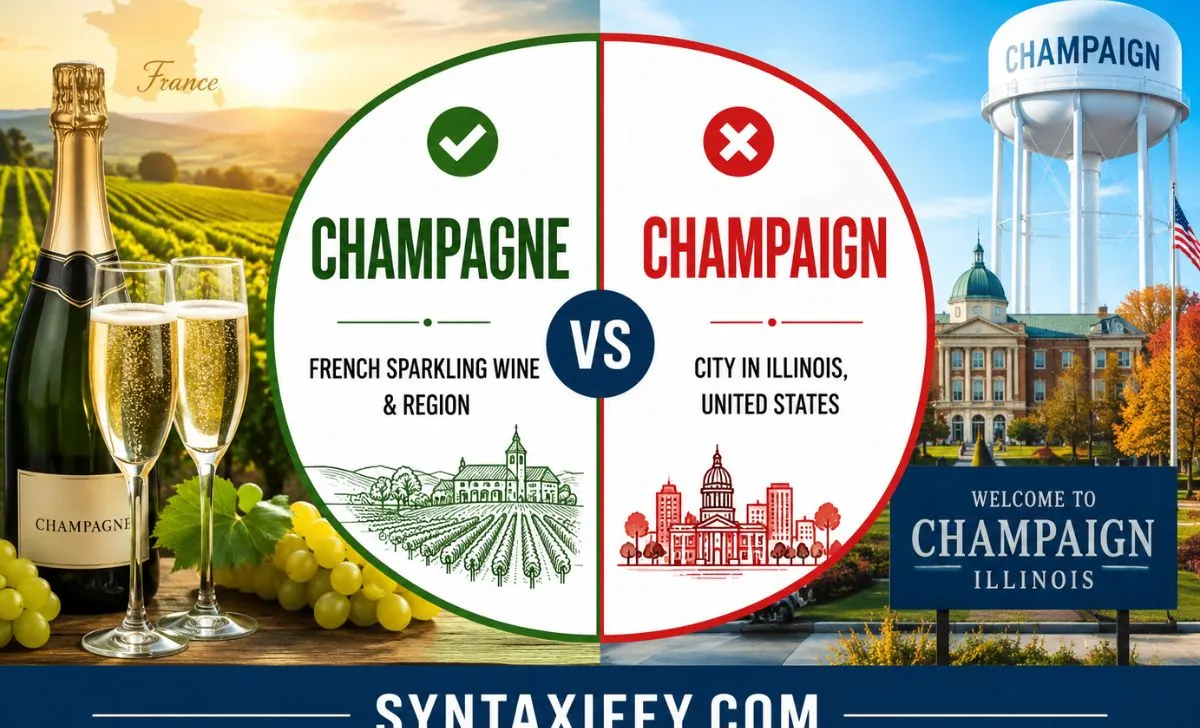
Champagne or Champaign is a common spelling confusion because the two words look and sound very similar, but they have completely different meanings. Champagne is the correct spelling when you are talking about the famous sparkling wine associated with the Champagne region of France.
Champaign, on the other hand, is primarily a proper noun used for Champaign, Illinois, a city in the United States.
Knowing the difference is important in English grammar, spelling, academic writing, business communication, travel writing, and everyday conversation.
In this guide, you will learn the meanings, origins, pronunciation, differences, correct usage, examples, and common mistakes involving Champagne and Champaign.
Quick Answer
Champagne is correct when referring to the French sparkling wine or the Champagne region of France.
Champaign is usually a proper noun referring to Champaign, Illinois, a city in the United States.
Examples:
- We opened a bottle of Champagne for the celebration.
- She lives in Champaign, Illinois.
So, if you mean the wine, use Champagne. If you mean the Illinois city, use Champaign.
Champagne vs Champaign: The Main Difference
The easiest way to remember the difference is to connect each spelling with its meaning.
| Word | Meaning | Common Use | Example |
| Champagne | A sparkling wine from France | Wine, celebrations, food and drink | We served Champagne at dinner. |
| Champagne | A region in northeastern France | Geography, history, travel | Champagne is famous for its vineyards. |
| Champaign | A city in Illinois, USA | Place name | He studies in Champaign. |
The spelling Champagne contains -agne at the end, while Champaign contains -aign.
Although they are visually similar, they should not be treated as interchangeable words.
What Does Champagne Mean?
Champagne is a sparkling wine traditionally produced in the Champagne wine region of France. The name is strongly associated with French wine production and is protected as a geographical indication.
In everyday English, people commonly use Champagne when discussing:
- Sparkling wine
- French wine
- Weddings
- New Year’s celebrations
- Special occasions
- Luxury drinks
- Vineyards
- French cuisine
- Wine tasting
For example:
We bought a bottle of Champagne for the wedding.
Here, Champagne is the correct spelling because the sentence refers to the wine.
The word can also refer to the historical and geographical region of Champagne in France.
What Does Champaign Mean?
Champaign is most commonly used as a proper noun for Champaign, Illinois, a city in the United States.
The city is located in central Illinois and is closely connected with the University of Illinois Urbana-Champaign.
For example:
My brother moved to Champaign for college.
Here, Champaign is correct because the sentence refers to the city in Illinois.
It should normally be capitalized because it is a proper place name.
Examples of Champaign
- I visited Champaign last summer.
- She works in Champaign, Illinois.
- The University of Illinois Urbana-Champaign is located in the area.
- They moved from Chicago to Champaign.
- We booked a hotel in Champaign.
In these sentences, Champaign does not refer to wine.
Why Do People Confuse Champagne and Champaign?
The confusion mainly comes from their similar spelling and pronunciation.
Both words begin with:
Champ-
They also contain similar combinations of letters:
Champagne
Champaign
The final parts are different:
- Champagne → -agne
- Champaign → -aign
This small spelling difference can easily cause mistakes, especially when someone hears the word rather than sees it written.
Another reason is that Champagne is a well-known word, while Champaign is primarily encountered as a geographical name. People who have never encountered the Illinois city in writing may assume that Champagne is the only possible spelling.
Champagne: Meaning, Pronunciation, and Usage
Champagne is generally pronounced approximately:
sham-PAYN
The final sound is similar to the English word pain.
The word is commonly used as a noun.
Examples
They served Champagne after the ceremony.
She ordered a glass of Champagne.
Champagne is traditionally associated with celebrations.
We visited the Champagne region of France.
The restaurant has an extensive Champagne list.
Notice that Champagne is not normally used to describe a city in Illinois.
Champaign: Meaning, Pronunciation, and Usage
Champaign is the name of a city in Illinois.
Its pronunciation is also approximately:
sham-PAYN
This is one of the biggest reasons the two words are confusing. In many contexts, they sound essentially the same even though their spellings and meanings are different.
Examples
He lives in Champaign, Illinois.
She traveled to Champaign for a conference.
The students moved to Champaign for university.
Champaign is located in central Illinois.
We spent the weekend in Champaign.
The important point is that Champaign is a place name, not the standard spelling for the French sparkling wine.
Champagne vs Champaign Pronunciation
Interestingly, Champagne and Champaign are generally pronounced very similarly.
| Word | Approximate Pronunciation |
| Champagne | sham-PAYN |
| Champaign | sham-PAYN |
Because they can sound alike, pronunciation alone cannot always tell you which spelling is intended.
You need to use the context.
For example:
They drank Champagne.
The context clearly concerns a beverage.
But:
They live in Champaign.
The context indicates a location.
This is why learning the meaning of each word is more useful than simply memorizing the spelling.
When to Use Champagne
Use Champagne when you are talking about the French sparkling wine or the Champagne region of France.
Common contexts include wine, celebrations, restaurants, travel, food, and French geography.
Use Champagne for Wine
We opened a bottle of Champagne.
Use Champagne for the French Region
She traveled through Champagne during her trip to France.
Use Champagne in Food and Drink Writing
The menu includes Champagne and several French wines.
Use Champagne for Celebrations
They toasted the newlyweds with Champagne.
Use Champagne in Travel Content
The Champagne region is known for its vineyards and wine houses.
When to Use Champaign
Use Champaign when referring to the city in Illinois.
It is a proper noun, so the first letter should be capitalized.
Examples
I am traveling to Champaign tomorrow.
She attends the University of Illinois Urbana-Champaign.
The conference will take place in Champaign.
He grew up near Champaign, Illinois.
We found several restaurants in downtown Champaign.
A useful rule is:
French wine or French region = Champagne
Illinois city = Champaign
Champagne or Champaign in a Sentence
Seeing the two words in complete sentences makes the difference much easier to understand.
Correct Examples with Champagne
- We celebrated our anniversary with Champagne.
- The waiter brought a bottle of Champagne.
- Champagne is often associated with celebrations.
- They toured several vineyards in the Champagne region.
- She enjoys learning about French Champagne.
Correct Examples with Champaign
- She moved to Champaign last year.
- He is studying in Champaign, Illinois.
- The conference was held in Champaign.
- They rented an apartment near downtown Champaign.
- We are driving to Champaign this weekend.
The surrounding words usually make the intended meaning obvious.
Common Examples of the Confusion
A person might write:
We celebrated with a bottle of Champaign.
This is incorrect if the intended meaning is the sparkling wine.
The correct sentence is:
We celebrated with a bottle of Champagne.
Likewise, someone might accidentally write:
She lives in Champagne, Illinois.
If they mean the city, the correct spelling is:
She lives in Champaign, Illinois.
These errors are understandable because the words are pronounced similarly, but the meanings are different.
Champagne vs Champaign: A Simple Memory Trick
Use this simple trick:
Champagne = French wine 🇫🇷
Champaign = Illinois city 🇺🇸
You can also remember:
Champagne → wine
Champaign → place
If you are writing about a bottle, vineyard, celebration, or sparkling wine, choose Champagne.
If you are writing about Illinois, a university, a city, a trip, or a location, choose Champaign.
This simple association can prevent most spelling mistakes.
Is Champagne a Place or a Drink?
Champagne can refer to both a geographical region and a type of sparkling wine, depending on the context.
The Champagne region is located in northeastern France. It is internationally famous for producing sparkling wines made according to specific rules and traditions.
The word Champagne is also used for the wine produced in this region under the protected designation.
For example:
They traveled to the Champagne region of France.
Here, Champagne refers to a place.
We opened a bottle of Champagne.
Here, Champagne refers to wine.
This is completely different from Champaign, which most commonly refers to the city of Champaign, Illinois.
Is Champaign a Place?
Yes. Champaign is primarily a geographical name.
The best-known use is Champaign, Illinois, in the United States. It is part of the Champaign–Urbana metropolitan area and is closely associated with the University of Illinois Urbana-Champaign.
For example:
My cousin lives in Champaign, Illinois.
Here, Champaign is a proper noun and should begin with a capital letter.
You should not replace Champaign with Champagne simply because the two words sound similar.
Champagne or Champaign in American English
In American English, both spellings can appear, but they serve different purposes.
Champagne is used for:
- The French sparkling wine
- The Champagne region of France
Champaign is used mainly for:
- Champaign, Illinois
- Names connected with the city
- Institutions and organizations using the city’s name
For example:
The restaurant serves Champagne.
But:
The student attends the University of Illinois Urbana-Champaign.
The context determines which spelling is appropriate.
Champagne or Champaign in British English
The distinction remains the same in British English.
Champagne refers to the French wine or region, while Champaign refers to the Illinois place name.
For example:
They enjoyed Champagne at the celebration.
But:
She is traveling to Champaign, Illinois.
Therefore, this is not a British English vs American English spelling difference. Both varieties of English use the two spellings according to their meanings.
Champagne and Champaign as Proper Nouns
Capitalization is another important point.
Champagne is capitalized when it refers to the geographical region or the protected wine designation.
Champaign is capitalized because it is a proper place name.
Examples:
- Champagne is a famous wine-producing region.
- They visited Champagne in France.
- He moved to Champaign, Illinois.
- The conference was held in Champaign.
However, capitalization alone does not solve the spelling problem. You still need to choose the correct word based on meaning.
Comparison Table
| Feature | Champagne | Champaign |
| Main meaning | French sparkling wine | City in Illinois |
| Geographic connection | France | United States |
| Can refer to a region? | Yes | Not usually |
| Commonly associated with | Wine, vineyards, celebrations | Illinois, education, city life |
| Pronunciation | Approximately “sham-PAYN” | Approximately “sham-PAYN” |
| Capitalization | Usually capitalized in these uses | Capitalized |
| Common mistake | Writing Champaign for the wine | Writing Champagne for the city |
| Example | We drank Champagne. | She lives in Champaign. |
The most important distinction is meaning, not pronunciation.
Common Mistakes with Champagne and Champaign
Because the words sound almost identical, several mistakes are common.
| Incorrect | Correct | Why |
| We drank Champaign. | We drank Champagne. | The drink is Champagne. |
| She lives in Champagne, Illinois. | She lives in Champaign, Illinois. | The city is Champaign. |
| A bottle of Champaign | A bottle of Champagne | Wine spelling |
| University of Illinois Urbana-Champagne | University of Illinois Urbana-Champaign | Official place name |
| Champagne, Illinois | Champaign, Illinois | Illinois city spelling |
These mistakes are especially common in informal writing, social media posts, emails, and content created from speech-to-text.
Champagne vs Champaign in Professional Writing
Correct spelling becomes especially important in professional and academic writing.
If you are writing about wine, hospitality, tourism, food, or French culture, use Champagne when appropriate.
For example:
The hotel offers a selection of Champagne from renowned French producers.
If you are writing about education, travel, business, or research involving Illinois, use Champaign.
For example:
The research conference will take place in Champaign, Illinois.
Using the wrong spelling can make otherwise professional writing appear careless.
Champagne vs Champaign in Academic Writing
Academic writers should pay close attention to the distinction because proper nouns must be written accurately.
Consider this sentence:
The researchers traveled to Champagne, Illinois.
If the researchers actually traveled to the Illinois city, this is incorrect.
The correct version is:
The researchers traveled to Champaign, Illinois.
Similarly:
The researchers examined Champagne production in France.
Here, Champagne is correct because the subject is wine production in France.
Academic writing often involves geographical names, institutions, historical references, and specialized terminology, so spelling accuracy matters.
Champagne vs Champaign in Travel Writing
Travel writers may use both terms, but they describe very different destinations.
Champagne can refer to the famous wine region of France.
The couple planned a trip through France’s Champagne region.
Champaign refers to the Illinois city.
The students spent the summer exploring Champaign, Illinois.
If you are writing travel content, confusing these two words could mislead readers about the destination.
Champagne vs Champaign in Business Communication
Businesses may also use both terms.
A wine company might write:
Our selection includes premium Champagne.
A company located in Illinois might write:
Our headquarters are located in Champaign.
When dealing with addresses, company locations, universities, conferences, or events, it is particularly important to spell Champaign correctly.
For wine-related products and services, Champagne is the appropriate spelling when the product genuinely qualifies as Champagne.
The Origin of the Word Champagne
The word Champagne comes from the name of the Champagne region in France.
The region has a long history connected with agriculture, vineyards, and wine production. Over time, the name became strongly associated with the sparkling wine produced there.
The term is therefore much more than a generic spelling for every sparkling wine.
In modern usage, Champagne has a specific geographical and cultural identity connected with France.
This is why you will commonly see references to:
- Champagne wine
- Champagne vineyards
- Champagne houses
- Champagne region
- Champagne producers
- Champagne bottles
- Champagne tasting
The Origin of the Word Champaign
Champaign has a different history.
The name of Champaign, Illinois ultimately reflects the French word champagne, historically associated with an open or level countryside. The Illinois place name developed through French influence and later became the established spelling of the American city.
Although the two words have a historical linguistic connection, modern English treats them as distinct spellings with different practical meanings.
Today, when you see Champaign, the most likely reference is the Illinois city.
Champagne vs Champaign: Which One Should You Use?
Use this quick decision guide:
Are you talking about wine?
→ Use Champagne.
Are you talking about the French region?
→ Use Champagne.
Are you talking about Champaign, Illinois?
→ Use Champaign.
Are you referring to the University of Illinois Urbana-Champaign?
→ Use Champaign.
Are you writing about vineyards or French sparkling wine?
→ Use Champagne.
The easiest rule is:
Champagne = French wine/region
Champaign = Illinois city
Quick Memory Trick
Think of the final letters:
Champagne → AGNE → French wine
Champaign → AIGN → Illinois
Another easy sentence to remember is:
“Champagne is for celebrations; Champaign is for locations.”
This is not a grammatical rule, but it is an effective memory aid.
If you remember only one thing, remember this:
Wine = Champagne
Illinois = Champaign
FAQs
Is Champagne or Champaign correct?
Both are correct words, but they have different meanings. Champagne refers mainly to the French sparkling wine or its French region, while Champaign commonly refers to Champaign, Illinois.
Is Champaign the same as Champagne?
No. They are different spellings with different modern uses. They may sound very similar, but Champagne is associated with French wine and the Champagne region, while Champaign is associated primarily with the Illinois city.
How do you spell the wine Champagne?
The correct spelling is Champagne.
For example:
We ordered a bottle of Champagne.
How do you spell the city in Illinois?
The city is spelled Champaign.
For example:
She lives in Champaign, Illinois.
Are Champagne and Champaign pronounced the same?
They are generally pronounced very similarly, approximately “sham-PAYN.” This similarity in pronunciation is one reason people frequently confuse their spellings.
Is Champagne only a drink?
No. Champagne can also refer to the Champagne region of France. The meaning depends on context.
Should Champaign be capitalized?
Yes. When referring to Champaign, Illinois, it is a proper noun and should be capitalized.
Conclusion
The difference between Champagne and Champaign is simple once you connect each spelling with its meaning. Champagne refers to the famous French sparkling wine and can also refer to the Champagne region of France.
Champaign is primarily the name of a city in Illinois, USA. Although the two words have very similar pronunciation, they should not be used interchangeably.
Remember the simple rule: Champagne = French wine or region, while Champaign = Illinois city. Using the correct spelling will make your academic, professional, travel, and everyday English writing clearer and more accurate.
Read More Blogs:

Hi, I am Roy Peter Clark, and I write clear and practical grammar and writing blogs.
On Syntaxiffy.com, I focus on English grammar, style, and writing techniques to help readers improve clarity and communication.