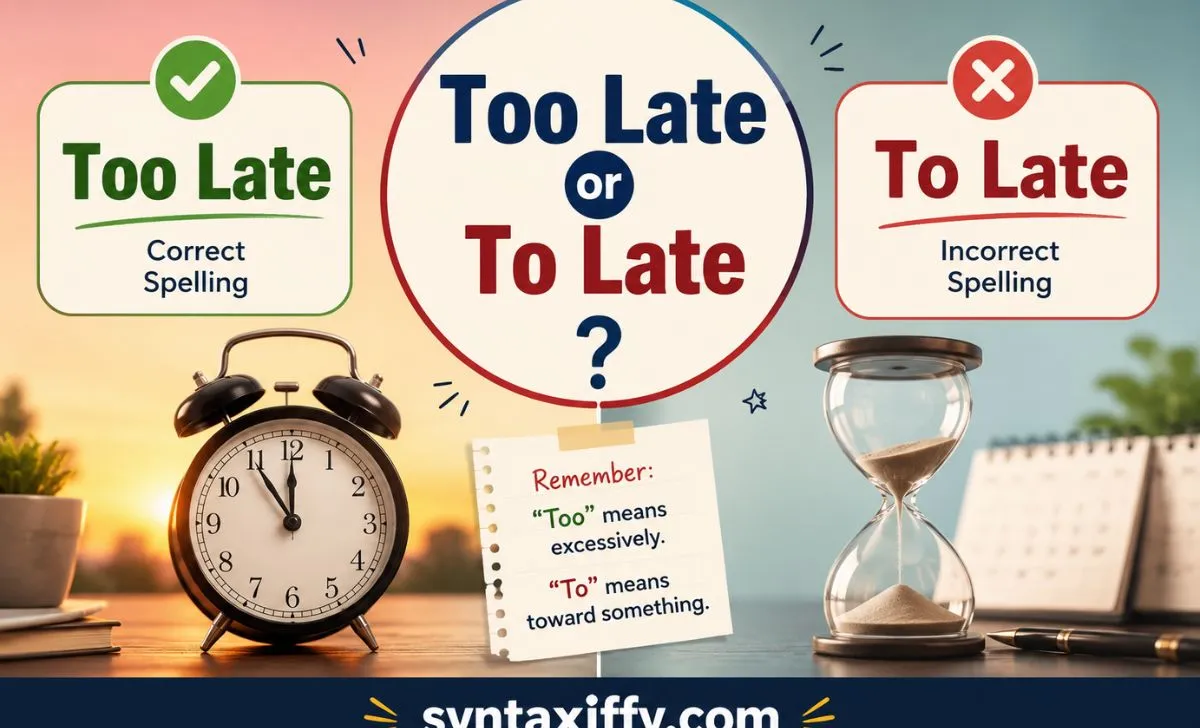
Too late or to late? The correct spelling is “too late.” It means that something happens after the proper, expected, or useful time. “To late” is not correct in standard English when you mean that something happened after the right time.
People often confuse these forms because too and to sound similar in everyday speech. However, they have different grammatical roles.
In this guide, you will learn the difference between too late and to late, their meanings, pronunciation, origins, common mistakes, and practical examples. You will also learn a simple memory trick so you can choose the correct form confidently in emails, academic writing, social media, and everyday English.
Quick Answer
The correct phrase is “too late.”
Use too when you mean more than is suitable, necessary, or possible. In too late, it means that the appropriate time has already passed.
Correct:
- I arrived too late for the meeting.
- It is too late to change the schedule.
- She realized her mistake too late.
- We were too late to catch the train.
Incorrect:
- I arrived to late for the meeting.
- It is to late to change the schedule.
The word to has different jobs in English. It commonly works as a preposition or an infinitive marker, as in “go to school” or “to study.” It does not create the standard phrase to late.
Oxford defines too late as being after the point when something can be done successfully.
The Origin of Too Late or To Late
The confusion becomes easier when we look at the history of the words.
Too has a long history in English. Merriam-Webster traces it to Middle English and Old English tō. In modern English, too can mean “also” or indicate an excessive degree. For example, “too expensive” means more expensive than is acceptable or desired.
The word late also comes from Old English. Its older form was læt, meaning something like slow, sluggish, or occurring after the expected time. Over time, its meaning developed into the modern idea of something happening after the expected or appropriate time.
Together, too late developed as a natural English expression meaning that an action is happening after the useful or acceptable time.
The spelling to late is not a British English alternative or an American English alternative. It is normally a grammar or spelling mistake when the intended meaning is “after the right time.”
British English vs American English Spelling

There is no spelling difference between British English and American English for this phrase.
Both varieties use:
too late
not:
to late
| English variety | Correct | Incorrect |
| British English | too late | to late |
| American English | too late | to late |
| Canadian English | too late | to late |
| Australian English | too late | to late |
| New Zealand English | too late | to late |
| International English | too late | to late |
For example:
British English:
“It is too late to apply.”
American English:
“It is too late to apply.”
The sentence remains the same in both varieties.
British and American English may differ in words such as colour/color, centre/center, and travelling/traveling, but too late is not one of those spelling differences.
Pronunciation of Too Late or To Late
The pronunciation is one major reason people confuse these expressions.
Too is normally pronounced /tuː/. It has the same basic vowel sound as two.
To can have different pronunciations depending on its position in a sentence. When stressed, it can sound like /tuː/, but in normal unstressed speech it is often pronounced /tə/.
For example:
- too late → /tuː leɪt/
- to school → often /tə skuːl/
- to go → often /tə ɡoʊ/
The word late is pronounced approximately /leɪt/.
This means too late sounds like “too-late,” while the intended phrase to late may sound similar enough in fast speech to cause confusion.
The important point is that pronunciation alone cannot always tell you which spelling to choose. You need to look at the meaning and grammatical role.
Why People Confuse Too Late or To Late
People commonly mix up too and to because they are homophones or near-homophones in many contexts.
There are several reasons for the confusion.
1. Similar pronunciation
In everyday conversation, to is frequently reduced to a weak sound like /tə/. In some sentences, however, it receives more stress and can sound closer to too.
2. Similar spelling
Both words begin with t and contain o. The extra o in too is easy to forget while typing quickly.
3. Different grammatical roles
Too is an adverb. It can show excessive degree:
- too late
- too early
- too expensive
- too difficult
To is commonly a preposition or an infinitive marker:
- go to work
- walk to school
- want to leave
- need to study
4. Fast typing
People often type what they hear. Since too and to can sound similar, autocorrect and typing habits can lead to mistakes.
5. English learners
English learners may memorize the sound before they fully understand the grammatical difference. This can make to and too especially confusing.
Which Spelling Should You Use?
If you mean “after the appropriate time” or “later than is useful or acceptable,” always use:
too late
This applies regardless of your audience.
For American English, use too late.
For British English, use too late.
For Canadian, Australian, and other international English, use too late.
This is especially important in professional and academic writing. A sentence such as:
“We submitted the application too late.”
is clear and grammatically correct.
Writing:
“We submitted the application to late.”
creates an obvious word-choice error.
When writing emails, reports, assignments, business documents, or website content, choose too late whenever you are describing something that happened beyond the useful or expected time.
Common Mistakes with Too Late or To Late
The most common mistake is replacing too with to.
| Incorrect | Correct | Why? |
| It is to late. | It is too late. | Too shows excessive or unsuitable timing. |
| I came to late. | I came too late. | The arrival happened after the right time. |
| We were to late for class. | We were too late for class. | The students arrived after class had started. |
| She called to late. | She called too late. | The call happened after the useful time. |
| You are to late to join. | You are too late to join. | The opportunity has passed. |
| He noticed it to late. | He noticed it too late. | He noticed it after the appropriate time. |
Another mistake is assuming that to should be used before every adjective or adverb.
That is not how English works.
Compare:
- I want to leave.
- I went to school.
- It is too late.
- The box is too heavy.
Here, to and too have completely different functions.
Too Late or To Late in Everyday Examples
The phrase too late appears in many types of communication.
In emails:
“I apologize, but I submitted the form too late.”
“We received your request too late to make the changes.”
In academic writing:
“The researcher discovered the problem too late to change the results.”
“Students who begin preparation too late may struggle with the final examination.”
In professional writing:
“The client informed us too late to update the order.”
“The report was completed too late for the morning meeting.”
In news writing:
“Officials arrived too late to prevent further damage.”
On social media:
“I saw this post too late!”
“Too late—I already ordered it.”
In everyday conversation:
“Are we too late?”
“No, we still have five minutes.”
The phrase can describe a literal delay, a missed deadline, or a missed opportunity.
Easy Trick to Remember Too Late or To Late
Use this simple trick:
Too has an extra O because there is “too much” of something.
Think:
TOO = MORE
- too late = later than acceptable
- too early = earlier than acceptable
- too expensive = more expensive than acceptable
- too difficult = more difficult than acceptable
If you can replace too with “excessively”, “more than necessary”, or sometimes “also,” then too is probably the correct word.
For example:
It is too late.
You can think:
It is more than acceptably late.
But you cannot say:
It is to late.
Another quick memory sentence is:
“Too late has two O’s because I waited too long.”
This makes the spelling easier to remember.
Too Late or To Late – Google Trends & Usage Data
Search interest around too late is naturally much stronger than interest in to late because too late is the standard English phrase.
However, Google Trends should be interpreted carefully. Trends measures relative search interest, not the total number of times a phrase appears in all written English. Search volume can also change because of events, news stories, song titles, social media posts, and popular phrases.
The phrase too late is used across many English-speaking regions, including the United States, United Kingdom, Canada, Australia, and other countries where English is widely learned or used.
Its search intent usually falls into several categories:
- grammar and spelling questions
- missed deadlines
- relationships and personal situations
- news and current events
- song and entertainment searches
- everyday expressions
- English-language learning
The phrase also occurs frequently in dictionaries and educational materials. Oxford specifically lists too late as an established expression for an action happening after the time when it can be successfully completed.
Because to late is normally an error rather than a standard phrase, searches for it often reflect people checking whether the spelling is correct.
Comparison Table
| Feature | Too Late | To Late |
| Standard English? | Yes | No, in this meaning |
| Correct spelling? | Yes | No |
| Meaning | After the appropriate time | Usually a spelling error |
| “Too” grammatical role | Adverb | — |
| “To” grammatical role | — | Preposition/infinitive marker |
| British English | Correct | Incorrect |
| American English | Correct | Incorrect |
| Pronunciation | /tuː leɪt/ | May sound similar |
| Example | It is too late. | It is to late. |
| Use in formal writing | Yes | No |
The key difference is simple: too late is a valid English phrase, while to late is not the standard spelling for this meaning.
FAQs
Is “too late” correct?
Yes. Too late is the correct phrase when something happens after the appropriate, expected, or useful time.
Is “to late” ever correct?
Not when you mean “after the right time.” To can appear before a verb, noun, or destination in other structures, but to late is not the standard phrase.
What does “too late” mean?
It means something happens after the time when it can be done successfully or appropriately.
Is “too late” the same in British and American English?
Yes. Both British English and American English use too late. There is no regional spelling difference.
How do you pronounce “too late”?
It is generally pronounced /tuː leɪt/. “Too” sounds like the number two, while “late” rhymes with words such as “wait” and “date.”
Why do people write “to late”?
The main reason is confusion between to and too. They can sound similar, especially in fast speech, and they have similar spellings.
How can I remember “too late”?
Remember that too has two O’s. Think: “I waited too long, so it is too late.”
Can I use “too late” in formal writing?
Yes. It is completely acceptable in academic, professional, business, and formal writing when the meaning is appropriate.
What is an example of “too late”?
“I arrived too late to attend the meeting.” This means the speaker arrived after the useful or acceptable time.
Conclusion
When choosing between too late or to late, the correct phrase is too late. Use it when something happens after the appropriate, expected, or useful time.
The word too works as an adverb, while to usually functions as a preposition or infinitive marker. British English and American English both use the same spelling: too late. Although the words can sound similar in speech, their grammatical roles are different.
Remember the extra o in too as a reminder of “too much” or “more than necessary.” This simple trick can help you avoid the common to late spelling error in everyday and professional English.
Read More Blogs:

Hi, I am Mary Norris, and I write clear and insightful grammar blogs on Syntaxiffy.com.
On Syntaxiffy.com, I focus on English grammar, usage, and writing accuracy to help readers improve their language skills.