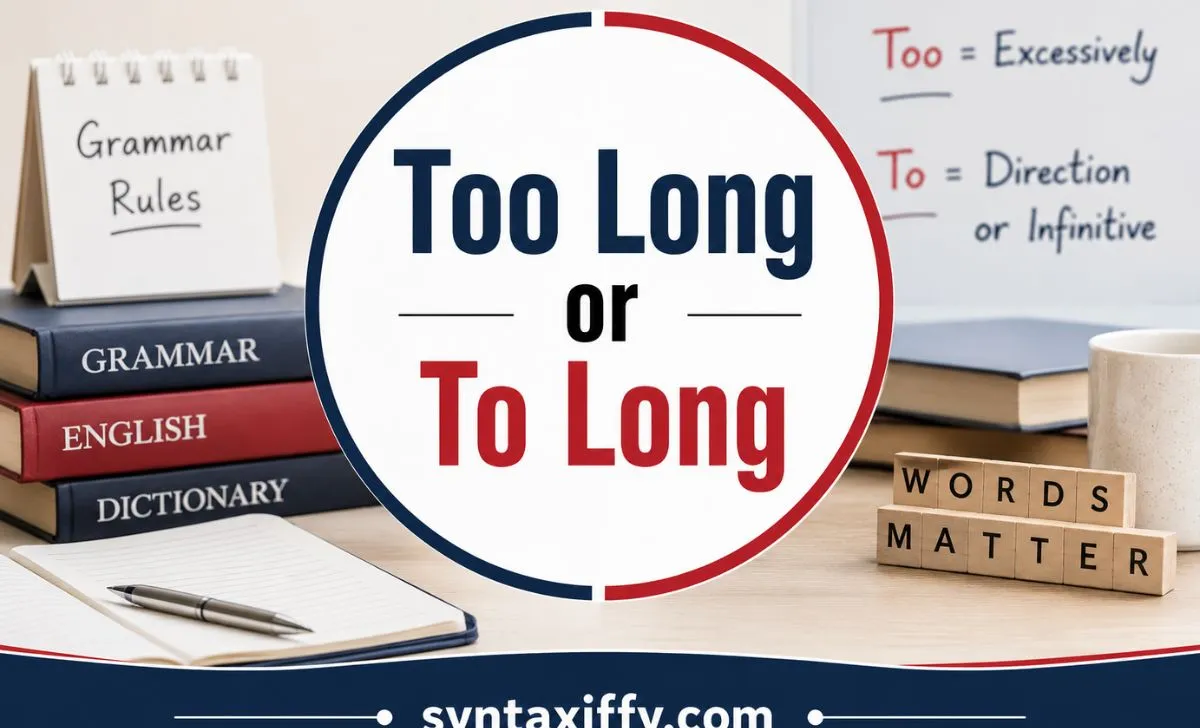
If you are wondering whether Too Long or To Long is correct, the answer is too long when you mean “excessively long” or “longer than acceptable.” For example, “The meeting was too long” is correct.
To is normally a preposition or an infinitive marker, while too is an adverb used for excess or addition. The confusion exists because to and too sound alike in standard English, even though they have different meanings and grammatical functions.
In this guide, you will learn their difference, pronunciation, history, British and American usage, common mistakes, everyday examples, and an easy trick for choosing the correct form.
Quick Answer
Too long is the correct choice when you mean that something has excessive length or duration.
- Correct: The movie was too long.
- Correct: I waited too long.
- Correct: This article is too long.
- Incorrect: The movie was to long.
- Incorrect: I waited to long.
Here, too is an adverb of degree. It modifies long and means “more than is wanted, needed, suitable, or acceptable.”
To has different grammatical jobs. It can work as a preposition:
We went to school.
It can also introduce an infinitive:
I want to leave.
So, if you are describing excessive length or duration, use too long, not to long.
One interesting exception is to long when long is being used as a verb meaning “to desire strongly”:
She began to long for her home.
This is grammatically different from too long.
The Origin of Too Long or To Long
The words to and too have different histories even though modern speakers usually pronounce them alike.
To is an old English grammatical word. It developed from Old English tō, which was commonly used to express movement, direction, relationship, and purpose. Over time, it also became an important marker for the infinitive, as in to read, to write, and to learn.
Too developed from Old English tō as well, but its meaning changed through historical usage. It eventually developed meanings associated with “also” and “excessively.”
This historical relationship helps explain why the words look and sound similar today. However, their modern grammatical functions are different.
The spelling too with two “o” letters helps distinguish it visually from to.
For modern English learners, the most useful distinction is simple:
- to = direction, relationship, purpose, or infinitive
- too = excessive degree or “also”
The phrase too long therefore follows a standard grammatical pattern:
too + adjective
Examples include:
- too long
- too short
- too expensive
- too difficult
- too cold
- too slow
British English vs American English Spelling
There is no British-versus-American spelling difference between too long and to long.
Both British English and American English use too long when something is excessively long.
| Feature | British English | American English |
| Correct expression | too long | too long |
| Incorrect for excessive length | to long | to long |
| Meaning of too | Excessively / also | Excessively / also |
| Meaning of to | Direction / infinitive | Direction / infinitive |
| Example | The film was too long. | The movie was too long. |
The vocabulary surrounding the phrase can sometimes differ. For example, British English commonly uses film, while American English commonly uses movie. But the spelling of too long remains the same.
Other spelling differences between British and American English, such as colour/color, behaviour/behavior, and centre/center, do not affect this particular phrase.
So whether you write for a British, American, Commonwealth, or international audience, too long is the standard expression when you mean excessive length.
Pronunciation of Too Long or To Long
The pronunciation is one of the biggest reasons people confuse to and too.
In normal speech, to and too are often pronounced the same or nearly the same.
- to → /tuː/ when stressed
- too → /tuː/
In connected speech, to is often reduced to a weaker sound, commonly /tə/, especially before another word:
I want to go.
But too generally keeps its stronger /tuː/ pronunciation:
It is too long.
This creates an important distinction between written and spoken English. When you hear a sentence, you may not immediately know whether the speaker means to or too. The surrounding words and context provide the meaning.
For example:
I waited too long.
The phrase expresses excessive duration.
Compare:
I want to long for something.
This is grammatically possible only when long is functioning as a verb, meaning to desire or yearn. It is much less common than the ordinary phrase too long.
Because pronunciation alone cannot always distinguish to, too, and two, writers must rely on meaning and grammar when choosing the spelling.
Why People Confuse Too Long or To Long
The main reason is pronunciation.
English has many words that sound alike but have different meanings or spellings. These are commonly called homophones. The words to, too, and two are a familiar example.
People may know the correct rule but still type the wrong word because they are writing from memory of the spoken sound.
There are several other reasons for the confusion.
1. The words look similar
The difference between to and too is only one extra letter. That makes a typing mistake easy.
2. They sound alike
In many sentences, to and too sound identical or almost identical.
3. English learners focus on sound
An English learner may hear:
The wait was too long.
and remember the sound rather than the spelling.
4. Informal online writing
Fast texting, social media, comments, and casual messages can encourage spelling mistakes. Repeated exposure to incorrect forms can make them seem familiar.
5. Grammar functions are different
The real solution is not simply memorizing the spelling. You need to recognize the grammatical function.
Too is an adverb when it means excessive degree:
The box is too heavy.
To can be a preposition:
Give it to me.
Or an infinitive marker:
I want to sleep.
Once you recognize the function, the spelling becomes much easier.
Which Spelling Should You Use?
Use too long whenever you want to say that something exceeds a suitable, expected, comfortable, or acceptable length or duration.
This applies to almost every variety of standard English.
For American English
Use:
The meeting was too long.
For British English
Use:
The meeting was too long.
For Academic Writing
Use:
The introduction is too long for the required word count.
For Professional Writing
Use:
The response may be too long for a customer email.
For Everyday Conversation
Use:
That movie was too long.
The audience does not change the spelling.
The important thing is the intended meaning. If too means “excessively” or “more than acceptable,” choose too.
Common Mistakes with Too Long or To Long
Here are some frequent mistakes and their corrections:
| Incorrect | Correct | Reason |
| The meeting was to long. | The meeting was too long. | Too means excessively. |
| I waited to long. | I waited too long. | The waiting lasted excessively long. |
| This essay is to long. | This essay is too long. | Too modifies the adjective long. |
| The video was to long. | The video was too long. | Excessive duration requires too. |
| It took to long. | It took too long. | The duration exceeded the acceptable amount. |
| I want too leave. | I want to leave. | To introduces the infinitive. |
| Send it too John. | Send it to John. | To indicates the recipient. |
| I went too school. | I went to school. | To indicates direction. |
Another common mistake is confusing too with two.
I have two books.
Here, two is a number.
I have too many books.
Here, too expresses excess.
The three words may sound alike, but their grammatical roles are completely different.
Too Long or To Long in Everyday Examples
The phrase too long appears frequently in everyday communication.
In Emails
The email may be too long, so I will shorten it.
Sorry for the delay. I know you have waited too long for a response.
In professional writing, too long can describe an email, report, message, meeting, or process.
In News Writing
The investigation took too long, according to the report.
Critics argued that the process was too long and complicated.
On Social Media
This video is too long for a short post.
That explanation was way too long!
In Academic Writing
The essay is too long and needs to meet the assigned word limit.
The introduction is too long compared with the main discussion.
In Business Communication
The presentation was too long for the scheduled meeting.
The approval process is taking too long.
In Everyday Conversation
The line was too long.
We stayed there too long.
The journey was too long for the children.
These examples all use too because the speaker is describing excessive length or duration.
Comparison Table
| Word/Phrase | Part of Speech | Meaning | Example |
| too | Adverb | Excessively | It is too expensive. |
| to | Preposition | Direction/relationship | Go to school. |
| to | Infinitive marker | Introduces a verb | I want to leave. |
| too long | Adverb + adjective | Excessively long | The meeting was too long. |
| to long | Infinitive + verb | To yearn/desire | She began to long for home. |
| two | Number | The number 2 | I have two books. |
| long | Adjective | Having great length/duration | The road is long. |
| long | Verb | Desire strongly | They long for peace. |
This table shows why too long and to long cannot normally be treated as interchangeable spellings.
Easy Trick to Remember Too Long or To Long
Use the extra O trick.
Think:
TOO = EXTRA
The word too has an extra o, and its meaning often involves something extra or excessive.
The wait is too long.
The wait has gone beyond what is acceptable.
You can also use the ALSO test.
If too can be replaced by also, use too:
I want to come too.
→ I want to come also.
For too long, use the excess test:
The meeting is too long.
Ask:
Is the meeting longer than acceptable?
Yes → too long.
For to, ask whether it shows direction or introduces a verb:
I went to work.
I want to study.
If yes, use to.
A three-second rule is:
Excess = TOO
Direction/action = TO
Number = TWO
This simple distinction solves most to, too, and two mistakes.
Too Long or To Long – Google Trends & Usage Data
Search interest for grammar questions involving to and too reflects a broader problem in English: people frequently search for help when two words sound alike but have different grammatical functions.
For this specific phrase, the practical search intent is strongly centered on whether too long or to long should be used. Grammar references consistently identify too long as the correct form when the intended meaning is excessive length or duration.
Usage also varies by context.
Too long is common in:
- Everyday conversation
- Emails
- Academic writing
- Business communication
- Online discussions
- Social media
- Reviews
- News writing
The phrase can describe both physical length and duration:
The cable is too long.
The meeting lasted too long.
It can also appear with other degree expressions:
way too long
far too long
much too long
Search behavior around to vs. too is especially relevant for English learners because pronunciation does not always provide a reliable clue. Written English requires the writer to identify the grammatical function of the word.
Because search interest changes over time and differs by country, exact Google Trends numbers should be checked for a specific date range, location, and search type rather than treated as permanent statistics.
FAQs
Is “too long” correct?
Yes. Too long is correct when you mean excessively long or longer than acceptable.
The movie was too long.
Is “to long” ever correct?
Yes, but not when you mean “excessively long.” To long can occur when long is a verb meaning “to desire strongly.”
She began to long for her family.
This is a different grammatical construction.
Should I write “I waited too long” or “I waited to long”?
Write:
I waited too long.
Too means that the waiting continued beyond a suitable or desired amount of time.
Why do “to” and “too” sound the same?
They are commonly pronounced alike in many contexts. This makes them easy to confuse in writing.
Is “too long” one word?
No. Too long consists of two separate words: the adverb too and the adjective long.
Is “too long” used in British English?
Yes. British English uses too long in the same way as American English when describing excessive length or duration.
What is the easiest way to remember “too long”?
Remember:
TOO has an extra O because it means something is extra or excessive.
So:
The meeting is too long.
Conclusion
When choosing between Too Long or To Long, use too long when you mean that something has excessive length or duration. Too is an adverb that expresses excess, while to usually works as a preposition or infinitive marker.
Although the two words often sound alike, their grammatical functions are different. British English and American English use the same spelling for this phrase. Remember the extra-O trick: too means something extra or excessive.
Whether you are writing an email, essay, report, social media post, or everyday message, too long is the correct choice when something exceeds an acceptable length.
Read More Blogs:

Hi, I am Mary Norris, and I write clear and insightful grammar blogs on Syntaxiffy.com.
On Syntaxiffy.com, I focus on English grammar, usage, and writing accuracy to help readers improve their language skills.