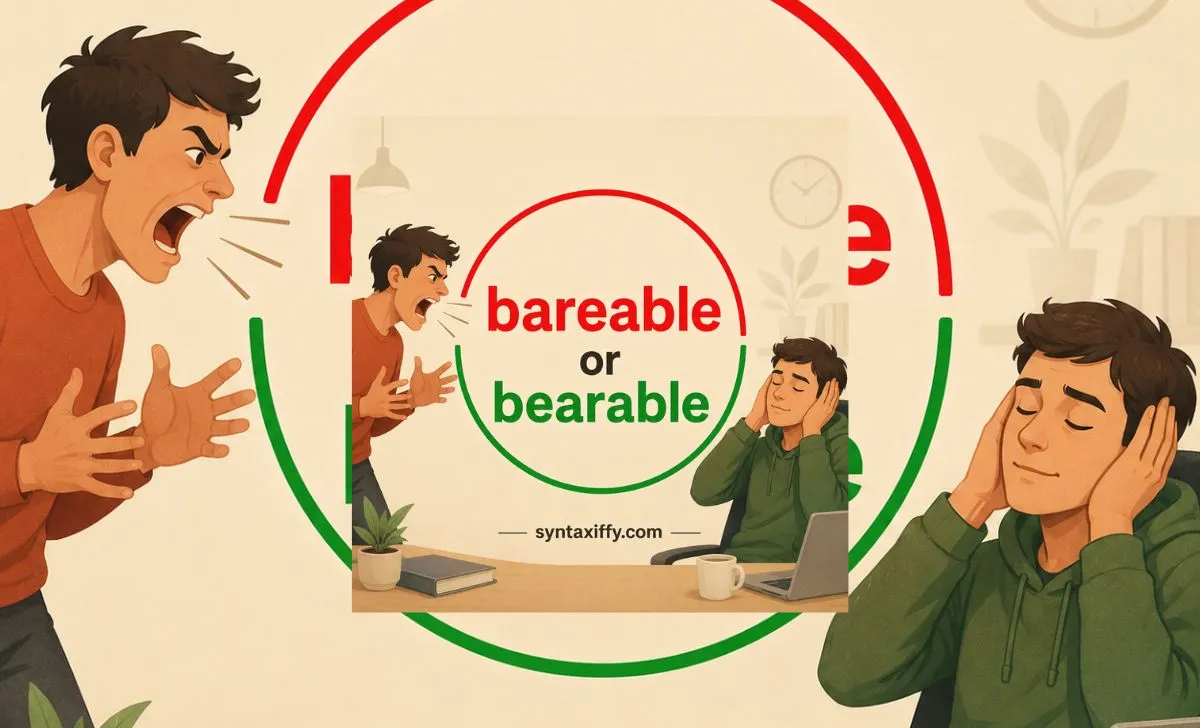
When people search for bareable or bearable, they usually want to know which spelling is correct. The correct spelling is bearable.
The word bareable is a common misspelling and is not recognized as a standard English word by major dictionaries such as Merriam-Webster, Cambridge Dictionary, Oxford English Dictionary, Collins Dictionary, and Dictionary.com.
This confusion happens because bear and bare sound similar in everyday speech. Many English learners, ESL students, and even native speakers accidentally replace one with the other.
In this guide, you’ll learn the correct spelling, meaning, pronunciation, word origin, British and American English usage, examples, and practical tips so you never confuse these words again.
Bareable or Bearable – Quick Answer

Bearable is the correct spelling.
Bareable is incorrect and should not be used in formal or informal writing.
The adjective bearable means something that is tolerable, manageable, or endurable. It describes a situation, feeling, or condition that is difficult but still possible to deal with.
Correct Examples
- The weather became bearable after the rain.
- The pain was bearable, so I didn’t need medicine.
- The long meeting was bearable because everyone stayed focused.
- The traffic was heavy, but it was still bearable.
Incorrect Examples
- ❌ The weather became bareable after the rain.
- ❌ The pain was bareable.
- ❌ The noise was bareable.
Quick Comparison
| Word | Correct? | Meaning |
| Bearable | ✅ Yes | Able to be endured or tolerated |
| Bareable | ❌ No | Incorrect spelling |
Tip: If you mean something can be endured, managed, or tolerated, always use bearable.
The Origin of Bareable or Bearable
Understanding the history of the word makes it much easier to remember the correct spelling.
The word bearable comes from the verb bear, which has existed in English for hundreds of years. In this context, bear does not mean the animal. Instead, it means to carry, support, endure, or tolerate.
When the suffix -able is added to bear, it forms bearable, meaning able to be endured.
Examples:
- bear + able = bearable
- endure + able = endurable
- manage + able = manageable
The spelling bareable likely appeared because people confused bear with bare.
The word bare has a completely different meaning. It refers to something that is uncovered, exposed, empty, or without clothing.
Examples:
- bare feet
- bare walls
- bare hands
Since bare has nothing to do with enduring or tolerating something, the spelling bareable is considered a spelling mistake rather than a real English word.
Modern dictionaries, grammar references, proofreading tools, and spell checkers all recognize bearable as the standard spelling.
Why the Confusion Exists
Several factors cause people to mix up these words.
- Both words begin with similar letters.
- They sound almost identical in many accents.
- English contains many confusing words with similar pronunciation.
- Fast typing often leads to spelling errors.
- Automatic correction does not always catch every mistake.
Because of this, bareable has become one of the more common misspelled words in English vocabulary, especially among language learners.
British English vs American English Spelling
Unlike many English words that have different spellings in the United States and the United Kingdom, bearable is spelled exactly the same in both British English and American English.
Whether you’re writing for readers in the UK, the US, Canada, Australia, New Zealand, or other Commonwealth countries, the correct spelling is always bearable.
There is no regional spelling variation.
Comparison Table
| Feature | British English | American English |
| Correct spelling | Bearable | Bearable |
| “Bareable” accepted? | ❌ No | ❌ No |
| Dictionary spelling | Bearable | Bearable |
| Formal writing | Bearable | Bearable |
| Everyday writing | Bearable | Bearable |
Example Sentences
British English
- The cold weather became bearable by the afternoon.
- The train journey was long but bearable.
American English
- The summer heat was bearable with air conditioning.
- The workload was difficult but still bearable.
Whether you’re writing an email, business report, academic paper, blog post, social media caption, or news article, bearable is the only correct choice.
Pronunciation of Bareable or Bearable
The correct pronunciation is:
Bearable → /ˈbeə.rə.bəl/ (British English)
Bearable → /ˈber.ə.bəl/ (American English)
A simple pronunciation guide is:
BEAR-uh-buhl
The first syllable sounds exactly like the word bear (the verb or the animal).
How It Sounds
- Bear + uh + buhl
- BEAR-uh-buhl
Although many people pronounce bear and bare almost the same, this does not change the spelling.
The pronunciation remains similar, but the meaning comes from the verb bear, which means to endure or tolerate.
Why Pronunciation Causes Confusion
English contains many words that sound alike but have different spellings and meanings. These are often called homophones or near-homophones.
Because bear and bare sound almost identical in everyday conversation, many writers mistakenly type bareable instead of bearable.
When proofreading your writing, remember this simple idea:
- If something can be endured, write bearable.
- If you’re talking about something uncovered or exposed, use bare in its own context—but never bareable.
Why People Confuse Bareable or Bearable
Many people write bareable instead of bearable because the two words look and sound very similar. This is one of the most common English spelling mistakes, especially among ESL learners, students, and people who type quickly.
The confusion usually comes from pronunciation, similar letter patterns, and the meanings of bear and bare.
Here are the main reasons:
1. They Sound Almost the Same
In everyday speech, bear and bare are pronounced almost identically.
Because people hear the word before writing it, they often choose the wrong spelling.
Example:
- “The pain is bearable.”
Someone who only hears the sentence may incorrectly write bareable.
2. The Words “Bear” and “Bare” Already Exist
Unlike many spelling mistakes, bare is a real English word.
Compare them:
| Word | Meaning |
| Bear | To carry, support, endure, or tolerate |
| Bare | Uncovered, exposed, or without covering |
Since both words are correct in different situations, writers sometimes mix them up.
3. English Has Many Confusing Words
English vocabulary contains many words that are easy to confuse because they sound alike.
Examples include:
- accept / except
- affect / effect
- their / there / they’re
- stationery / stationary
- bear / bare
Because learners regularly encounter these confusing words, bareable becomes an easy spelling mistake.
4. Fast Typing and Autocorrect
When writing emails, social media posts, or text messages, people often type quickly.
Some spell checkers catch bareable, while others may miss it depending on the software. That is why proofreading is still important.
5. Learning English as a Second Language
Many language learners focus first on pronunciation before learning spelling patterns.
Since bear and bare sound nearly identical, choosing the correct spelling can be difficult without understanding the meaning.
Which Spelling Should You Use?
The answer is simple:
Use bearable every time.
It is the only spelling accepted in modern English by trusted dictionaries, grammar guides, and proofreading tools.
Whether you write for:
- the United States
- the United Kingdom
- Canada
- Australia
- New Zealand
- other Commonwealth countries
the correct spelling never changes.
Use “Bearable” When Something Can Be Endured
Correct examples:
- The noise became bearable after the windows were closed.
- The traffic was heavy but still bearable.
- Her headache was bearable without medicine.
- The wait was long but bearable.
Never Use “Bareable”
Examples:
❌ This weather is bareable.
✅ This weather is bearable.
❌ The pain was bareable.
✅ The pain was bearable.
If you use bareable, readers may think it is a spelling mistake, especially in professional or academic writing.
Common Mistakes with Bareable or Bearable
Writers often make the same errors when using this word.
Here are the most common ones.
| Incorrect | Correct |
| Bareable | Bearable |
| Bareably | Bearably |
| Unbareable | Unbearable |
| Bareability | Bearability |
Mistake 1: Replacing “Bear” with “Bare”
❌ The journey was bareable.
✅ The journey was bearable.
Mistake 2: Thinking “Bareable” Is British English
Some people believe bareable is used in British English.
It is not.
Both British English and American English use bearable.
Mistake 3: Confusing the Meaning
Remember:
- Bearable = tolerable, manageable, endurable, acceptable
- Bare = uncovered, exposed
These meanings are completely different.
Mistake 4: Ignoring Spell Check
Even experienced writers make typing mistakes.
Before publishing blog posts, reports, or emails, run a spell check or proofread your work carefully.
Many professional editors use trusted resources such as Merriam-Webster, Cambridge Dictionary, Oxford English Dictionary, Collins Dictionary, and Dictionary.com to verify correct spelling and usage.
Bareable or Bearable in Everyday Examples
Understanding real-life usage makes the difference much easier to remember.
In Emails
✅ The workload is difficult, but it is bearable.
✅ The delay was bearable because everyone was informed.
In News Writing
✅ Rising temperatures remain bearable in most regions.
✅ The economic pressure is still bearable for many families
On Social Media
✅ Monday mornings are only bearable with coffee.
✅ The movie was long, but it was bearable.
In Formal Writing
✅ The patient’s discomfort was bearable throughout the treatment.
✅ The financial loss was significant but still bearable.
In Everyday Conversation
- The heat is finally bearable today.
- The exam wasn’t easy, but it was bearable.
- Waiting an extra hour was bearable.
- The traffic wasn’t great, but it was bearable.
Using bearable correctly improves your writing accuracy and helps avoid one of the most common English spelling mistakes.
Easy Trick to Remember Bareable or Bearable
A simple memory trick can help you remember the correct spelling forever.
Think about the verb bear, which means to carry, endure, or tolerate.
If you can bear something, then it is bearable.
Memory Trick
Bear = Endure → Bearable = Able to be endured
For example:
- You can bear the pain.
- Therefore, the pain is bearable.
Now compare that with bare.
The word bare means uncovered, empty, or without clothing.
Examples:
- bare feet
- bare walls
- bare hands
None of these meanings relate to enduring or tolerating something. That is why bareable is always incorrect.
Another Easy Way to Remember
Ask yourself this question:
Can I endure it?
If the answer is yes, write bearable.
Examples:
- The weather is bearable.
- The noise is bearable.
- The pain is bearable.
This small trick works in school assignments, business emails, social media posts, and formal writing.
FAQs
Is bareable a real word?
No. Bareable is not a standard English word. It is a common misspelling of bearable.
Which spelling is correct: bareable or bearable?
Bearable is the correct spelling. It is accepted in both British English and American English.
What does bearable mean?
Bearable means something is tolerable, manageable, or able to be endured.
Why do people spell bearable as bareable?
People confuse the words because bear and bare are pronounced almost the same. Similar pronunciation often leads to spelling mistakes.
Is the spelling different in the UK and the US?
No. Both British English and American English use the spelling bearable.
What is the opposite of bearable?
The opposite is unbearable, which means impossible or very difficult to endure.
What are some synonyms for bearable?
Common synonyms include:
- tolerable
- manageable
- endurable
- acceptable
- supportable
Conclusion
If you are choosing between bareable and bearable, the correct answer is simple: bearable is the only correct spelling.
It comes from the verb bear, meaning to endure or tolerate, while bare means uncovered or exposed and has no connection to this meaning.
Whether you are writing an email, blog post, academic paper, news article, or social media update, always use bearable.
Remember the simple rule: if you can bear it, it is bearable. Following this rule will improve your spelling, strengthen your writing, and help you avoid a common English mistake.
Read More Blogs:

Hi, I am Mary Norris, and I write clear and insightful grammar blogs on Syntaxiffy.com.
On Syntaxiffy.com, I focus on English grammar, usage, and writing accuracy to help readers improve their language skills.