Icey or icy—which spelling is correct? The correct spelling is “icy.” The word “icey” is a common misspelling and is not accepted in standard English dictionaries.
People often write icey because they expect the word to keep the e from ice, but English spelling rules drop the e before adding the suffix -y, creating icy.
In this guide, you’ll learn why this spelling mistake happens, the history of the word, how British English and American English treat it, how to pronounce it correctly, and how to use icy confidently in everyday writing.
Quick Answer

If you’re wondering whether icey or icy is correct, the answer is simple:
| Word | Correct? | Notes |
| Icy | ✅ Yes | Standard English spelling used worldwide. |
| Icey | ❌ No | A common misspelling that should be avoided in formal writing. |
The adjective icy describes something that is:
- Covered with ice
- Extremely cold
- Slippery because of frozen water
- Emotionally cold or unfriendly
Examples
- The roads became icy after the snowstorm.
- Be careful on the icy bridge.
- She gave him an icy stare.
- The mountain was covered in icy frost.
You should always write icy, whether you’re writing an email, school assignment, article, business report, or social media post.
The Origin of Icey or Icy
The spelling confusion between icey and icy comes from the way English forms adjectives.
The noun ice has existed in English for hundreds of years. It comes from the Old English word īs, which referred to frozen water. As English developed, writers needed an adjective to describe things that were covered in ice, extremely cold, or dangerously slippery.
Instead of keeping the final e, English follows a common spelling pattern.
When a word ends with a silent e, the e is usually removed before adding the suffix -y.
Examples include:
| Base Word | Correct Adjective |
| Ice | Icy |
| Juice | Juicy |
| Spice | Spicy |
| Lace | Lacy |
| Cream | Creamy |
Because of this spelling rule, icy became the accepted spelling in dictionaries, while icey never became part of standard English vocabulary.
Many English learners assume the word should remain ice + y, creating icey, but that is not how English spelling works.
Today, respected dictionaries, publishers, teachers, editors, and proofreading tools all recognize icy as the correct form.
The word is commonly used to describe:
- Frozen roads
- Snow-covered mountains
- Ice crystals
- Glaciers
- Icicles
- Cold weather
- Freezing temperatures
- Arctic landscapes
- Polar climates
- Chilly winds
- Frost on windows
- Emotionally cold behavior
Because of its broad meaning, icy appears frequently in news reports, weather forecasts, travel advice, novels, and everyday conversation.
British English vs American English

Many spelling differences exist between British English and American English.
For example:
| British English | American English |
| Colour | Color |
| Favourite | Favorite |
| Centre | Center |
| Jewellery | Jewelry |
However, icy is not one of those differences.
Both British and American English use the same spelling.
| Feature | British English | American English |
| Correct spelling | Icy | Icy |
| “Icey” accepted? | No | No |
| Dictionary spelling | Icy | Icy |
| Formal writing | Icy | Icy |
| Everyday use | Icy | Icy |
Examples in British English
- The pavement became icy overnight.
- Drivers should slow down on icy roads.
- The weather turned icy after sunset.
Examples in American English
- The highway was icy this morning.
- Watch out for icy sidewalks.
- Schools closed because of icy conditions.
Whether you’re writing for readers in the United States, the United Kingdom, Canada, Australia, New Zealand, or anywhere else, icy is always the correct spelling.
There is no regional variation where icey is considered standard English.
Pronunciation of Icey or Icy
Although many people spell the word incorrectly as icey, both spellings are usually intended to represent the same pronunciation.
The correct written form is icy.
Pronunciation: /ˈaɪ.si/
It sounds like:
EYE-see
The word has two syllables:
- Eye
- See
The first syllable receives the stress.
Pronunciation Examples
- Icy road
- Icy wind
- Icy water
- Icy smile
- Icy stare
Notice that the pronunciation never changes even though some people mistakenly write icey.
This is one reason the spelling confusion exists. Since ice ends with e, many writers naturally expect the adjective to be icey. Instead, English spelling rules remove the silent e, leaving icy.
Whether you’re speaking with a native speaker, learning English as an ESL learner, or improving your English vocabulary, remembering the pronunciation EYE-see can help reinforce the correct spelling.
Why People Confuse Icey or Icy
The confusion between icey and icy is one of the most common spelling mistakes in English. The good news is that it has a simple explanation.
Most people know the base word is ice. When they turn it into an adjective, they naturally think the word should become icey. This seems logical because the original noun ends with the letter e.
However, English spelling follows a different rule.
When many words ending in a silent e take the suffix -y, the e is dropped. That is why ice becomes icy, not icey.
Here are the main reasons people mix them up:
1. The Base Word Ends with E
People often write words exactly as they see them.
Since ice ends with e, many assume adding -y creates icey.
English spelling rules remove the silent e, making icy the correct form.
2. Pronunciation Doesn’t Help
Both icy and the incorrect icey would be pronounced almost the same.
Because there is no difference in spoken English, many people never realize they have been spelling it incorrectly.
3. Typing Quickly
Fast typing often leads to common misspellings.
Writers on social media, text messages, or online forums sometimes type icey without noticing the mistake.
4. Lack of Proofreading
Many spelling errors happen because people skip proofreading.
A spell checker or grammar checker usually flags icey and suggests icy.
5. Learning English
Many English learners focus first on pronunciation instead of spelling rules.
Since ice is familiar, they naturally expect the adjective to keep the same ending.
Similar Spelling Mistakes
The same kind of confusion appears in other English words.
| Incorrect | Correct |
| Icey | Icy |
| Shiney | Shiny |
| Dicey (correct word) | Dicey |
| Spicey | Spicy |
Notice that dicey is an exception because it is an independent word, not simply dice + y.
Learning common spelling patterns helps improve your English vocabulary, proofreading, and overall writing skills.
Which Spelling Should You Use?
The answer is straightforward.
Use icy every time.
It is the accepted spelling in dictionaries and is used in:
- Academic writing
- School assignments
- Business reports
- Newspapers
- Books
- News websites
- Government publications
- Professional emails
- Social media
- Everyday conversations
For American English
Always use icy.
For British English
Always use icy.
For Canadian English
Always use icy.
For Australian English
Always use icy.
For New Zealand English
Always use icy.
For Global English
Whether your audience is international or local, icy is the safest and most professional choice.
There is no English-speaking country where icey is considered the standard spelling.
If you want your writing to look polished and professional, always choose icy.
Common Mistakes with Icey or Icy
Here are some mistakes writers frequently make and how to correct them.
| Incorrect Sentence | Correct Sentence |
| The road is icey today. | The road is icy today. |
| Be careful on the icey stairs. | Be careful on the icy stairs. |
| It was an icey morning. | It was an icy morning. |
| The weather became icey overnight. | The weather became icy overnight. |
| She gave me an icey smile. | She gave me an icy smile. |
Other Common Errors
❌ Writing icey in formal documents.
✅ Use icy instead
❌ Assuming icey is the British spelling.
✅ British and American English both use icy
❌ Believing pronunciation changes the spelling.
✅ Pronunciation stays the same, but the correct spelling is still icy.
❌ Ignoring spelling suggestions.
✅ Most dictionaries and proofreading tools recommend icy immediately.
Icey or Icy in Everyday Examples
The word icy appears in many real-life situations. Here are examples from different types of writing.
The parking lot is icy this morning, so please drive carefully.
News Report
Heavy snowfall left several highways icy, causing travel delays across the region.
Weather Forecast
Temperatures will fall below freezing tonight, creating icy roads and bridges.
Social Media
Stay safe everyone! The sidewalks are really icy today.
Formal Writing
Workers should wear proper footwear when walking on icy surfaces.
School Assignment
Penguins can safely walk across icy ground because of their unique movement.
Daily Conversation
The lake looks beautiful, but it’s too icy to skate on safely.
Creative Writing
An icy wind swept across the frozen valley, covering the trees with sparkling frost.
Notice how icy can describe:
- Frozen roads
- Snow
- Frost
- Ice crystals
- Cold weather
- Freezing temperatures
- Glaciers
- Icicles
- Slippery surfaces
- Cold emotions, such as an icy stare or icy silence
This flexibility makes icy a useful adjective in both formal and informal English.
Easy Trick to Remember Icey or Icy
A simple memory trick can help you avoid this spelling mistake forever.
Remember This Rule
Drop the silent “E” before adding “-Y.”
Think like this:
Ice → Drop E → Icy
Not
Ice → Icey ❌
You can also remember this sentence:
“Ice loses its E before becoming icy.”
Another helpful pattern is to compare similar words.
| Base Word | Correct Form |
| Ice | Icy |
| Spice | Spicy |
| Juice | Juicy |
| Lace | Lacy |
Once you learn this spelling rule, you’ll recognize many other English words that follow the same pattern.
This small trick makes it easier to spell icy correctly in emails, essays, exams, business writing, and everyday conversations.
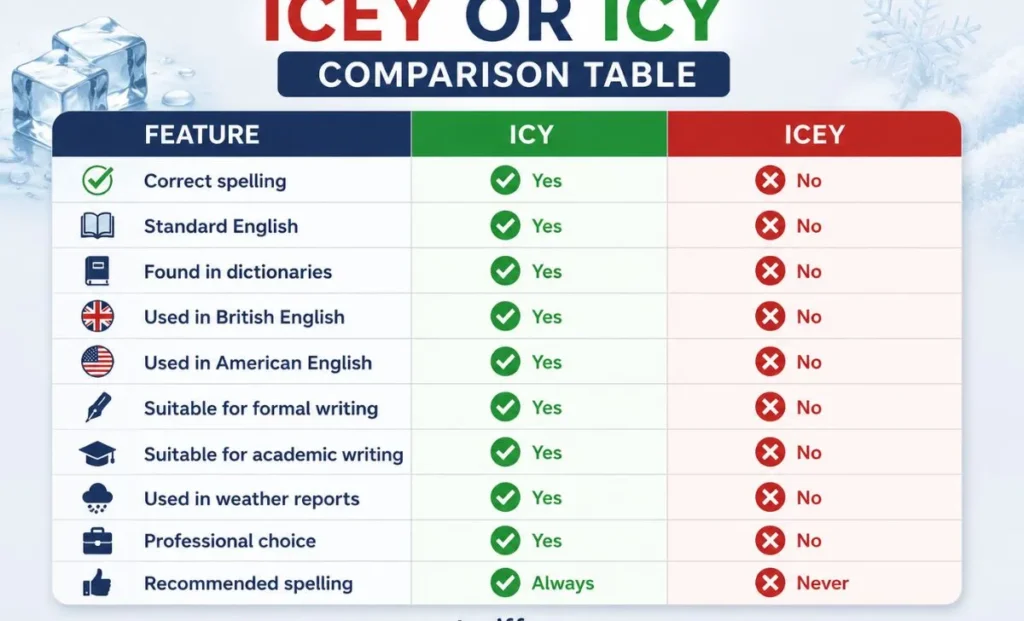
Icey or Icy Comparison Table
FAQs
1. Is icey a real word?
No. Icey is not the standard spelling in English. The correct word is icy.
2. Why is icy spelled without the letter e?
English spelling rules usually remove the silent e before adding the suffix -y. That is why ice becomes icy.
3. Is icey accepted in British English?
No. British English uses icy, just like American English.
4. How do you pronounce icy?
It is pronounced EYE-see (/ˈaɪ.si/).
5. What does icy mean?
Icy means covered with ice, very cold, slippery, or emotionally cold and unfriendly, depending on the context.
6. Can icy describe a person’s behavior?
Yes. It can describe someone who is distant, unfriendly, or cold.
Example: She gave him an icy response.
7. Is icy an adjective?
Yes. Icy is an adjective that describes a noun.
Example: The hikers crossed an icy path.
Conclusion
Choosing between icey or icy is easier once you know the spelling rule. Icy is the only correct spelling in standard English, while icey is simply a common misspelling.
The confusion happens because the base word ice ends with the letter e, but English spelling rules drop the silent e before adding the suffix -y.
Whether you are writing an email, school assignment, article, weather report, or social media post, always use icy. It is the spelling accepted in British English, American English, and every other major variety of English.
Remember the simple trick—drop the silent “e” before adding “-y”—and you’ll never confuse icey and icy again.
Read More Blogs:
- Immaculate or Emaculate: Avoid This Common Spelling Error
- Until or Untill: Easy Grammar Guide with Examples

Hi, I am Roy Peter Clark, and I write clear and practical grammar and writing blogs.
On Syntaxiffy.com, I focus on English grammar, style, and writing techniques to help readers improve clarity and communication.