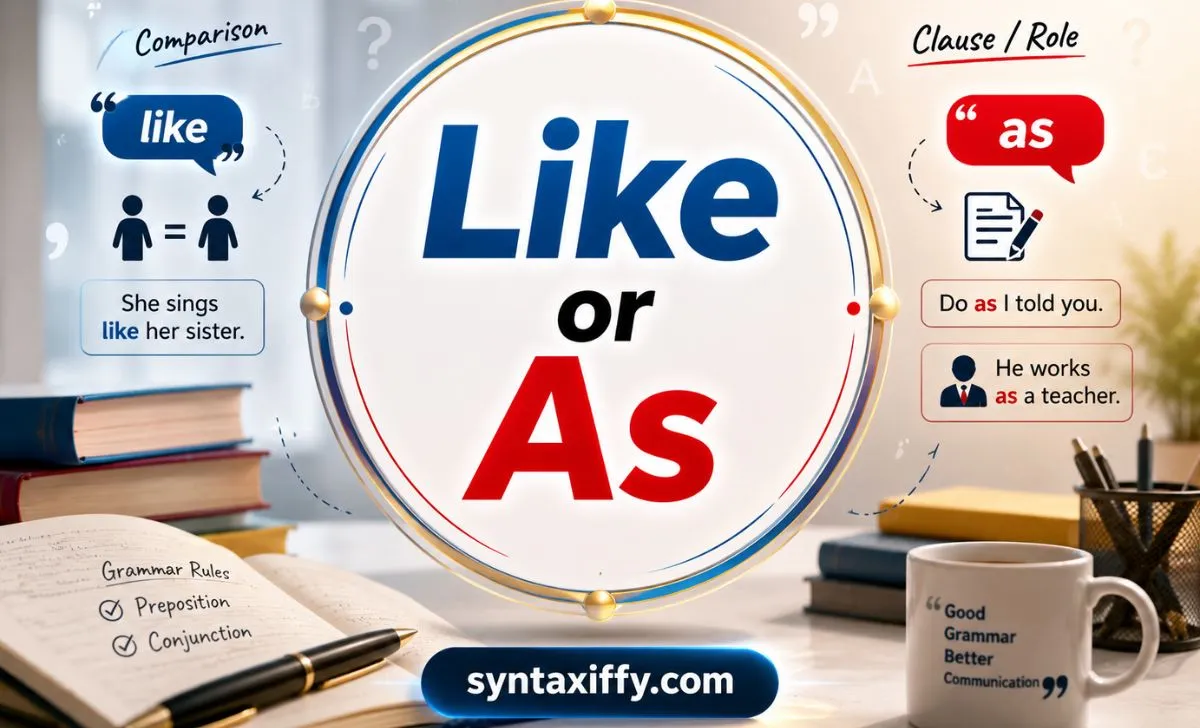
Many English learners ask whether they should use like or as because both words compare things, but they are not always interchangeable. The simple answer is this: use “like” before a noun or pronoun, and use “as” before a clause with a subject and verb or when describing a role or function.
This confusion happens because both words appear in everyday English, spoken English, academic writing, business communication, and social media. In this guide, you’ll learn the grammar rules, sentence structure, common mistakes, real-life examples, and easy tips to choose the correct word with confidence in both British English and American English.
Quick Answer
The difference between like and as depends on how they are used in a sentence.
- Like is usually a preposition. It comes before a noun or pronoun to show similarity.
- As is usually a conjunction. It introduces a clause that contains a subject and a verb. It is also used to show someone’s role or function.
Quick Examples
| Correct Usage | Explanation |
| She sings like her mother. | Like compares two people. |
| She sings as her mother taught her. | As introduces a clause. |
| He works as a teacher. | As shows a role or job. |
| It looks like rain. | Like comes before a noun. |
Simple Rule
- Use like before a noun or pronoun.
- Use as before a clause (subject + verb).
- Use as when talking about someone’s job, role, or purpose.
Examples in Different Contexts
Everyday English
- You look like your brother.
- Do it as I showed you.
Academic Writing
- The results were as researchers expected.
- The pattern looks like previous studies.
Business Writing
- Please complete the report as instructed.
- The new logo looks like the old one.
Using the correct word improves your writing skills, communication skills, and overall English grammar, especially in formal writing and professional communication.
The Origin of Like or As
The words like and as have different histories, which helps explain why they serve different purposes in English grammar today.
Origin of Like
The word like comes from the Old English word gelīc, meaning similar or having the same form. For hundreds of years, it has mainly been used as a preposition to compare people, objects, or ideas.
Examples:
- This painting looks like the original.
- Your handwriting is like mine.
Over time, native English speakers also began using like in informal speech, making it one of the most common words in everyday conversation.
Origin of As
The word as comes from Old English ealswā, meaning in the same way or to the same degree. Unlike like, it became an important conjunction that connects clauses and explains how something happens.
Examples:
- Do as I say.
- Everything happened as we expected.
It also developed another important meaning: describing a person’s role or function.
Examples:
- She works as a doctor.
- He served as team captain.
Why Do People Confuse Them?
The confusion exists because both words often express comparison. In casual conversation, many native speakers sometimes use like where formal grammar prefers as. This has made the distinction less obvious, especially for ESL learners, EFL learners, students, and content writers.
Understanding the difference between a phrase and a clause, along with the roles of a preposition and a conjunction, makes choosing the correct word much easier in both spoken and written English.
British English vs American English Usage
Unlike many confusing words, like and as are spelled the same in both British English and American English. There is no spelling difference. The real difference is how often each word is used in formal and informal English.
In everyday conversation, especially in American English, people sometimes use like where traditional grammar recommends as. In formal writing, however, both British and American style guides still encourage using each word according to its grammar function.
Comparison Table
| Feature | British English | American English |
| Spelling of like | Like | Like |
| Spelling of as | As | As |
| Formal grammar | Follows traditional grammar rules | Follows traditional grammar rules |
| Informal speech | Sometimes uses like instead of as | More likely to use like in casual conversation |
| Academic writing | Prefers as before a clause | Prefers as before a clause |
| Business writing | Uses standard grammar | Uses standard grammar |
Examples
| Correct Sentence | Why It Is Correct |
| She looks like her mother. | Like comes before a noun. |
| She dances as her mother taught her. | As introduces a clause. |
| He works as an engineer. | As shows a role or profession. |
| It sounds like a great idea. | Like compares two things. |
Whether you write for a UK audience, a US audience, or an international audience, following these grammar rules makes your writing clearer and more professional.
Pronunciation of Like or As
Although like and as have different meanings and grammar functions, their pronunciation is simple. The confusion is not caused by how they sound. Instead, people mix them up because both words are often used to compare things.
| Word | IPA Pronunciation | Sounds Like |
| Like | /laɪk/ | “lyke” |
| As | /æz/ | “az” |
How They Sound
- Like rhymes with bike, hike, and strike.
- As sounds similar to the beginning of ask, but without the final k sound.
Spoken English Examples
- She looks like her sister.
- Please do it as I explained.
- It feels like summer.
- Everything happened as planned.
Because both words are short and common, native speakers say them quickly in everyday conversation. Listening to English podcasts, news reports, or classroom lessons can help English learners recognize when each word is used.
Remember, pronunciation is rarely the problem. The real challenge is understanding sentence structure, knowing the difference between a phrase and a clause, and applying the correct grammar rule.
Why People Confuse Like or As
Many people confuse like and as because both words express comparison. At first glance, they seem to mean the same thing, but they have different jobs in English grammar.
Here are the main reasons for the confusion.
1. Both Compare Things
Both words can show similarity.
Examples
- She looks like her mother.
- She sings as her mother sings.
Since both sentences compare people, learners often think the words are interchangeable.
2. Informal Speech Changes the Rules
In casual conversation, many native English speakers use like before clauses.
Example:
- Like I said before…
In formal English, this is usually written as:
- As I said before.
This difference between spoken English and formal writing often confuses students.
3. Grammar Functions Are Different
The biggest difference is grammatical.
- Like is mainly a preposition followed by a noun or pronoun.
- As is mainly a conjunction followed by a clause containing a subject and verb.
Learning this rule makes choosing the correct word much easier.
4. Both Appear in Many Types of Writing
You will see like and as in:
- Academic writing
- Essay writing
- Business communication
- Professional emails
- News articles
- Social media posts
- Creative writing
- Everyday conversations
Because both words appear almost everywhere, writers sometimes copy incorrect usage without noticing.
5. Translation from Other Languages
Many ESL learners and EFL learners come from languages that use only one word for comparison. When translating into English, they naturally use the same word in every situation, creating common grammar mistakes.
The good news is that once you remember one simple rule—like + noun/pronoun and as + clause or role—most of the confusion disappears, and your writing becomes clearer, more accurate, and more professional.
Which Should You Use?
The correct choice between like and as depends on your sentence structure, your audience, and the type of writing. Neither word is better than the other—they simply have different grammar functions.
Use Like When:
- You compare two people or things.
- It comes before a noun or pronoun.
- You are describing similarity.
Examples
- She runs like a professional athlete.
- This fabric feels like silk.
- Your handwriting looks like mine.
- The sky looks like a painting.
Use As When:
- It introduces a clause with a subject and verb.
- It describes someone’s role, job, or function.
- You are writing formal or academic content.
Examples
- Do as I instructed.
- She works as a project manager.
- Everything happened as we expected.
- Please complete the assignment as explained.
Which Is Best for Different Audiences?
| Audience | Recommended Choice |
| Students | Follow standard grammar rules. |
| Academic writing | Use like before nouns and as before clauses. |
| Business writing | Follow the same grammar rule for professional communication. |
| Emails | Use the correct word based on sentence structure. |
| Blog writing | Prefer standard English for better readability. |
| Creative writing | Informal dialogue may use like, but narration should follow grammar rules. |
| Social media | Casual usage is common, but correct grammar improves credibility. |
| Global audience | Standard English grammar is the safest choice. |
Whether you write in British English or American English, using the correct word makes your writing skills, communication skills, and overall English usage much stronger.
Common Mistakes with Like or As
Many writers make the same mistakes because both words express comparison. Here are the most common errors and how to fix them.
| Incorrect | Correct | Why? |
| Like I said yesterday… | As I said yesterday… | As introduces a clause. |
| Do like I do. | Do as I do. | A clause follows. |
| He works like a teacher. | He works as a teacher. | As shows a role or profession. |
| She looks as her sister. | She looks like her sister. | Like comes before a noun. |
| It sounds as good news. | It sounds like good news. | Like compares with a noun phrase. |
| They acted like we expected. | They acted as we expected. | As introduces a clause. |
Tips to Avoid These Mistakes
- Check whether a noun or a clause comes after the word.
- Remember that like is usually a preposition.
- Remember that as is usually a conjunction.
- In formal writing, avoid replacing as with like before a clause.
- Proofread your emails, reports, and essays before submitting them.
Following these simple rules helps improve editing, proofreading, and overall grammar accuracy.
Like or As in Everyday Examples
Understanding grammar is easier when you see real-life examples. Here is how like and as appear in different situations.
Emails
- Please complete the form as instructed.
- Your signature looks like the previous version.
Business Communication
- She joined the company as a marketing manager.
- This proposal reads like the original draft.
Academic Writing
- The experiment produced results as researchers predicted.
- The graph looks like last year’s report.
News Writing
- The event unfolded as expected.
- The new stadium looks like a modern landmark.
Social Media
- This sunset looks like a painting!
- Try the recipe as shown in the video.
Everyday Conversation
- You sound like your father.
- Do it as I showed you yesterday.
- It feels like summer already.
- Everything happened as planned.
Using the correct word in these everyday situations makes your written English and spoken English clearer, more natural, and more professional.
Easy Trick to Remember Like or As
A simple memory trick can help you choose the correct word every time.
The “Noun or Clause?” Rule
Ask yourself one question:
What comes next?
- If the next words are a noun or pronoun, use like.
- If the next words include a subject and a verb, use as.
Easy Formula
✅ Like + Noun/Pronoun
- Like my friend
- Like the teacher
- Like her
- Like this movie
✅ As + Subject + Verb
- As I expected
- As she explained
- As they promised
- As we discussed
Another Memory Trick
Think of this sentence:
Like compares. As connects.
- Like compares people or things.
- As connects a complete idea (a clause) or shows someone’s role.
If you remember these two short rules, you’ll avoid one of the most common English grammar mistakes and write with greater confidence in school, at work, and in everyday communication.
Like or As – Google Trends & Usage Data
The keyword like or as is searched throughout the year because it is one of the most common topics in English grammar. Students, ESL learners, teachers, bloggers, and professional writers often search for it when they want to improve their writing skills and avoid common grammar mistakes.
People usually search this topic before:
- School or college assignments
- English grammar exams
- IELTS, TOEFL, and PTE preparation
- Writing business emails
- Editing blog posts
- Proofreading reports
- Improving spoken and written English
Where Is It Most Popular?
| Country/Region | Common Search Intent |
| United States | Difference between like and as |
| United Kingdom | Formal grammar rules and writing style |
| Canada | Correct usage in academic writing |
| Australia | Everyday English and business communication |
| India | English learning and competitive exams |
| Pakistan | Grammar practice and spoken English |
| Philippines | ESL learning and classroom English |
Where Is It Commonly Used?
| Context | Usage |
| Academic Writing | Very common |
| Business Writing | Very common |
| Professional Emails | Common |
| News Writing | Common |
| Blog Writing | Common |
| Social Media | Common, often informal |
| Everyday Conversation | Extremely common |
Although informal speech sometimes bends the rules, standard English grammar recommends using like and as according to their grammatical functions. This improves clarity in both British English and American English.
Like or As Comparison Table
| Feature | Like | As |
| Part of Speech | Usually a Preposition | Usually a Conjunction |
| Main Purpose | Shows similarity | Introduces a clause or shows a role |
| Followed By | Noun or Pronoun | Subject + Verb (Clause) |
| Formal Writing | Yes | Yes |
| Informal Speech | Very common | Very common |
| Academic Writing | Used before nouns | Preferred before clauses |
| Business Communication | Used for comparisons | Used for instructions and job roles |
| Example | She looks like her sister. | Do as I told you. |
| Role Example | ❌ He works like a doctor. | ✅ He works as a doctor. |
| Grammar Rule | Compare things | Connect ideas or describe a role |
FAQs
1. What is the main difference between like and as?
The main difference is grammar. Like is usually followed by a noun or pronoun, while as is followed by a clause with a subject and verb or is used to describe someone’s role.
2. Can I use like instead of as?
In casual conversation, many people do. However, in formal writing, academic writing, and business communication, it is better to follow standard grammar rules and use as before a clause.
3. Is “Like I said” grammatically correct?
It is common in spoken English, but many grammar guides recommend “As I said” in formal writing because a clause follows.
4. When should I use as to describe a job?
Use as when talking about someone’s role or profession.
Example:
- She works as a lawyer.
- He served as team captain.
5. Is there any spelling difference between British and American English?
No. Both British English and American English spell like and as exactly the same. The difference is mainly in usage and writing style.
6. Why do English learners confuse like and as?
Many ESL and EFL learners confuse them because both express comparison. Learning the difference between a phrase and a clause makes the choice much easier.
7. How can I remember the correct usage?
Remember this simple rule:
- Like + noun
- As + clause or role
This works in almost every situation.
Conclusion
Choosing between like and as becomes easy once you understand their grammar functions. Use like before a noun or pronoun when making a comparison, and use as before a clause or when describing a person’s role or function. While casual conversation may sometimes blur the distinction, following standard English grammar will improve your academic writing, business communication, emails, essays, and everyday writing.
Keep the simple rule in mind—like compares, as connects—and you’ll write more naturally, confidently, and accurately in both British English and American English.
Read More Blogs:

Hi, I am Mary Norris, and I write clear and insightful grammar blogs on Syntaxiffy.com.
On Syntaxiffy.com, I focus on English grammar, usage, and writing accuracy to help readers improve their language skills.