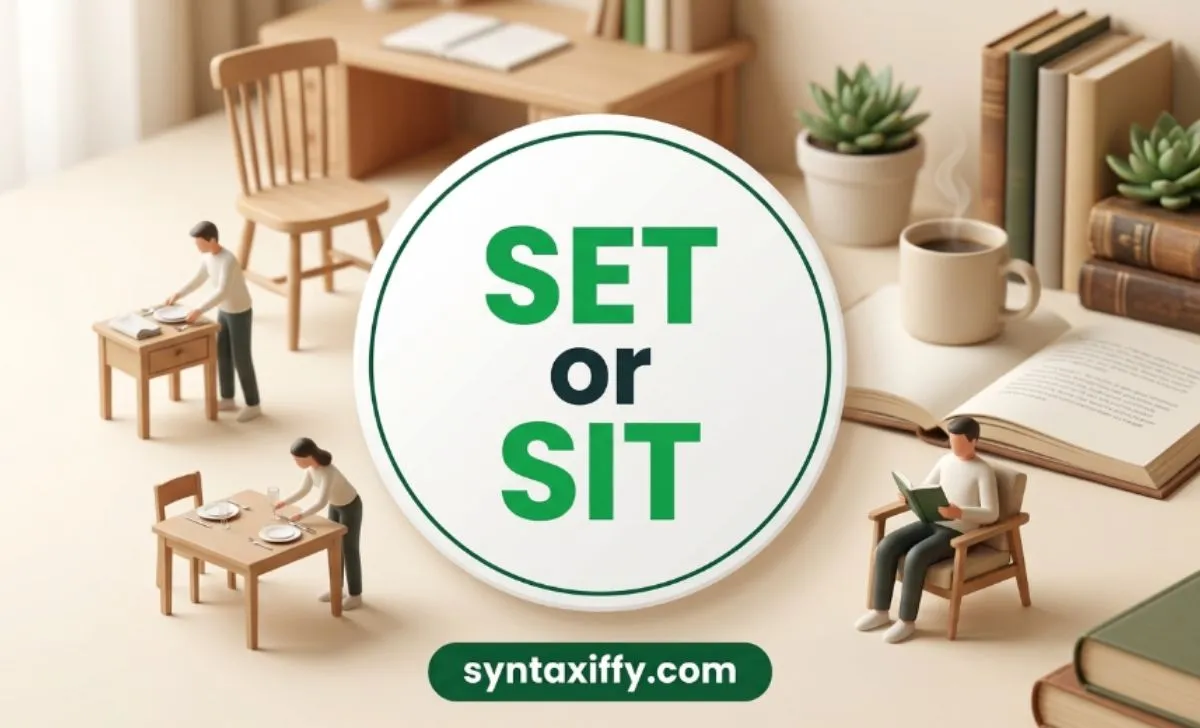
Many English learners wonder whether they should use set or sit. The short answer is that both words are correct, but they have different meanings and uses. Sit means to rest your body in a seated position, while set usually means to place something somewhere.
People often confuse these verbs because they sound similar and are related to position and movement. This guide explains the difference between set or sit in simple English, with clear examples, pronunciation tips, comparison tables, common mistakes, and practical advice for academic writing, business communication, emails, social media, and everyday conversations.
Set or Sit – Quick Answer
Both set and sit are correct English verbs, but they are not interchangeable.
| Word | Meaning | Example |
| Set | To put or place something in a particular position | Please set the book on the table. |
| Sit | To rest your body on a chair, seat, or surface | Please sit here. |
Quick examples:
- ✅ Sit on the chair.
- ✅ Set the chair by the window.
- ✅ She sat quietly during the meeting.
- ✅ He set his laptop on the desk.
Understanding whether the action is done by a person sitting or by placing an object will help you choose the correct word.
The Origin of Set or Sit
The verbs set and sit have different histories in the English language, although both come from ancient Germanic roots.
- Sit comes from the Old English word sittan, meaning “to occupy a seat” or “remain seated.”
- Set comes from the Old English word settan, meaning “to place, put, or arrange.”
Because the words developed from related roots, they look and sound somewhat alike. Over time, each verb gained its own grammar rules and meanings.
Today:
- Sit describes the action of a person or animal being seated.
- Set describes placing, arranging, or positioning someone or something.
Although their origins are connected, modern English grammar treats them as separate verbs with different purposes.
British English vs American English Spelling
Unlike many English words, set and sit have the same spelling in both British English and American English. There are no regional spelling differences between these verbs.
The only differences you may notice are in vocabulary choices or expressions—not in the spelling of the words themselves. Whether you’re writing for the UK, the US, Canada, Australia, or another English-speaking country, you should spell these words exactly the same.
Comparison Table
| Feature | British English | American English |
| Set spelling | Set ✅ | Set ✅ |
| Sit spelling | Sit ✅ | Sit ✅ |
| Pronunciation | Nearly identical | Nearly identical |
| Meaning | Same | Same |
| Grammar rules | Same | Same |
| Everyday usage | Common | Common |
Examples
| British English | American English |
| Please sit down. | Please sit down. |
| She set the plates on the table. | She set the plates on the table. |
| The teacher asked everyone to sit quietly. | The teacher asked everyone to sit quietly. |
| He carefully set his phone beside the computer. | He carefully set his phone beside the computer. |
Whether you’re writing an email, academic paper, business report, or social media post, you can confidently use set and sit with the same spelling in every major variety of English.
Pronunciation of Set or Sit
Although set and sit differ by only one vowel sound, they are pronounced differently. This small difference is one reason many English learners confuse them in conversation.
| Word | IPA | Sounds Like |
| Set | /set/ | “SET” (rhymes with pet) |
| Sit | /sɪt/ | “SIT” (rhymes with hit) |
How to Hear the Difference
- Set uses the short e sound, as in bed, pen, and red.
- Sit uses the short i sound, as in big, fish, and win.
Practice Sentences
- Please set the cup on the table.
- Please sit beside me.
- She set the alarm before sleeping.
- They sit together every morning.
- He set the laptop on his desk.
- The children sit quietly during class.
Common Pronunciation Confusion
Many ESL learners pronounce both words the same because the /e/ and /ɪ/ vowel sounds can be difficult to distinguish. Listening to native speakers and repeating minimal pairs such as set–sit, pen–pin, and bed–bid can improve pronunciation and speaking confidence.
These pronunciation differences are small, but using the correct sound helps your communication skills become clearer and more natural.
Why People Confuse Set or Sit
Many English learners confuse set and sit because the words look similar, sound alike, and both relate to position or movement. However, they describe different actions and follow different grammar rules.
Here are the main reasons for the confusion:
- Similar spelling: Only one letter changes (e vs. i).
- Similar pronunciation: The words have nearly identical sounds, making them easy to mix up in conversation.
- Related meanings: Both involve position, but sit refers to a person or animal taking a seat, while set means placing or arranging something.
- Irregular verb forms: The past tense of sit is sat, while set remains set in the present, past, and past participle.
- Translation issues: In some languages, a single verb may cover both meanings, leading learners to use the wrong English verb.
- Fast speech: Native speakers often pronounce the words quickly, making the vowel difference difficult to hear.
Quick Comparison
| Situation | Correct Word | Example |
| Taking a seat | Sit | Please sit here. |
| Placing an object | Set | Please set the box on the shelf. |
| A dog lowering itself | Sit | The dog sat by the door. |
| Putting dishes on a table | Set | She set the plates on the table. |
Remember this simple rule:
- Sit = You move yourself into a seated position.
- Set = You place something somewhere.
This distinction improves writing skills, academic writing, business communication, and everyday English usage.
Which Spelling Should You Use?
Choosing between set and sit is not about British English versus American English. The spelling is identical in every major variety of English. Instead, the correct choice depends entirely on the meaning you want to express.
Use sit when someone or something takes a seated position.
Examples:
- Please sit beside me.
- The students sit quietly during the exam.
- We usually sit near the front of the classroom.
Use set when placing, arranging, or positioning an object.
Examples:
- Please set your phone on the desk.
- She set the flowers in a vase.
- The chef set the plates on the table.
Audience-Based Advice
| Audience | Recommendation |
| Students | Learn the meaning before memorizing the word. |
| ESL learners | Focus on whether someone is sitting or placing something. |
| Academic writers | Choose the verb that matches the action exactly. |
| Business professionals | Use the correct verb in emails and reports to avoid confusion. |
| Content writers | Double-check the context during proofreading and editing. |
Quick Decision Guide
| If you mean… | Use |
| Take a seat | Sit |
| Be seated | Sit |
| Place an object | Set |
| Arrange something | Set |
| Put something somewhere | Set |
Whenever you’re unsure, ask yourself this question:
Is someone sitting down, or is someone placing something?
If someone is taking a seat, use sit. If an object is being placed or arranged, use set. This simple habit will help you make the correct choice in formal writing, emails, professional communication, and everyday conversations.
Common Mistakes with Set or Sit
Because set and sit are both common verbs in the English language, learners often use one when they mean the other. Understanding these mistakes can improve your grammar, writing skills, and communication.
Frequent Errors and Corrections
| Incorrect Sentence | Correct Sentence | Why? |
| ❌ Set down on the chair. | ✅ Sit down on the chair. | A person takes a seat, so use sit. |
| ❌ Sit the book on the table. | ✅ Set the book on the table. | You set an object in a place. |
| ❌ I will set beside you. | ✅ I will sit beside you. | Use sit when talking about yourself taking a seat. |
| ❌ She sat the keys on the desk. | ✅ She set the keys on the desk. | Keys are objects that are set, not sat. |
| ❌ Please set here. | ✅ Please sit here. | Use sit when inviting someone to take a seat. |
| ❌ He sit the bag on the floor. | ✅ He set the bag on the floor. | The bag is being placed somewhere. |
Tips to Avoid Mistakes
- Think about who or what is moving.
- If a person or animal is taking a seat, use sit.
- If an object is being placed somewhere, use set.
- During proofreading and editing, check whether the verb matches the action.
- Read your sentence aloud to see if it sounds natural.
Set or Sit in Everyday Examples
Knowing the difference between set and sit becomes much easier when you see them in real-life situations.
Emails
- Please set the documents on my desk before lunch.
- You may sit anywhere during the meeting.
News
- Officials set new safety standards for public buildings.
- Protesters sat peacefully outside the government office.
Social Media
- I just set up my new workspace!
- Time to sit back and enjoy the weekend.
Academic Writing
- Researchers set clear objectives before starting the experiment.
- Students should sit quietly during the examination.
Business Communication
- Please set the presentation materials in the conference room.
- Everyone should sit before the meeting begins.
Everyday Conversation
- Can I sit next to you?
- Please set your groceries on the kitchen counter.
- The cat likes to sit by the window.
- Dad set the toolbox in the garage.
These examples show that the correct verb depends on the context, not on spelling or pronunciation. Choosing the right word makes your formal writing, content writing, emails, and everyday conversations more accurate and professional.
Easy Trick to Remember Set or Sit
A simple memory trick can help you remember the difference forever.
Memory Trick
Sit = Self
Both words start with the letter S.
- Sit → Self sits.
- Set → Set something somewhere.
Another easy way to remember:
- Sit = Person or animal takes a seat.
- Set = Place an object in a position.
Quick Examples
- I sit on a chair. ✅
- I set my phone on the table. ✅
- The dog sits by the door. ✅
- She sets the dishes on the table. ✅
Whenever you’re unsure, ask yourself:
Am I talking about a person sitting or an object being placed?
If it’s a person or animal, choose sit.
If it’s an object, choose set.
This easy rule works in English grammar, academic writing, professional communication, emails, and everyday conversations, helping you avoid one of the most common verb mistakes.
FAQs
Is it correct to say “set or sit”?
Yes. Both set and sit are correct English words, but they have different meanings. Sit means to take a seat, while set means to place or arrange something.
What is the main difference between set and sit?
The main difference is the action. Sit describes a person or animal taking a seat. Set describes placing an object in a specific position.
Is “set” a transitive verb?
Yes. Set is usually a transitive verb, meaning it normally takes an object.
Example: She set the book on the shelf.
Is “sit” an intransitive verb?
Yes. Sit is usually an intransitive verb because it describes what the subject does without needing a direct object.
Example: The children sit quietly.
What is the past tense of set and sit?
- Set → Set
- Sit → Sat
Examples:
- He set the alarm before bed.
- She sat by the window.
Can set and sit be used interchangeably?
No. They have different meanings and grammar rules. Replacing one with the other will usually make a sentence incorrect.
How can I remember the difference between set and sit?
Remember this simple rule:
- Sit = You sit yourself.
- Set = You set something somewhere.
This trick makes choosing the correct verb much easier.
Conclusion
Understanding the difference between set or sit is simple once you focus on the action. Use sit when a person or animal takes a seat, and use set when placing or arranging an object. Although the words look and sound similar, they follow different grammar rules and are used in different contexts.
Learning this distinction will improve your English grammar, writing skills, academic writing, business communication, and everyday conversations. Whenever you’re unsure, ask yourself whether someone is taking a seat or placing something. This quick check will help you choose the correct word with confidence every time.
Read More Blogs:

Hi, I am Bill Walsh, and I write clear and practical grammar blogs on Syntaxiffy.com.
I focus on English grammar, pair of words, and spelling differences to help readers improve their writing skills.