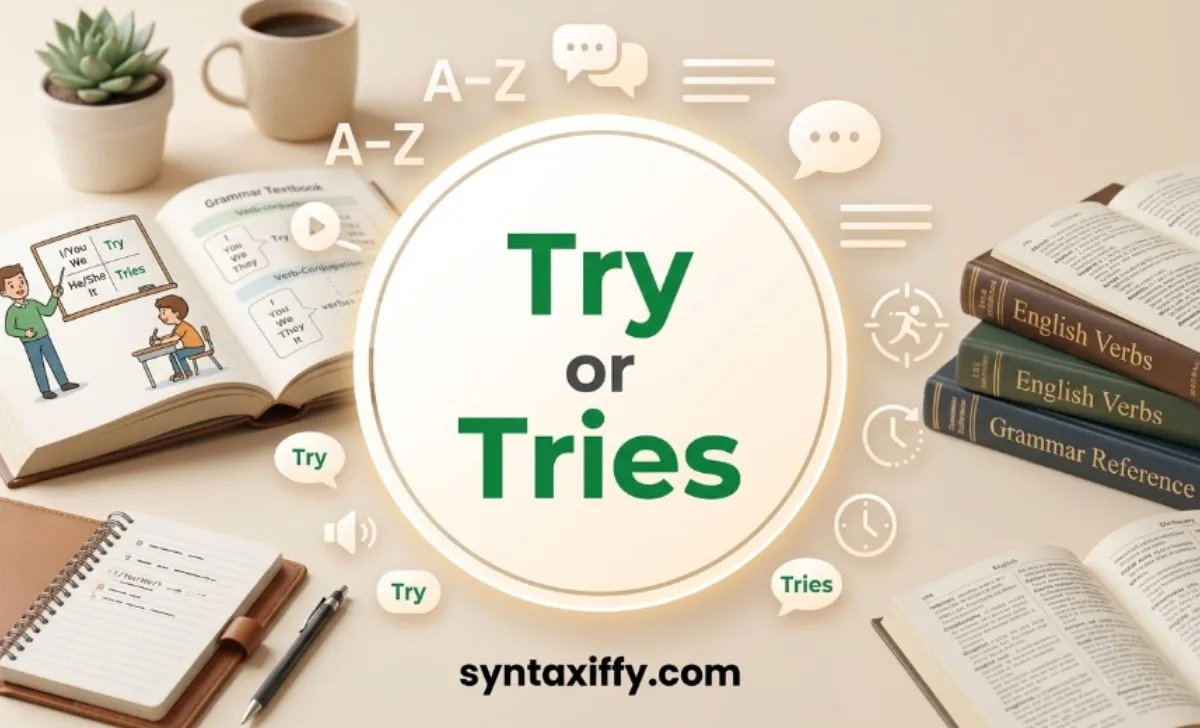
Try or tries is a common English grammar question. The correct word depends on the subject of the sentence. Try is the base form of the verb and is used with I, you, we, they, and plural nouns. Tries is the third-person singular form used with he, she, it, and singular nouns in the simple present tense.
Many English learners, students, and writers confuse these two verb forms because they both come from the same action verb. Understanding subject-verb agreement, verb conjugation, and present tense grammar rules makes choosing the correct form easy.
This guide explains the difference between try and tries, shows when to use each one, covers common mistakes, pronunciation, usage in academic writing, business writing, emails, social media, and everyday English, and answers the most common questions with clear examples.
Quick Answer
The choice between try and tries depends on the subject of the sentence.
| Subject | Correct Verb | Example |
| I | Try | I try my best every day. |
| You | Try | You try too hard sometimes. |
| We | Try | We try to finish early. |
| They | Try | They try new ideas often. |
| He | Tries | He tries to help everyone. |
| She | Tries | She tries every morning. |
| It | Tries | It tries to connect again. |
| Singular noun | Tries | The student tries hard. |
| Plural noun | Try | The students try hard. |
Here is the basic grammar rule:
- Use try with first person, second person, and plural subjects.
- Use tries with a third-person singular subject in the simple present tense.
- Try is the base form of the verb.
- Tries is the conjugated verb form created by changing try → tries.
Correct Examples
- I try to improve my English every day.
- You try your best in every class.
- We try new learning methods.
- They try different solutions.
- He tries to answer every question.
- She tries to write clearly.
- It tries to restart automatically.
- My brother tries every weekend.
- The children try again after failing.
These examples show proper subject-verb agreement, one of the most important English grammar rules.
The Origin of Try or Tries
The word try has been part of the English language for hundreds of years. It comes from the Anglo-French word trier, meaning to test, examine, or separate. Over time, English adopted the word, and it became a common action verb used in both spoken English and written English.
As English grammar developed, verbs began changing their forms depending on the person and number of the subject. This process is known as verb conjugation or verb inflection.
The base verb remained try, while the third-person singular form became tries.
For verbs ending in a consonant + y, English follows a regular spelling rule:
- Remove y
- Add ies
Examples include:
| Base Verb | Third-Person Singular |
| Try | Tries |
| Cry | Cries |
| Carry | Carries |
| Study | Studies |
| Fly | Flies |
This spelling change is part of standard English grammar and applies in both British English and American English.
Although try and tries look different, they have the same meaning. The only difference is their grammatical role within the sentence.
Understanding this rule helps improve:
- English writing
- Academic writing
- Professional writing
- Business communication
- Creative writing
- Grammar practice
- Proofreading
- Editing
- Language learning
Once you recognize the subject of the sentence, choosing between try and tries becomes simple and natural.
British English vs American English Spelling
Unlike many English words, try and tries have the same spelling in both British English and American English. There is no regional variation. Whether you are writing for the United States, the United Kingdom, Canada, Australia, New Zealand, or other English-speaking countries, the grammar rule remains exactly the same.
The only thing that changes is the subject of the sentence—not the spelling.
For example:
| Subject | British English | American English |
| I | I try every day. | I try every day. |
| You | You try your best. | You try your best. |
| We | We try to help. | We try to help. |
| They | They try again. | They try again. |
| He | He tries every week. | He tries every week. |
| She | She tries every morning. | She tries every morning. |
| It | It tries to connect. | It tries to connect. |
Comparison Table
| Feature | British English | American English |
| Base verb | Try | Try |
| Third-person singular | Tries | Tries |
| Grammar rule | Same | Same |
| Pronunciation | Same | Same |
| Everyday usage | Same | Same |
| Formal writing | Same | Same |
| Academic writing | Same | Same |
Unlike spelling pairs such as colour/color or traveller/traveler, try and tries do not change between English varieties. The difference is purely a matter of verb conjugation and subject-verb agreement.
Pronunciation of Try or Tries
Although the spelling changes, the pronunciation stays very similar.
| Word | IPA | Simple Pronunciation |
| Try | /traɪ/ | try |
| Tries | /traɪz/ | tryz |
The only extra sound in tries is the /z/ sound at the end.
Examples:
- Try your best.
- He tries every day.
Say them aloud:
- Try → traɪ
- Tries → traɪz
Many English learners understand the difference when reading but miss the final z sound while speaking. Paying attention to this ending helps improve both spoken English and communication skills.
Pronunciation Tips
- Say try with one clear syllable.
- Add a soft z sound to say tries.
- Do not pronounce tries as try-es.
- Listen to native speakers and repeat the words in complete sentences.
Good pronunciation also makes your spoken English sound more natural in conversations, presentations, and interviews.
Why People Confuse Try or Tries
Many learners mix up try and tries because both words come from the same verb and have the same meaning. The confusion is grammatical rather than spelling-related.
Here are the main reasons people make this mistake.
1. They Forget Subject-Verb Agreement
The most common error is ignoring the subject.
❌ He try every day.
✅ He tries every day.
The verb must agree with the singular subject.
2. They Use the Base Verb Everywhere
Some learners use the base form of the verb with every subject.
Incorrect:
- She try.
- My friend try.
- The teacher try.
Correct:
- She tries.
- My friend tries.
- The teacher tries.
3. They Confuse Singular and Plural Subjects
Many writers focus on the verb instead of identifying whether the subject is singular or plural.
| Subject | Correct Form |
| The student | Tries |
| The students | Try |
| My brother | Tries |
| My brothers | Try |
Finding the subject first makes choosing the correct verb much easier.
4. They Forget the “-y to -ies” Rule
When a verb ends in a consonant + y, English changes y to ies for the third-person singular.
Examples:
- Try → Tries
- Study → Studies
- Carry → Carries
- Cry → Cries
Learning this pattern helps with many verb forms, not just try.
5. Speaking Can Hide the Difference
In fast conversations, try and tries sound very similar. Because of this, many people repeat what they hear without noticing the grammar.
This is common among:
- English learners
- ESL students
- EFL students
- Beginner writers
- Children learning grammar
Reading complete sentences and practicing grammar exercises helps build the correct habit.
6. They Translate Directly from Their Native Language
Some languages do not change verbs based on the subject. Learners who translate directly into English often write:
- He try
- She try
Instead of:
- He tries
- She tries
Understanding English verb conjugation instead of translating word for word leads to more accurate written English, academic writing, and professional communication.
Which Spelling Should You Use?
The good news is that you do not have to choose between British and American spelling for try and tries. Both English varieties use the same forms. Your choice depends only on the subject in the sentence.
Follow these simple rules:
- Use try with I, you, we, they, and plural nouns.
- Use tries with he, she, it, and singular nouns.
- Keep the same rule in formal writing, informal writing, academic writing, business writing, and creative writing.
Quick Guide
| If your subject is… | Use | Example |
| I | Try | I try to stay positive. |
| You | Try | You try every day. |
| We | Try | We try new ideas. |
| They | Try | They try to solve the problem. |
| He | Tries | He tries to learn faster. |
| She | Tries | She tries her best. |
| It | Tries | It tries to reconnect. |
| Singular noun | Tries | The player tries again. |
| Plural noun | Try | The players try again. |
Whether you are writing an essay, email, report, assignment, or blog post, this rule never changes.
Common Mistakes with Try or Tries
Many grammar mistakes happen because writers forget subject-verb agreement. Here are some of the most common errors and their corrections.
| Incorrect | Correct | Why? |
| He try every day. | He tries every day. | Singular subject takes tries. |
| She try to help. | She tries to help. | Third-person singular rule. |
| The dog try to escape. | The dog tries to escape. | Singular noun needs tries. |
| They tries every weekend. | They try every weekend. | Plural subject uses try. |
| We tries our best. | We try our best. | First-person plural uses try. |
| My friends tries hard. | My friends try hard. | Plural noun takes try. |
| I tries every morning. | I try every morning. | First person uses the base form. |
| The teachers tries new methods. | The teachers try new methods. | Plural subject uses try. |
Tips to Avoid These Mistakes
- Find the subject before choosing the verb.
- Check whether the subject is singular or plural.
- Remember that only he, she, it, and singular nouns take tries.
- Proofread your work with a grammar checker before submitting important documents.
Try or Tries in Everyday Examples
You will see try and tries in many forms of written English and spoken English. Here are examples from real-life situations.
Emails
- I try to reply within one business day.
- She tries to answer every customer email promptly.
Business Writing
- Our team tries new strategies each quarter.
- We try to improve customer satisfaction.
Academic Writing
- The researcher tries a different method.
- Students try to complete every assignment on time.
News
- The government tries to reduce inflation.
- Experts try to explain the latest findings.
Social Media
- I always try new recipes.
- He tries every fitness challenge.
Everyday Conversation
- We try to arrive early.
- My sister tries to stay organized.
- They try their best every day.
- The baby tries to walk.
- You try and learn from your mistakes.
These examples show that the correct verb form depends on the subject, not on the type of writing.
Easy Trick to Remember Try or Tries
A simple memory trick can help you choose the correct form every time.
Remember This Sentence:
“He, She, It = Tries. Everyone Else = Try.”
Think of the letter S:
- She has S.
- He and It belong to the same grammar rule.
- Their verb also gets an S sound: tries.
Examples:
- He → tries
- She → tries
- It → tries
Everyone else keeps the base verb:
- I → try
- You → try
- We → try
- They → try
The more you practice this pattern, the easier it becomes to use the correct verb form naturally.
Try or Tries – Google Trends & Usage Data
Both try and tries are common English words, but they are used in different grammatical situations.
The word try appears much more often because it is:
- The base form of the verb.
- Used with I, you, we, they, and plural nouns.
- Found in dictionaries, grammar books, learning materials, and verb lists.
The word tries is also widely used because it is the correct third-person singular form in the simple present tense.
Usage by Country
| Country | Common Form | Notes |
| United States | Try & Tries | Same grammar rules |
| United Kingdom | Try & Tries | No spelling difference |
| Canada | Try & Tries | Standard English usage |
| Australia | Try & Tries | Same verb forms |
| New Zealand | Try & Tries | Identical grammar rules |
| India | Try & Tries | Frequently taught in ESL classrooms |
| Pakistan | Try & Tries | Common in schools and competitive exams |
Search interest in “try or tries” usually comes from:
- English learners
- Students preparing for exams
- ESL and EFL learners
- Teachers
- Content writers
- Bloggers
- Professionals improving their writing skills
People often search for this keyword because they want to write grammatically correct emails, assignments, reports, and professional documents.
Comparison Table
| Feature | Try | Tries |
| Part of speech | Verb (base form) | Verb (third-person singular) |
| Tense | Simple present | Simple present |
| Used with | I, You, We, They, plural nouns | He, She, It, singular nouns |
| Verb form | Base form | Conjugated form |
| Subject-verb agreement | Plural/first & second person | Third-person singular |
| British English | ✔ | ✔ |
| American English | ✔ | ✔ |
| Example | They try every day. | She tries every day. |
FAQs
Is it try or tries?
Both are correct. Use try with I, you, we, they, and plural nouns. Use tries with he, she, it, and singular nouns in the simple present tense.
Why does try become tries?
English grammar changes verbs ending in a consonant + y by replacing y with ies for the third-person singular form. That is why try becomes tries.
Is tries singular or plural?
Tries is a singular verb. It is used only with he, she, it, or a singular noun.
Examples:
- She tries every day.
- The teacher tries a new method.
Can I say he try?
No. He try is grammatically incorrect in the simple present tense.
✔ Correct: He tries to learn English every day.
Do I and you use try or tries?
Always use try.
Examples:
- I try my best.
- You try to stay calm.
Are try and tries different in British and American English?
No. Both British English and American English use the same spelling and grammar rules for try and tries.
What is the base form of tries?
The base form is try. It is the form you will find in dictionaries and is used with most subjects.
Conclusion
Choosing between try and tries is simple once you understand subject-verb agreement. Try is the base form of the verb and is used with I, you, we, they, and plural nouns. Tries is the third-person singular form used with he, she, it, and singular nouns in the simple present tense. This rule is the same in British English and American English, so you do not need to worry about regional spelling differences.
Whether you are writing emails, essays, assignments, business reports, blog posts, or social media updates, using the correct verb form makes your writing clear and professional. Remember the simple rule: “He, She, It = Tries. Everyone Else = Try.” With regular grammar practice, careful proofreading, and attention to the subject, you will use these verb forms correctly every time.
Read More Blogs:

Hi, I am Roy Peter Clark, and I write clear and practical grammar and writing blogs.
On Syntaxiffy.com, I focus on English grammar, style, and writing techniques to help readers improve clarity and communication.