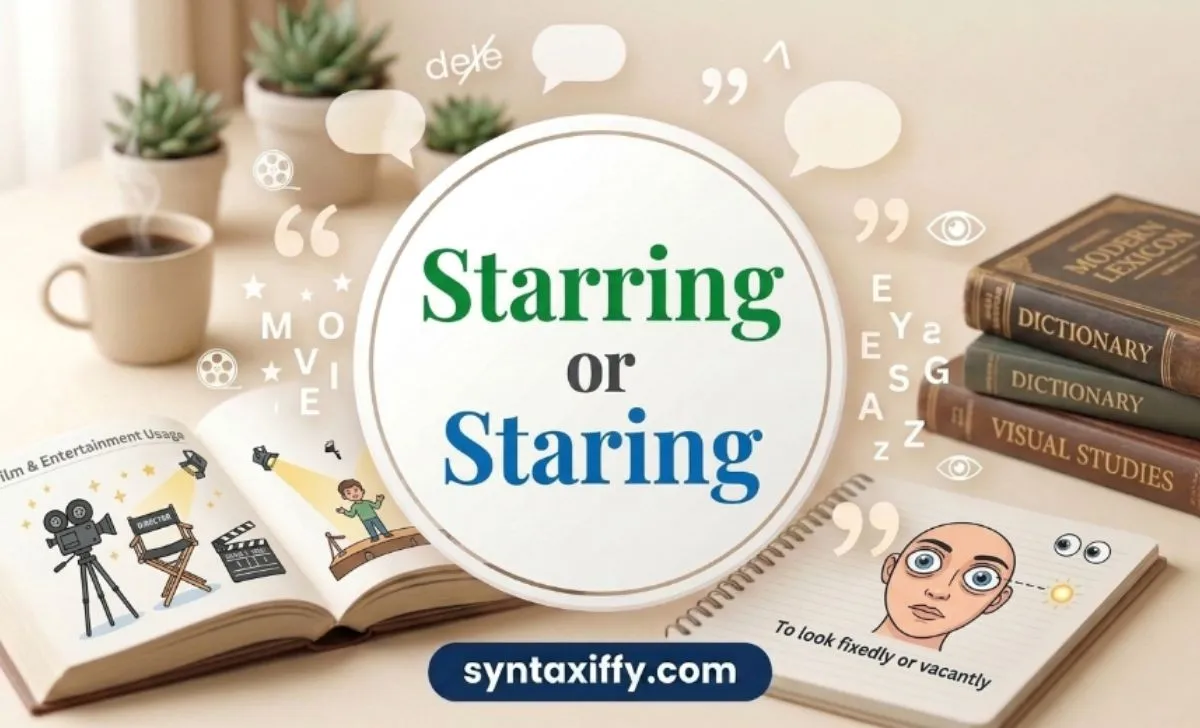
Many people confuse starring or staring because the two words look and sound similar. The quick answer is simple: starring means playing the main role in a movie, TV show, or play, while staring means looking at someone or something for a long time.
This mistake is common among native English speakers, ESL learners, and EFL learners because both words differ by just one letter. In this guide, you’ll learn their meanings, origins, pronunciation, grammar rules, British and American usage, real-life examples, and easy memory tricks so you can confidently choose the correct word in any situation.
Quick Answer
If you’re wondering whether to use starring or staring, the correct choice depends on the meaning of your sentence.
- Starring is the present participle of the verb star. It means playing the lead role or being featured in a movie, television series, theatre production, or other performance.
- Staring is the present participle of the verb stare. It means looking fixedly at someone or something for a long time.
Quick Comparison
| Word | Part of Speech | Meaning | Example |
| Starring | Present participle (Verb) | Playing the lead role or being featured | Emma Stone is starring in a new film. |
| Staring | Present participle (Verb) | Looking continuously at someone or something | He kept staring at the painting. |
Examples
✅ Tom Cruise is starring in a new action movie.
✅ She is starring in a television series.
✅ The child kept staring at the magician.
✅ Why are you staring at me?
❌ Tom Cruise is staring in a new movie.
❌ She is starring at the sky.
Whether you’re writing an email, entertainment news article, academic essay, business document, blog post, or social media caption, using the correct word improves clarity and professionalism.
The Origin of Starring or Staring
Although starring and staring are similar in spelling, they come from different verbs and have completely different meanings.
The word starring comes from the verb star, which originally referred to someone who shines like a star because of outstanding talent. As the entertainment industry grew, the word became associated with actors and actresses playing the main role in a movie, film, television series, or theatre production.
Today, starring is widely used in entertainment news and movie promotions.
Examples include:
- Starring Tom Hanks
- Starring Emma Watson
- The film is starring two award-winning actors.
- She is starring in a Broadway play.
The word staring comes from the verb stare, which has been part of English for centuries. It means looking at someone or something with fixed attention.
Examples include:
- Staring at the stars
- Staring through the window
- Staring at the teacher
- Staring into the distance
Why the confusion exists
People often confuse these words because:
- They differ by only one letter.
- Their pronunciation is similar.
- Both are present participles ending in -ing.
- They are both action verbs.
- Many writers type quickly without proofreading.
- They are among the most common confusing English words.
Knowing their origins makes the difference easy to remember:
- Star → Starring → Lead role
- Stare → Staring → Looking fixedly
British English vs American English Spelling

Good news! There is no spelling difference between British English and American English for these words.
Both English varieties use:
- Starring
- Staring
Comparison Table
| English Variety | Starring | Staring |
| British English | ✅ Starring | ✅ Staring |
| American English | ✅ Starring | ✅ Staring |
| Canadian English | ✅ Starring | ✅ Staring |
| Australian English | ✅ Starring | ✅ Staring |
The difference is not regional. It depends entirely on the meaning of your sentence.
Examples in British English
- Benedict Cumberbatch is starring in a new television drama.
- The audience was staring at the stage in silence.
Examples in American English
- Zendaya is starring in a new Hollywood movie.
- Everyone was staring at the strange object in the sky.
Whether you’re writing for readers in the United States, the United Kingdom, Canada, Australia, or anywhere else, the grammar rule remains the same:
- Use starring for actors, actresses, films, television shows, theatre, and entertainment.
- Use staring when talking about looking fixedly at someone or something.
Professional editors, grammar checkers, proofreaders, teachers, and style guides recommend these same spellings in academic writing, professional writing, business communication, content writing, creative writing, and everyday English.
Pronunciation of Starring or Staring
The words starring and staring sound similar, but they are not pronounced exactly the same. This small difference in pronunciation often causes confusion, especially for ESL learners and EFL learners.
Correct Pronunciation
- Starring → /ˈstɑːrɪŋ/ (STAR-ing)
- Staring → /ˈsteərɪŋ/ (STAIR-ing)
The difference is in the first syllable:
- Starring sounds like star.
- Staring sounds like stare.
Pronunciation Comparison
| Word | Pronunciation | Sounds Like |
| Starring | /ˈstɑːrɪŋ/ | STAR-ing |
| Staring | /ˈsteərɪŋ/ | STAIR-ing |
Example Sentences
- Tom Holland is starring in a new superhero film.
- The actress is starring alongside an award-winning actor.
- She kept staring at the beautiful painting.
- Why is everyone staring at the television?
When speaking, context usually makes the meaning clear. However, in written English, using the correct spelling is essential for accurate communication.
Why People Confuse Starring or Staring
Starring and staring are among the most frequently confused words in English because they look alike and are both verb forms ending in -ing.
Here are the main reasons people mix them up.
Similar Spelling
The only difference is one letter:
- Starring
- Staring
This makes typing mistakes very common.
Similar Pronunciation
Although their pronunciation is slightly different, many people speak quickly, making the words sound almost identical.
Both Are Present Participles
Both words are present participles and are often used in the present continuous tense.
Examples:
- She is starring in a movie.
- He is staring at the screen.
Different Meanings
The words belong to different contexts.
| Word | Meaning | Common Context |
| Starring | Playing the lead role | Movies, television, theatre, entertainment |
| Staring | Looking fixedly | Eyes, vision, attention, observation |
Lack of Proofreading
Many grammar mistakes happen because writers focus on pronunciation instead of meaning.
Using a grammar checker and proofreading your work can help you catch these errors before publishing articles, emails, reports, or social media posts.
This confusion is especially common among:
- Students
- ESL learners
- EFL learners
- Bloggers
- Content writers
- Journalists
- Professionals
Which Spelling Should You Use?
The correct spelling depends on the message you want to communicate.
Choose starring when talking about:
- Movies
- Films
- Television series
- TV shows
- Theatre performances
- Actors
- Actresses
- Main characters
- Featured performers
Choose staring when talking about:
- Looking at someone
- Looking at something
- Eye contact
- Watching continuously
- Observing carefully
Audience-Based Advice
| Audience | Recommended Usage |
| American English users | Starring and Staring |
| British English users | Starring and Staring |
| Canadian English users | Starring and Staring |
| Australian English users | Starring and Staring |
| Global English learners | Choose the word based on the sentence meaning |
There is no spelling difference between British and American English.
Instead, remember the meaning:
- Starring = Star performer
- Staring = Looking with your eyes
If you’re writing entertainment news, academic essays, professional emails, business communication, blogs, or social media posts, selecting the correct word will make your writing more accurate and natural.
Common Mistakes with Starring or Staring
Because starring and staring differ by only one letter, writers often choose the wrong word. These mistakes are common in entertainment blogs, news articles, emails, school assignments, and social media posts.
Here are some of the most frequent errors and their corrections.
| Incorrect Sentence | Correct Sentence | Why? |
| ❌ Tom Cruise is staring in a new movie. | ✅ Tom Cruise is starring in a new movie. | Starring means playing the lead role. |
| ❌ Emma is staring in a television series. | ✅ Emma is starring in a television series. | Actors and actresses star in films and TV shows. |
| ❌ He kept starring at me. | ✅ He kept staring at me. | Staring means looking fixedly. |
| ❌ The children were starring at the magician. | ✅ The children were staring at the magician. | Use staring for eye contact or observation. |
| ❌ The film is staring two famous actors. | ✅ The film is starring two famous actors. | Movies star actors. |
Tips to Avoid These Mistakes
- Think about the meaning before writing.
- If the sentence is about a movie, television show, theatre, actor, actress, or lead role, use starring.
- If the sentence is about looking with your eyes, use staring.
- Proofread your work before publishing or sending it.
- Use a grammar checker to catch spelling mistakes.
Following these simple tips will improve your writing skills, English vocabulary, and professional communication.
Starring or Staring in Everyday Examples
Both words are common in everyday English, but they are used in completely different situations.
In Emails
- Our company is sponsoring an event starring several well-known speakers.
- I noticed everyone was staring at the presentation screen.
In Entertainment News
- Zendaya is starring in an upcoming science fiction film.
- The new television series is starring two award-winning actors.
In Academic Writing
- The student kept staring at the whiteboard while solving the problem.
- The school play is starring several talented students.
On Social Media
- Can’t wait for the new movie starring my favorite actor!
- My cat keeps staring at the wall for no reason!
In Everyday Conversation
- She is starring in a local theatre production.
- They are starring together in a new TV show.
- Why are you staring at me?
- The baby kept staring at the colorful balloons.
- Everyone was staring at the beautiful sunset.
These examples show that starring belongs to the world of movies, films, television, actors, actresses, performances, and entertainment, while staring relates to eyes, vision, looking, observing, and attention.
Easy Trick to Remember Starring or Staring
A simple memory trick can help you choose the correct word every time.
Remember the Word “Star”
Starring contains the word star.
Think of:
- Movie star
- TV star
- Theatre star
- Lead star
If someone is performing as the main character, the correct word is starring.
Examples:
- Tom Hanks is starring in a new film.
- She is starring in a television drama.
Remember the Word “Stare”
Staring comes from stare, which means to look fixedly.
Think about your eyes.
Examples:
- He kept staring at the painting.
- Why are you staring at the sky?
Quick Memory Formula
- Starring = Star = Movie, Film, Actor, Actress
- Staring = Stare = Eyes, Looking, Watching
One-Question Test
Ask yourself:
“Am I talking about acting or looking?”
- Acting in a movie or TV show? → Starring
- Looking with your eyes? → Staring
This easy trick helps students, English learners, bloggers, content writers, journalists, and professionals avoid one of the most common English grammar mistakes.
Comparison Table
| Feature | Starring | Staring |
| Part of Speech | Present Participle (Verb) | Present Participle (Verb) |
| Main Meaning | Playing the lead or featured role | Looking fixedly at someone or something |
| Common Context | Movies, TV shows, theatre, entertainment | Eyes, observation, attention |
| Related To | Actor, actress, film, television | Looking, gazing, watching |
| Example | She is starring in a new movie. | He is staring at the screen. |
| British English | Same spelling | Same spelling |
| American English | Same spelling | Same spelling |
| Used in Professional Writing | ✅ Yes | ✅ Yes |
| Used in Academic Writing | ✅ Yes | ✅ Yes |
FAQs
Is it starring or staring?
Both words are correct, but they have different meanings. Starring means playing the lead role in a movie, TV show, or play, while staring means looking at someone or something for a long time.
What is the difference between starring and staring?
Starring relates to acting and entertainment. Staring relates to looking fixedly with your eyes.
Can starring be used outside movies?
Yes. It can also describe someone playing the main role in a television series, theatre production, school play, or other performance.
Why do people confuse starring and staring?
They have similar spelling, similar pronunciation, and are both present participles ending in -ing, but they have different meanings.
Are the spellings different in British and American English?
No. British English and American English use the same spellings: starring and staring.
How can I remember the correct word?
Remember:
- Starring = Star = Actor or Actress
- Staring = Stare = Looking with your eyes
This simple trick works in almost every sentence.
Can I use these words in formal writing?
Yes. Both words are standard English and are commonly used in academic writing, business communication, entertainment journalism, news articles, emails, blogs, and everyday writing.
Conclusion
Understanding the difference between starring or staring is simple once you focus on the meaning. Starring is used when someone is playing the lead or featured role in a movie, television series, theatre production, or other performance. Staring means looking fixedly at someone or something for a period of time.
Although the words look similar, they belong to different contexts and cannot replace each other. Whether you’re writing an entertainment article, business email, academic essay, or social media post, choosing the correct word will make your English clearer and more professional. Remember the easy rule: Star = Starring, Stare = Staring.
Read More Blogs:
- Accept or Except: Easy Grammar Guide with Examples
- Mind as Well or Mine as Well: What’s the Difference?

Hi, I am Mary Norris, and I write clear and insightful grammar blogs on Syntaxiffy.com.
On Syntaxiffy.com, I focus on English grammar, usage, and writing accuracy to help readers improve their language skills.