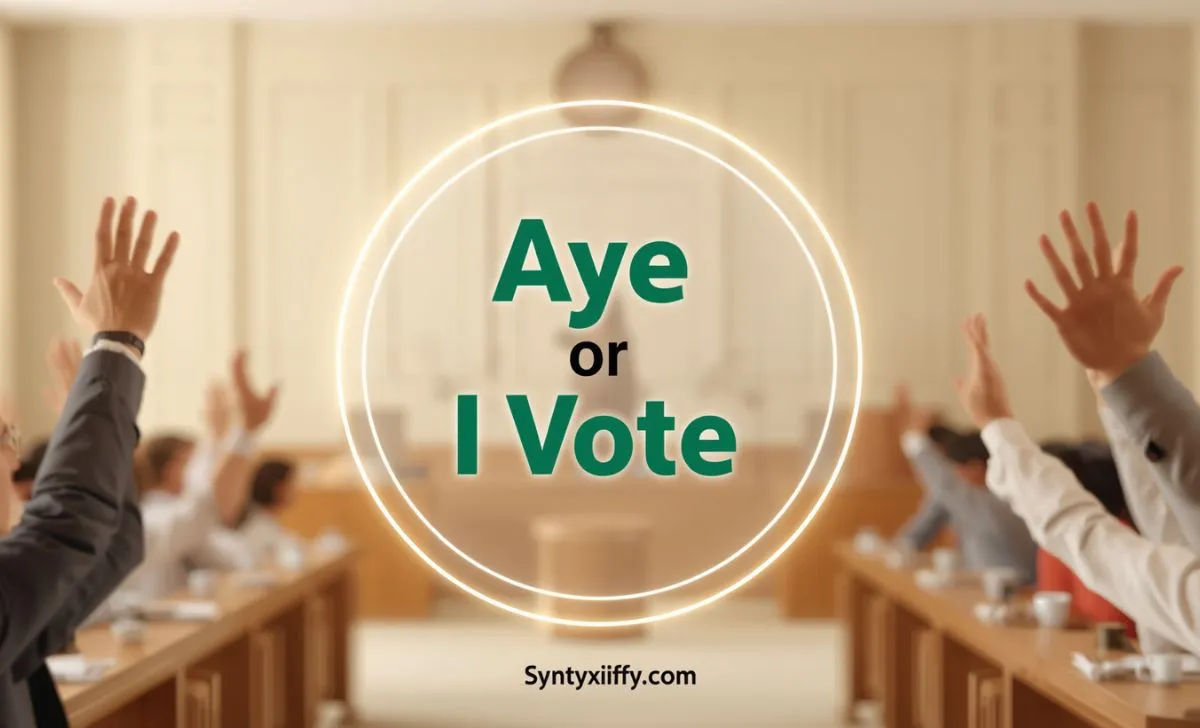
Many people wonder whether they should say aye or I vote when agreeing during a vote or meeting. The answer depends on the context. Aye is the traditional and correct word used in parliamentary procedure, voice votes, and other formal voting situations to show approval. I vote is also grammatically correct, but it is a complete expression used when someone states their personal choice in everyday conversation or informal discussions.
People often confuse these expressions because aye and I sound the same. In this guide, you’ll learn their meanings, origin, pronunciation, British and American English usage, common mistakes, real-life examples, and when each expression is appropriate in formal writing, business meetings, student councils, and everyday English.
Quick Answer
Both aye and I vote are correct, but they are used in different situations.
- Aye is used during a voice vote in parliament, legislatures, council meetings, and other formal voting procedures to mean yes or in favor.
- I vote is a normal English expression that means I choose or I support something.
Examples
Aye
- Those in favor, say “Aye.”
- The committee members responded, “Aye.”
I Vote
- I vote for the blue design.
- I vote we leave early.
- I vote to approve the proposal.
Quick Comparison
| Expression | Meaning | Common Use |
| Aye | Yes; in favor | Parliamentary procedure, voice votes |
| I vote | I choose or support | Everyday English, meetings, conversations |
Understanding this difference improves your English grammar, communication skills, and professional writing.
The Origin of Aye or I Vote
The word aye has been part of the English language for centuries. It comes from Middle English and has long been used to express agreement, especially during parliamentary voting and official decision-making.
Today, many legislative assemblies, councils, and committees still use aye during a voice vote.
Examples:
- Those in favor say, “Aye.”
- The motion passed by a majority of ayes.
The expression I vote, however, follows ordinary English grammar. It combines the first-person pronoun I with the verb vote to show a personal decision.
Examples:
- I vote for Option A.
- I vote against the proposal.
Why Do People Think “Aye” Is Wrong?
Many learners hear the word aye but assume it is the pronoun I because both words sound alike.
For example:
- “Aye” → sounds like “I”
Without understanding parliamentary language, people often write:
- I vote!
when the official response should simply be:
- Aye!
Formal vs Everyday English
The difference is mainly about context.
Use aye in:
- Parliament
- Legislature
- Senate
- Congress
- Committee meetings
- Board meetings
- Student council elections
- Voice voting
Use I vote in:
- Daily conversation
- Informal discussions
- Business meetings
- Classroom activities
- Emails
- Social media
Knowing the origin of both expressions helps improve your English vocabulary, grammar practice, proofreading, academic writing, and business communication.
British English vs American English Spelling
There is no spelling difference between aye and I vote in British English and American English. The difference is based on meaning and context, not spelling.
- Aye is the traditional word used in parliamentary procedure, voice votes, and formal meetings to mean “yes” or “in favor.”
- I vote is a normal English expression used when someone personally states a preference or decision.
Both expressions are understood in English-speaking countries, but aye is more common in official voting procedures.
Examples
British English
- The Speaker asked, “All those in favor?”
- Members replied, “Aye.”
American English
- During a committee meeting, members answered, “Aye.”
- In a casual discussion, someone said, “I vote we order pizza.”
British vs American English Comparison
| Feature | British English | American English |
| Spelling of Aye | Aye | Aye |
| Spelling of I vote | I vote | I vote |
| Parliamentary use | Common | Common |
| Everyday conversations | Less common | Less common |
| Informal discussions | I vote | I vote |
| Grammar rule | Same | Same |
Whether you write for readers in the United Kingdom, United States, Canada, Australia, New Zealand, India, or Pakistan, the spelling remains the same.
Pronunciation of Aye or I Vote
The biggest reason for confusion is pronunciation.
The word aye and the pronoun I sound exactly alike.
| Expression | IPA | Simple Pronunciation |
| Aye | /aɪ/ | eye |
| I | /aɪ/ | eye |
| Vote | /voʊt/ | voht |
Pronunciation Tips
- Aye rhymes with eye, fly, sky, and my.
- I has exactly the same pronunciation.
- Vote rhymes with boat, coat, and note.
Example Sentences
- The committee answered, “Aye!”
- I vote for the first option.
- The council members said “Aye” during the voice vote.
- I vote we approve the proposal.
Although aye and I sound identical, their meanings are completely different.
Learning this pronunciation helps improve both spoken English and written English.
Why People Confuse Aye or I Vote
Many English learners, students, and even native speakers confuse these expressions because they sound the same but serve different purposes.
1. They Sound Identical
The most common reason is pronunciation.
- Aye = /aɪ/
- I = /aɪ/
Because they are homophones, people often write one when they mean the other.
2. “Aye” Is Rare in Everyday English
Most people use yes instead of aye in daily conversation.
As a result, learners may not recognize aye when they hear it during:
- Parliament
- Student council meetings
- Board meetings
- Committee meetings
- Government proceedings
3. “I Vote” Is a Complete Sentence
Unlike aye, the phrase I vote contains:
- A first-person pronoun (I)
- A verb (vote)
It expresses a personal opinion or choice.
Examples:
- I vote for Option B.
- I vote we start the meeting.
4. Parliamentary Language Is Different
Official voting follows special parliamentary procedure.
Instead of saying:
- Yes
Members often respond:
- Aye
The opposite response is:
- No
This style is common in legislatures, congresses, senates, councils, and committees.
5. Context Determines the Correct Choice
Ask yourself one question:
Am I responding to a formal vote or expressing my own opinion?
If it is a voice vote, use:
- Aye
If you are expressing your own choice, use:
- I vote
Understanding the context, sentence structure, and purpose helps you choose the correct expression in academic writing, business communication, news writing, and everyday English.
I and Eye Homophones
I and eye are homophones, which means they sound the same but have different meanings and spellings.
- I is a personal pronoun that refers to yourself.
- Eye is the organ used for seeing.
Examples:
- I am going to school.
- My eye hurts today.
Common Homophones Examples
Here are a few common homophones in English:
| Word 1 | Word 2 | Meaning |
|---|---|---|
| I | Eye | Pronoun / Body part |
| Sea | See | Ocean / To look |
| Sun | Son | Star / Male child |
| Right | Write | Correct / To record words |
| Flour | Flower | Baking ingredient / Plant bloom |
| Pair | Pear | Two items / Fruit |
| Knight | Night | Warrior / Time after sunset |
Which Spelling Should You Use?
Both aye and I vote are correct, but they are used in different situations.
Use aye when taking part in a formal voice vote during a parliamentary procedure, committee meeting, board meeting, student council, or legislative assembly. It simply means “yes” or “in favor.”
Use I vote when you want to express your personal opinion, choice, or recommendation in everyday English.
Quick Guide
| Situation | Correct Expression | Example |
| Voice vote | Aye | “Those in favor?” — “Aye!” |
| Parliament | Aye | Members answered, “Aye.” |
| Committee meeting | Aye | The motion passed with several “Aye” votes. |
| Casual conversation | I vote | I vote we leave early. |
| Business meeting | I vote | I vote for the first proposal. |
| Classroom discussion | I vote | I vote for Team Blue. |
| Social media | I vote | I vote this is the best movie. |
No matter whether you are writing in British English, American English, Canadian English, or Australian English, the rule is the same. Choose the expression based on the context, not the country.
Common Mistakes with Aye or I Vote
People often make mistakes because aye and I are pronounced the same.
| Incorrect | Correct | Why? |
| I vote! (during a parliamentary voice vote) | Aye! | Formal votes use aye. |
| Members shouted I. | Members shouted Aye. | Aye means “yes” in a voice vote. |
| Aye for the blue logo. (casual discussion) | I vote for the blue logo. | Personal choices use I vote. |
| The committee said I vote together. | The committee responded Aye. | Voice voting uses aye. |
| I cast an I vote. | I cast an aye vote. | The correct term is aye vote. |
| The motion passed with many I votes. | The motion passed with many aye votes. | Official voting uses aye and nay. |
Tips to Avoid Mistakes
- Remember that aye means yes during a formal vote.
- Use I vote when giving your own opinion or preference.
- Think about the setting:
- Parliament or committee → Aye
- Conversation or meeting → I vote
- Proofread formal documents to ensure the correct expression is used.
Aye or I Vote in Everyday Examples
Here are examples showing how each expression is used in real-life situations.
Parliament
- The Speaker asked, “All those in favor?”
- Members replied, “Aye!”
Committee Meeting
- The chairperson called for a voice vote.
- Everyone answered, “Aye.”
Business Meeting
- I vote we approve the new budget.
- I vote for the second marketing strategy.
Classroom
- I vote for Sarah as class representative.
- The student council members answered “Aye” during the official vote.
Emails
- I vote that we schedule the meeting for Monday.
- I vote to move forward with the proposal.
Social Media
- I vote this is the best phone of the year!
- I vote for Team Green.
News
- Parliament approved the bill after members voted “Aye.”
- The council passed the motion with a majority of aye votes.
These examples show that aye belongs to formal voting procedures, while I vote fits everyday communication and informal decision-making.
“An Eye for an Eye” Meaning
The phrase “an eye for an eye” means that a person should receive the same punishment or harm that they caused to someone else. It is an old expression often used when talking about justice or revenge.
Example:
Some people believe in “an eye for an eye,” while others prefer forgiveness.
Easy Trick to Remember Aye or I Vote
A simple memory trick makes this easy.
Remember This Rule
Aye = Yes
I vote = My personal choice
Ask yourself one question:
Am I taking part in an official voice vote?
- Yes → Use Aye.
- No → Use I vote.
Another Easy Trick
Think of this phrase:
- Aye = Assembly
- I vote = Individual
If you are speaking as part of a parliament, committee, or council, use aye.
If you are sharing your own opinion, use I vote.
Aye or I Vote – Google Trends & Usage Data
The keyword “aye or I vote” is commonly searched by English learners, students, writers, and professionals who hear the word aye in movies, parliamentary debates, or government proceedings.
Most searches are about understanding whether aye and I are the same word and when each expression is correct.
Usage by Country
| Country | Common Usage | Notes |
| United Kingdom | Aye in Parliament, I vote in conversation | Traditional parliamentary term |
| United States | Aye in formal meetings, I vote in daily English | Both understood |
| Canada | Same | Standard English |
| Australia | Same | Common parliamentary usage |
| New Zealand | Same | Standard English |
| India | Frequently searched by English learners | Common grammar topic |
| Pakistan | Popular among students and competitive exam learners | ESL topic |
Comparison Table
| Feature | Aye | I Vote |
| Correct English | ✅ Yes | ✅ Yes |
| Means “yes” | ✅ Yes | ❌ No |
| Personal opinion | ❌ No | ✅ Yes |
| Used in Parliament | ✅ Yes | ❌ Rare |
| Used in voice vote | ✅ Yes | ❌ No |
| Used in conversation | ❌ Rare | ✅ Yes |
| Formal English | ✅ Yes | ✅ Yes (different context) |
| Informal English | ❌ Rare | ✅ Yes |
FAQs
Is it aye or I vote?
Both are correct, but they are used in different contexts. Aye is the traditional response during a voice vote in parliamentary procedure and means “yes.” I vote is used when expressing your personal opinion or choice.
What does aye mean?
Aye means yes, in favor, or approval during a formal vote. It is commonly used in Parliament, Congress, Senate, legislative assemblies, committee meetings, and board meetings.
Example:
- Chairperson: “All those in favor?”
- Members: “Aye!”
Is I vote grammatically correct?
Yes. I vote is a grammatically correct expression because I is a first-person pronoun and vote is the main verb.
Examples:
- I vote for the blue logo.
- I vote we start the meeting now.
Why do people say aye instead of yes?
The word aye is part of traditional parliamentary language. It has been used for centuries in official voting procedures to indicate agreement or approval.
Can I use aye in everyday conversation?
You can, but it is uncommon. In everyday English, most people simply say yes or use I vote when expressing an opinion.
What is an aye vote?
An aye vote is a vote in favor of a motion, bill, or proposal. It is the opposite of a nay vote, which means against.
How can I remember the difference between aye and I vote?
Use this simple rule:
- Aye = Official vote = Yes
- I vote = My personal choice
If you are participating in a voice vote, say aye. If you are sharing your own opinion or recommendation, say I vote.
Conclusion
Understanding the difference between aye and I vote is easier once you know the context. Aye is the traditional word used during voice votes in parliamentary procedure, legislative assemblies, committee meetings, and other formal settings. It simply means “yes” or “in favor.” On the other hand, I vote is a normal English expression used when you state your own choice or opinion in everyday conversations, classrooms, business meetings, and informal discussions.
Although aye and I have the same pronunciation, they serve different purposes. Remember that aye belongs to official voting, while I vote expresses a personal decision. By understanding this distinction and practicing the examples in this guide, you can improve your English grammar, writing skills, and professional communication with confidence.
Read More Blogs:
- Send or Sent? Learn the Difference with Easy Grammar Rules
- By Who or By Whom? Grammar Rules with Examples

Hi, I am Bill Walsh, and I write clear and practical grammar blogs on Syntaxiffy.com.
I focus on English grammar, pair of words, and spelling differences to help readers improve their writing skills.