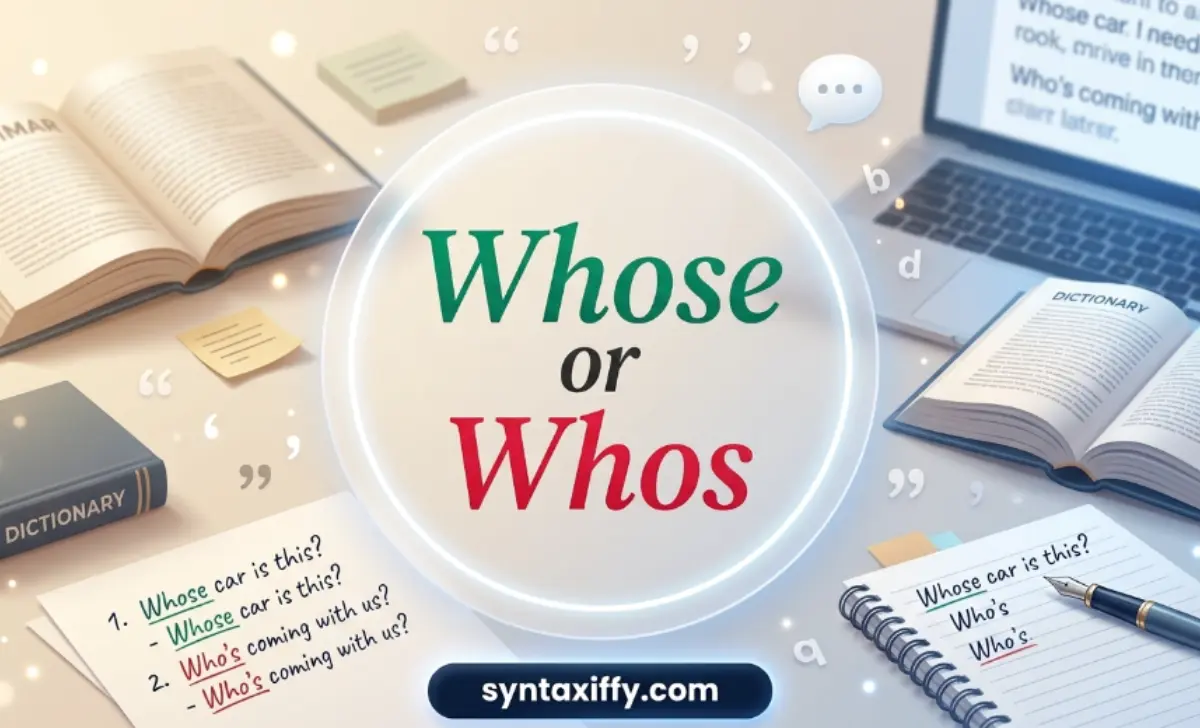
Have you ever wondered whether whose or who’s is correct? The short answer is that both words are correct, but they have different meanings and uses in English grammar. Many writers confuse them because they sound the same when spoken.
\However, using the wrong one can make your writing look unprofessional and cause confusion in emails, essays, social media posts, and business communication. Understanding the difference is easier than you might think. In this guide, you’ll learn what each word means, when to use it, common mistakes to avoid, and simple tricks to remember the correct choice every time.
Whose or Who’s – Quick Answer
Whose and who’s are both correct, but they are not interchangeable.
- Whose shows possession or ownership.
- Who’s is a contraction of who is or who has.
Examples
✅ Whose book is on the table?
✅ Do you know whose phone this is?
✅ Who’s coming to the meeting?
✅ Who’s finished the assignment?
Incorrect Examples
❌ Who’s book is this?
❌ Whose going to the party?
Quick Comparison
| Word | Meaning | Example |
|---|---|---|
| Whose | Shows ownership or possession | Whose jacket is this? |
| Who’s | Short form of who is or who has | Who’s ready to begin? |
A simple rule is: if you can replace the word with who is or who has, use who’s. Otherwise, use whose.
The Origin of Whose or Who’s
Understanding the history of these words can help you remember how they work.
The word whose comes from Old English and has been used for centuries as a possessive pronoun and possessive determiner. It is related to the word who and is used when asking or describing ownership.
Examples:
- Whose car is parked outside?
- I met a student whose project won first prize.
In both examples, whose refers to possession.
The word who’s appeared later as a shortened form of who is and who has. English often creates contractions by combining words and replacing missing letters with an apostrophe.
Examples:
- Who’s at the door? (Who is at the door?)
- Who’s completed the report? (Who has completed the report?)
This contraction follows the same pattern as:
- It’s = It is
- You’re = You are
- They’re = They are
Because whose and who’s sound identical in spoken English, many English learners and native speakers confuse them in writing. This is one of the most common grammar mistakes found in essays, emails, and social media posts.
Key Difference
- Whose = ownership
- Who’s = who is / who has
Knowing this distinction improves your writing skills, proofreading, and overall grammar usage.
British English vs American English Spelling
Unlike words such as colour/color or traveller/traveler, there is no spelling difference between British English and American English for whose and who’s.
Both varieties of English follow exactly the same rule.
British English Examples
- Whose umbrella is this?
- Who’s joining us for lunch?
- Do you know whose bag was left behind?
American English Examples
- Whose laptop is on the desk?
- Who’s attending the conference?
- Whose idea was selected?
In both countries:
- Whose shows possession.
- Who’s means who is or who has.
British English vs American English Comparison
| Feature | British English | American English |
|---|---|---|
| Whose | ✅ Correct | ✅ Correct |
| Who’s | ✅ Correct | ✅ Correct |
| Meaning of whose | Ownership | Ownership |
| Meaning of who’s | Who is / Who has | Who is / Who has |
| Formal writing | ✅ Accepted | ✅ Accepted |
| Academic writing | ✅ Accepted | ✅ Accepted |
| Business writing | ✅ Accepted | ✅ Accepted |
Whether you are writing for a university, company, website, or global audience, the rule remains the same. There is no regional variation in spelling or usage.
Both formal English and informal English rely on the same distinction between whose and who’s, making it an important rule for students, professionals, content writers, and anyone learning the English language.
Pronunciation of Whose or Who’s
One reason people confuse whose and who’s is that they are homophones. A homophone is a pair of words that sound the same but have different meanings and spellings.
Correct Pronunciation
- Whose → /huːz/
- Who’s → /huːz/
Both words are pronounced exactly the same. This is why you cannot tell which one is correct just by listening. You must look at the sentence structure and the meaning of the sentence.
How to Choose the Correct Word
Ask yourself these questions:
- Am I talking about ownership or possession?
- Use whose.
- Can I replace the word with “who is” or “who has”?
- Use who’s.
Examples
Whose (Possession)
- Whose notebook is on the desk?
- Do you know whose bicycle this is?
- Whose turn is it?
Who’s (Who is / Who has)
- Who’s waiting outside?
- Who’s completed the assignment?
- Who’s ready for the presentation?
Although they sound identical, they serve different grammatical purposes. Understanding the context is more important than relying on pronunciation.
Why People Confuse Whose or Who’s
The confusion between whose and who’s is one of the most common English grammar mistakes. Even experienced writers sometimes use the wrong word.
Here are the main reasons.
They Sound Exactly the Same
Because both words are pronounced /huːz/, listeners cannot hear the spelling difference. This often leads to mistakes when writing.
The Apostrophe Causes Confusion
Many people believe that an apostrophe always shows possession.
However, this is not true here.
- Who’s has an apostrophe because it is a contraction.
- Whose has no apostrophe because it is a possessive determiner.
This is similar to:
- It’s = It is
- You’re = You are
- They’re = They are
Fast Typing
People often write quickly without checking their work.
For example:
❌ Who’s backpack is this?
The correct sentence is:
✅ Whose backpack is this?
Skipping Proofreading
Many spelling tools do not detect this mistake because whose and who’s are both real English words.
A careful proofreading review is the best way to catch this error.
Lack of Grammar Knowledge
Some English learners, students, and even native speakers are unfamiliar with the difference between possessive pronouns, possessive determiners, and contractions.
Learning this grammar rule improves your writing skills, English vocabulary, and confidence in both formal English and informal English.
Which Spelling Should You Use?
The correct choice depends entirely on the meaning of your sentence.
Use Whose When Showing Ownership
Choose whose whenever you ask or describe who owns something.
Examples:
- Whose shoes are these?
- Whose phone keeps ringing?
- I know the teacher whose lesson inspired everyone.
- Whose idea was selected?
In these sentences, whose shows possession.
Use Who’s for “Who Is” or “Who Has”
Use who’s only when it means who is or who has.
Examples:
- Who’s your new manager?
- Who’s coming to dinner?
- Who’s finished the project?
- Who’s responsible for this report?
Try expanding the contraction.
Example:
Who’s coming today?
↓
Who is coming today?
The sentence still makes sense, so who’s is correct.
Quick Decision Table
| If you mean… | Use |
|---|---|
| Ownership | Whose |
| Who is | Who’s |
| Who has | Who’s |
This rule applies in:
- Academic writing
- Business writing
- Professional writing
- Technical writing
- Content writing
- Blog writing
- Email writing
- Social media posts
Both British English and American English follow exactly the same grammar rule.
Common Mistakes with Whose or Who’s
Below are the mistakes writers make most often and the correct versions.
| Incorrect Sentence | Correct Sentence | Explanation |
|---|---|---|
| Who’s jacket is this? | Whose jacket is this? | Ownership requires whose. |
| Who’s car is parked outside? | Whose car is parked outside? | Showing possession. |
| Whose coming with us? | Who’s coming with us? | Means who is. |
| Whose finished the report? | Who’s finished the report? | Means who has. |
| I know who’s notebook this is. | I know whose notebook this is. | Possession requires whose. |
Another Helpful Test
Replace who’s with who is.
If the sentence still makes sense, use who’s.
Example:
Who’s calling?
↓
Who is calling?
✅ Correct.
Now try:
Who’s backpack is this?
↓
Who is backpack is this?
❌ Incorrect.
Therefore, the correct sentence is:
Whose backpack is this?
Tips to Avoid Mistakes
- Think about ownership before writing.
- Expand who’s into who is or who has.
- Proofread important documents.
- Use a trusted grammar checker.
- Read your sentence twice before publishing.
Following these simple habits will help you avoid one of the most common grammar mistakes in English and improve the quality of your academic writing, business communication, and everyday writing.
Whose or Who’s in Everyday Examples
Learning grammar rules is useful, but seeing them in real-life situations makes them much easier to understand. Below are examples from emails, academic writing, business communication, social media, news articles, and everyday conversations.
Emails
- ✅ Who’s available for tomorrow’s meeting?
- ✅ Do you know whose document this is?
- ✅ Who’s responsible for sending the final report?
- ✅ Please return the notebook to whose desk it belongs to. (Better: Please return the notebook to its owner.)
Academic Writing
- ✅ The researcher whose study received the award will present first.
- ✅ Who’s presenting the final project today?
- ✅ The student whose essay scored the highest received a certificate.
- ✅ Who’s completed the assignment before the deadline?
Business Writing
- ✅ Do you know whose office this is?
- ✅ Who’s leading today’s client meeting?
- ✅ The employee whose idea increased sales received a bonus.
- ✅ Who’s signed the agreement?
News Writing
- ✅ Police are searching for the person whose vehicle was stolen.
- ✅ Who’s expected to address the media this afternoon?
- ✅ The athlete whose record remains unbeaten inspired many young players.
Social Media
- ✅ Who’s watching the match tonight?
- ✅ Who’s excited for the weekend?
- ✅ Whose dog is this? It’s adorable!
- ✅ I wonder whose photo this is.
Everyday Conversations
- “Whose keys are on the table?”
- “Who’s knocking at the door?”
- “Do you know whose bag this is?”
- “Who’s making dinner tonight?”
- “Whose phone keeps ringing?”
- “Who’s ready to leave?”
These examples show how whose and who’s appear naturally in formal English, informal English, professional writing, and everyday speech.
Easy Trick to Remember Whose or Who’s
A simple memory trick can help you choose the correct word every time.
The Expansion Trick
Whenever you see who’s, expand it to who is or who has.
Example:
Who’s calling?
↓
Who is calling?
✅ The sentence still makes sense.
Another example:
Who’s finished the report?
↓
Who has finished the report?
✅ Still correct.
If the expanded sentence sounds wrong, who’s is not the correct choice.
The Ownership Trick
Think of whose as the word for ownership.
Ask yourself:
“Who owns this?”
If your sentence is about possession, use whose.
Examples:
- Whose coat is this?
- Whose laptop is missing?
- Whose responsibility is this?
Quick Memory Formula
- Whose = Ownership
- Who’s = Who is / Who has
This easy rule works in almost every sentence.
One-Minute Test
Choose the correct word.
- ______ coming to dinner?
✅ Who’s
- ______ bicycle is parked outside?
✅ Whose
- I met the teacher ______ class won the competition.
✅ Whose
If you can answer these correctly, you’ve already mastered one of the most common English grammar mistakes.
Whose or Who’s – Google Trends & Usage Data
Search behavior shows that whose or who’s is one of the most searched confusing word pairs in English. Students, professionals, bloggers, and English learners frequently look up this topic because the words sound identical but serve different grammatical purposes.
Why Do People Search for “Whose or Who’s”?
Common search reasons include:
- Understanding the difference between whose and who’s
- Learning when to use an apostrophe
- Improving writing skills
- Avoiding grammar mistakes in school and work
- Preparing for English exams
- Writing better emails and reports
Where Is “Whose” Commonly Used?
You’ll often see whose in:
- Academic essays
- Business reports
- Professional emails
- Books
- Newspapers
- Legal documents
- Research papers
Where Is “Who’s” Commonly Used?
You’ll often find who’s in:
- Conversations
- Social media posts
- Emails
- Blog articles
- Interviews
- News reports
- Everyday writing
Usage Around the World
| Country | Preferred Usage |
|---|---|
| United States | Whose & Who’s (correct grammar) |
| United Kingdom | Whose & Who’s (correct grammar) |
| Canada | Whose & Who’s |
| Australia | Whose & Who’s |
| New Zealand | Whose & Who’s |
| India | Whose & Who’s |
The grammar rule is identical across British English, American English, and other varieties of English. The only challenge is choosing the correct word based on the sentence’s meaning.
Whose or Who’s Comparison Table
| Feature | Whose | Who’s |
|---|---|---|
| Correct spelling | ✅ Yes | ✅ Yes |
| Meaning | Shows ownership or possession | Means who is or who has |
| Part of speech | Possessive determiner / Relative pronoun | Contraction |
| Uses an apostrophe | ❌ No | ✅ Yes |
| Indicates possession | ✅ Yes | ❌ No |
| Can replace “who is” | ❌ No | ✅ Yes |
| Can replace “who has” | ❌ No | ✅ Yes |
| Used in formal writing | ✅ Yes | ✅ Yes |
| Used in academic writing | ✅ Yes | ✅ Yes |
| Used in business writing | ✅ Yes | ✅ Yes |
| Example | Whose book is this? | Who’s coming today? |
Understanding this table makes it easy to choose the correct word in any sentence. Instead of memorizing grammar rules, simply remember the meaning:
- Whose = ownership
- Who’s = who is / who has
This simple distinction will help you write more accurately and confidently in every context.
FAQs
Is whose or who’s correct?
Both are correct, but they have different meanings. Whose shows ownership or possession, while who’s is a contraction of who is or who has. The correct choice depends on the meaning of your sentence.
How do I know whether to use whose or who’s?
A simple trick is to replace who’s with who is or who has.
If the sentence still makes sense, use who’s.
If it doesn’t, use whose.
Example:
- Who’s calling? → Who is calling? ✅
- Whose bag is this? → Who is bag is this? ❌
Is whose a possessive pronoun?
Whose can function as both a possessive determiner and a relative pronoun, depending on the sentence.
Examples:
- Whose keys are these? (Possessive determiner)
- I met the writer whose novel won the award. (Relative pronoun)
In both cases, it expresses ownership.
Can who’s mean who has?
Yes. Besides meaning who is, who’s can also mean who has.
Examples:
- Who’s finished the report? (Who has finished the report.)
- Who’s completed the training? (Who has completed the training.)
The correct meaning depends on the context.
Is there a difference between British and American English?
No. British English and American English follow the same grammar rule.
- Whose always shows possession.
- Who’s always means who is or who has.
There is no spelling difference between the two varieties of English.
Why do people confuse whose and who’s?
The confusion happens because both words are pronounced the same. They are homophones, meaning they have the same pronunciation but different spellings and meanings. Fast typing, skipped proofreading, and misunderstanding apostrophe rules also contribute to this common grammar mistake.
Can I use whose and who’s in formal writing?
Yes. Both words are correct when used properly. They are commonly found in academic writing, business writing, professional communication, news articles, and formal English. Using the correct form improves clarity and demonstrates strong writing skills.
Conclusion
Understanding the difference between whose or who’s is easier once you know what each word does. Whose is used to show ownership or possession, while who’s is simply a contraction of who is or who has. Although they sound exactly the same, they serve different purposes in English grammar.
Remember to test whether who’s can be expanded to who is or who has. If it cannot, choose whose instead. With regular practice, careful proofreading, and these simple memory tricks, you’ll avoid this common grammar mistake and write with greater confidence in school, work, and everyday communication.
Read More Blogs:

Hi, I am Mary Norris, and I write clear and insightful grammar blogs on Syntaxiffy.com.
On Syntaxiffy.com, I focus on English grammar, usage, and writing accuracy to help readers improve their language skills.