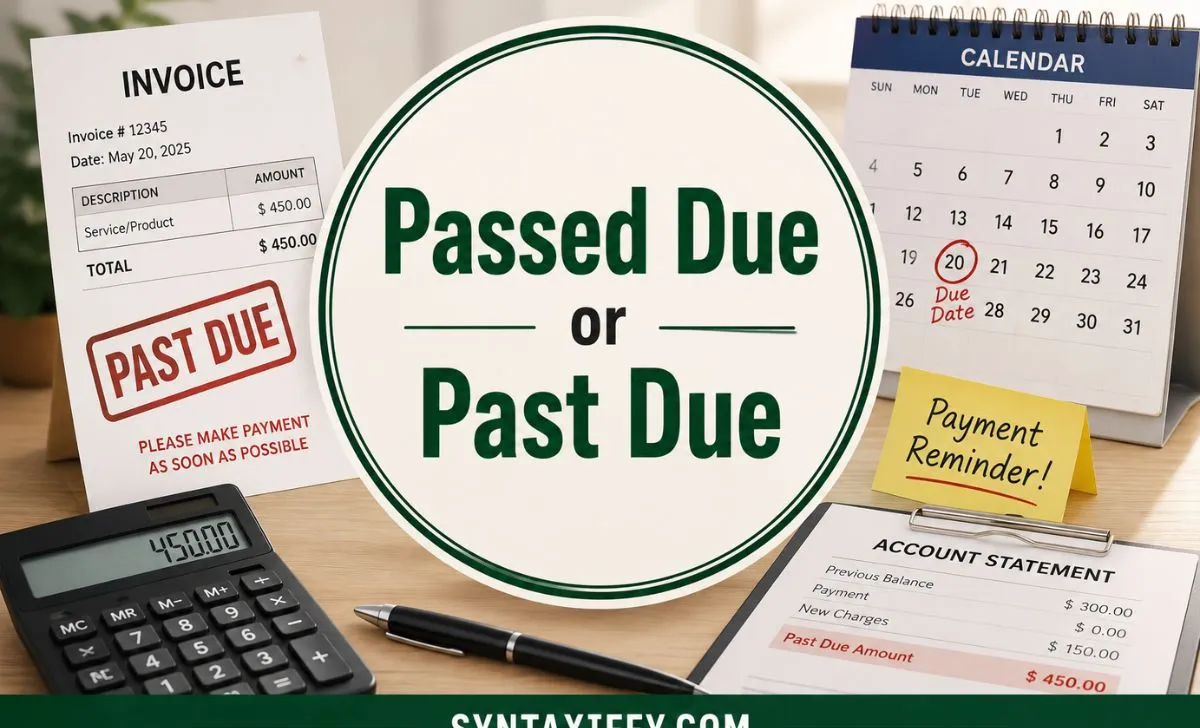
Passed due or past due is a common English usage question, especially when writing about bills, invoices, payments, deadlines, and overdue accounts. The correct phrase for something that has gone beyond its due date is past due.
For example, “Your payment is past due” is correct, while “Your payment is passed due” is not standard English. The confusion happens because past and passed sound very similar, but they have different grammatical roles.
In this guide, you will learn the difference between them, their origins, pronunciation, British and American usage, common mistakes, professional examples, and an easy way to remember which form to use.
Quick Answer
The correct phrase is past due when you mean that something has not been completed or paid by its required date.
Past due means late, overdue, or beyond the due date. Cambridge Dictionary defines it as being past the date when a payment should have been made.
Examples:
Your payment is past due.
The electricity bill is past due.
The invoice is past due by 10 days.
Your account has a past-due balance.
By contrast, passed is the past tense of the verb pass. It describes an action, such as:
The deadline passed yesterday.
The due date passed last Friday.
Notice the difference:
The payment is past due.
The due date has passed.
This is the easiest way to understand the two forms.
| Phrase | Correct? | Meaning |
| Past due | Yes | Beyond the due date |
| Passed due | No, in this meaning | Not standard usage |
| Due date passed | Yes | The due date ended |
| Past the due date | Yes | After the due date |
| Overdue | Yes | Late or not completed on time |
So, when talking about an unpaid bill, invoice, loan, rent payment, or missed deadline, choose past due.
The Origin of Passed Due or Past Due
Understanding the history of past, passed, and due helps explain why these words are so easy to confuse.
The word past developed from forms related to Middle English passen, meaning “to pass” or “go by.” It developed meanings connected with something that has gone by or is beyond a particular point in time. Etymological sources trace the modern word to the past participle of passen.
The word pass entered English through Old French passer, ultimately from Latin passus, meaning “step” or “pace.” Modern English uses passed as the past-tense and past-participle form of pass.
The word due has a different history. It came into Middle English from Anglo-French deu, related to the verb meaning “to owe,” and ultimately traces to Latin debere, meaning “to owe.”
These histories explain the modern grammar:
Past can describe a time or position beyond something.
Passed describes an action that happened.
Due describes something that is owed or expected by a particular time.
Therefore:
The payment is past due.
Here, past describes the payment’s status relative to its deadline.
But:
The due date has passed.
Here, passed is the verb describing what happened to the date.
British English vs American English Spelling
There is no British English vs American English spelling difference between past due and passed due.
Both British and American English use past due when referring to a payment or obligation that has gone beyond its required date.
The main difference is that overdue may be more natural in some British contexts, while past due is especially common in accounting, billing, and financial communication.
Cambridge specifically labels past due as an accounting term and provides both UK and US entries.
| Usage | British English | American English |
| Past due | Correct | Correct |
| Passed due | Not standard for this meaning | Not standard for this meaning |
| Overdue | Very common | Very common |
| Past-due payment | Correct | Correct |
| Past-due account | Correct | Correct |
| Due date has passed | Correct | Correct |
For example:
British English:
The invoice is past due.
American English:
The invoice is past due.
Both sentences are correct.
You may also hear:
The invoice is overdue.
This is natural in both varieties.
The important point is that past due is not a British or American spelling variation. The distinction between past and passed is a grammar and word-choice issue.
Pronunciation of Passed Due or Past Due
One reason people confuse past and passed is pronunciation.
In many varieties of English, past and passed are pronounced very similarly. They can both sound approximately like:
past / passed → “past”
The final -ed in passed does not create an extra syllable. The two words therefore sound almost identical in ordinary speech.
For example:
The payment is past due.
and:
The payment date passed.
When spoken quickly, learners may not notice which spelling is being used.
This is why the confusion is more common in writing than in speech.
The solution is to focus on the grammatical role of the word rather than its sound.
Past can function as a preposition, adjective, noun, or adverb.
Examples:
We walked past the bank.
The deadline is past.
Passed is a form of the verb pass.
Examples:
The deadline passed.
She passed the exam.
We passed the store.
So even though the pronunciation can be similar, the grammar is different.
Why People Confuse Passed Due or Past Due
The biggest reason is that past and passed are homophones or near-homophones in many English varieties.
They sound alike or nearly alike, but their meanings and grammatical functions differ.
There are several common causes of confusion.
First, people hear past due and may assume that passed should be used because the due date has “passed.”
Second, learners often remember passed as something connected with a completed action. Since a deadline can pass, they may incorrectly transfer passed into the phrase.
Third, autocorrect and spellcheck may not catch the mistake because past and passed are both legitimate English words.
For example, a spelling checker may recognize:
Your payment is passed due.
as containing correctly spelled individual words, even though the phrase is wrong in standard usage.
The key difference is:
Past = beyond a point in time
Passed = an action that happened
Compare:
The payment is past due.
The due date has passed.
Both sentences describe the same general situation, but the grammar is different.
Which Spelling Should You Use?
If you are writing about payments, invoices, bills, loans, rent, credit cards, accounts, deadlines, or other obligations, use past due.
This is the safest choice for:
- US English
- British English
- Canadian English
- Australian English
- Academic writing
- Business communication
- Professional emails
- Financial communication
- Customer service
- Accounting
- Billing notices
Examples:
Your account is past due.
This invoice is past due.
The rent payment is past due.
Please settle the past-due balance.
For a general audience, overdue is also an excellent alternative.
For example:
Your payment is overdue.
This means essentially the same thing as:
Your payment is past due.
However, if the question specifically asks whether passed due or past due is correct, choose past due.
Remember:
Past due = correct phrase
Passed due = avoid
The due date has passed = correct sentence
Common Mistakes with Passed Due or Past Due
The most common mistake is replacing past with passed.
| Incorrect | Correct |
| Your bill is passed due. | Your bill is past due. |
| The invoice is passed due. | The invoice is past due. |
| My rent is passed due. | My rent is past due. |
| The payment is passed due. | The payment is past due. |
| This account is passed due. | This account is past due. |
| The loan is passed due. | The loan is past due. |
Another mistake is using past where passed is actually required.
Incorrect:
The due date has past.
Correct:
The due date has passed.
Why?
Because has requires a past participle here, and passed is the past participle of pass.
Another common error is:
The payment has past due.
Better:
The payment is past due.
Or:
The payment is overdue.
The phrase past due normally describes the status of the payment, bill, account, or obligation.
Passed Due or Past Due in Everyday Examples
The phrase past due is especially common in financial and professional communication.
In Emails
A business might write:
This is a reminder that your invoice is past due.
A customer service representative might write:
Your account currently has a past-due balance.
A landlord might write:
Your rent payment is past due.
These examples are appropriate for professional communication because they are clear and direct.
In Business Writing
The company has several past-due invoices.
Please contact the billing department regarding your past-due account.
A late fee may apply to past-due payments.
Cambridge gives examples involving past-due bills and loans, showing how strongly the phrase is associated with accounting and financial contexts.
In News Writing
Several households struggled to pay their past-due bills.
The report examined the number of loans that were past due.
In Social Media
A person might write:
Just realized my library book is past due!
Or:
I forgot about the payment and now it’s past due.
In Formal Writing
The outstanding balance became past due after the payment deadline expired.
Customers with past-due accounts may receive a payment reminder.
The phrase is useful because it clearly communicates that a deadline has already been missed.
Easy Trick to Remember Passed Due or Past Due
The easiest way to remember past due is to connect past with the idea of going beyond a time or deadline.
Think:
Past = beyond
Passed = an action
So:
The bill is past due.
But:
The due date has passed.
A simple memory trick is:
“Past describes the status; passed describes what happened.”
You can also remember:
Past due = overdue
If a bill is late, it is past due or overdue.
If you are talking about the deadline itself, use passed:
The deadline has passed.
This trick works for invoices, bills, rent, loans, credit card payments, and other financial obligations.
Passed Due or Past Due – Google Trends & Usage Data
Search interest can change over time, but Google Trends measures search popularity, not whether a phrase is grammatically correct. For this reason, search volume alone should not be used to decide between past due and passed due.
In actual English usage, past due is the established expression for something that has not been paid or completed by its due date. It is especially common in:
- Banking
- Accounting
- Billing
- Finance
- Customer service
- Business communication
- Payment reminders
- Credit reporting
- Loan management
The phrase overdue is also very common and often provides a shorter alternative.
For example:
Your payment is past due.
Your payment is overdue.
Both sentences communicate that the required payment date has been missed.
Searchers may also look for related questions such as:
- passed due or past due which is correct
- is it past due or passed due
- past due meaning
- passed due meaning
- past due vs overdue
- past due date meaning
- payment is past due
- past due invoice
- past due bill
- past due payment
The important usage distinction remains:
Past due describes something that is late.
Passed describes an action or event that has moved beyond a point.
Passed Due vs Past Due Comparison Table
| Expression | Correct? | Meaning | Example |
| Past due | Yes | Beyond the required date | The bill is past due. |
| Passed due | No in this meaning | Not the standard phrase | Avoid this form. |
| Overdue | Yes | Late or unpaid after the deadline | The bill is overdue. |
| Past the due date | Yes | After the required date | The payment is past the due date. |
| Due date has passed | Yes | The deadline has ended | The due date has passed. |
| Passed the due date | Yes | Moved beyond the due date | The payment date passed the due date. |
| Past-due payment | Yes | A payment that is late | We received the past-due payment. |
| Passed-due payment | No | Incorrect formation | Avoid this expression. |
The most useful distinction is between these two sentences:
The payment is past due.
The due date has passed.
The first describes the payment’s status. The second describes what happened to the date.
Past Due vs Overdue
Past due and overdue are very close in meaning.
Both can describe a payment, bill, invoice, loan, account, or other obligation that was not completed by the required date.
For example:
The invoice is past due.
The invoice is overdue.
Both are natural.
However, overdue is often more concise, while past due is especially common in financial and billing language.
| Term | Meaning | Example |
| Past due | Beyond the due date | Your payment is past due. |
| Overdue | Not completed by the required time | Your payment is overdue. |
| Late | Not on time | Your payment is late. |
| Outstanding | Still unpaid or unresolved | You have an outstanding balance. |
| Delinquent | Seriously or officially overdue | The account became delinquent. |
These words are related, but they are not always perfect substitutes in every financial context.
Past Due Date vs Passed the Due Date
This distinction is very important.
Past the due date means that something is beyond the required date.
The payment is past the due date.
Passed the due date uses passed as a verb.
The deadline passed without payment.
Both constructions can be correct, but their grammar is different.
Compare:
The invoice is past due.
The invoice is past the due date.
The due date has passed.
The first two describe the status or position of the invoice. The third describes an event involving the due date.
Past Due in Financial Communication
Past due is especially important in financial communication.
Banks, businesses, landlords, utility companies, and service providers may use the term when communicating about unpaid amounts.
Common financial entities include:
- Payment
- Invoice
- Bill
- Loan payment
- Rent
- Credit card payment
- Utility bill
- Account balance
- Outstanding balance
- Late payment
- Payment deadline
- Late fee
- Grace period
- Billing cycle
- Payment reminder
Examples:
Your credit card payment is past due.
The invoice became past due on August 1.
A late fee may apply to the past-due balance.
Please contact our billing department about your past-due account.
These examples are common in professional and financial communication.
Past Due in Professional Emails
When writing a payment reminder, past due is clear and professional.
For example:
Your invoice is now past due. Please arrange payment at your earliest convenience.
Another example:
Our records show that the payment is past due. Please contact the accounts receivable department if payment has already been made.
The phrase can also be softened when dealing with customers:
This is a friendly reminder that your invoice is past due. Please let us know if you need a copy of the invoice.
This makes past due useful in customer service and business communication.
Past Due in Everyday English
The phrase is not limited to formal financial writing.
People also use it in everyday situations.
My phone bill is past due.
I forgot that my rent was past due.
The library book is past due.
My payment became past due last week.
I need to pay this past-due bill today.
The meaning remains the same: the required date has already gone by.
FAQs
Is it passed due or past due?
Past due is the correct phrase when something has not been paid or completed by its due date.
The invoice is past due.
Passed should be used when describing an action:
The due date has passed.
Is “passed due” ever correct?
Passed due is not the standard expression for something that is overdue. In normal English, use past due.
For example:
Correct: The payment is past due.
Incorrect: The payment is passed due.
What does past due mean?
Past due means that something has gone beyond its required date or deadline. It is commonly used for bills, invoices, loans, rent, payments, and accounts.
For example:
The invoice is past due.
This means the invoice should have been paid earlier.
What is the difference between past and passed?
Past can describe something beyond a particular point in time or location.
The payment is past due.
Passed is the past tense and past participle of pass.
The deadline passed yesterday.
Is past due the same as overdue?
Usually, yes. Both terms describe something that has not been completed or paid by its required time.
The bill is past due.
The bill is overdue.
Both are natural sentences.
Should I write past due or past-due?
Both forms can appear, depending on their grammatical position.
When the phrase follows a verb, past due is common:
The invoice is past due.
When it comes directly before a noun as a compound modifier, past-due is often used:
The company sent reminders for past-due invoices.
Following the style guide of your organization is also a good idea.
Can I say “the due date has past”?
No. The correct sentence is:
The due date has passed.
Here, passed is the past participle of the verb pass.
Conclusion
The correct choice between passed due or past due is clear: use past due when something is late or has gone beyond its required date. For example, “The payment is past due” is correct.
Use passed when talking about an action, as in “The due date has passed.” Although past and passed sound very similar, they have different grammatical functions.
Past due is common in financial communication, invoices, bills, loans, rent, and professional emails. When in doubt, remember: past due means overdue, while passed describes something that happened.
Read More Blogs:

Hi, I am Mary Norris, and I write clear and insightful grammar blogs on Syntaxiffy.com.
On Syntaxiffy.com, I focus on English grammar, usage, and writing accuracy to help readers improve their language skills.