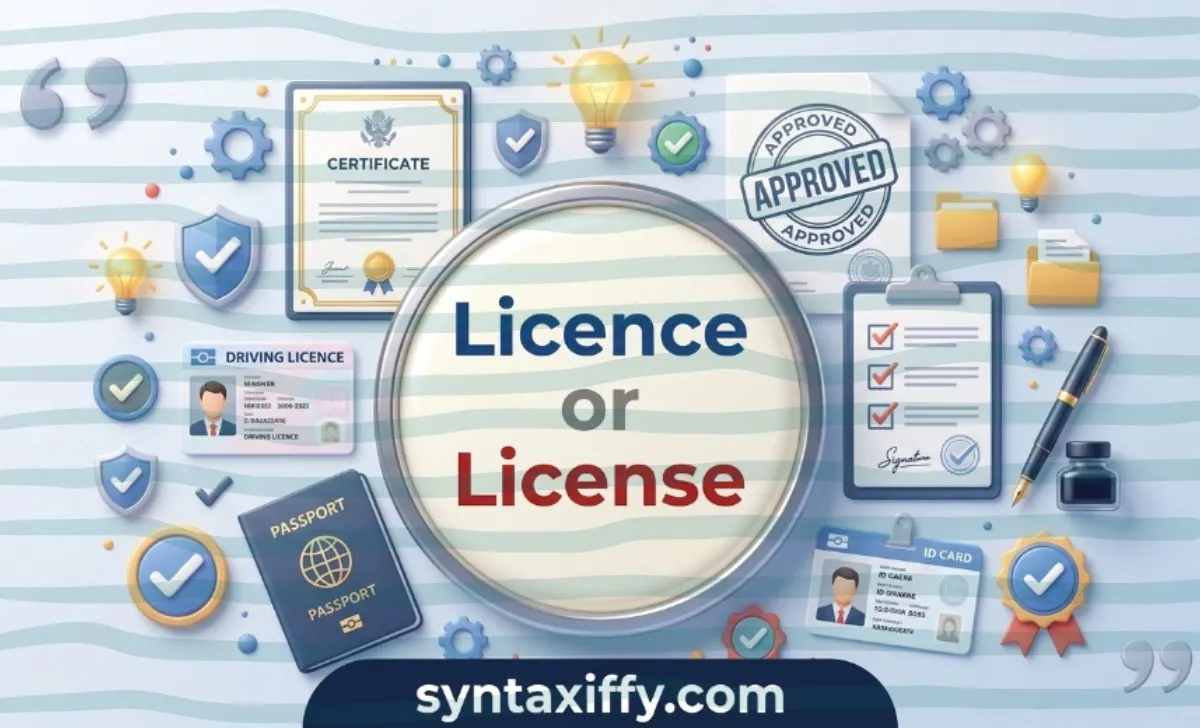
Licence or license are both correct words, but their usage depends on the variety of English you use. In British English, licence is usually the noun, while license is the verb. In American English, license is used as both the noun and the verb.
This difference often confuses English learners, especially when writing legal documents, business communication, or academic papers. In this guide, you’ll learn the meaning, origin, pronunciation, spelling rules, real-world examples, and the correct usage of licence and license so you can write confidently in any situation.
Quick Answer
The quick answer is simple:
- British English
- Licence = Noun
- License = Verb
- American English
- License = Both noun and verb
Both words relate to official permission, legal authorization, or a document that allows someone to do something.
Quick Examples
| English Variety | Noun | Verb |
| British English | Licence | License |
| American English | License | License |
Example Sentences
British English
- I renewed my driving licence yesterday.
- The government will license the new operator next month.
American English
- She received her driver’s license yesterday.
- The state will license the company this year.
What Does Licence or License Mean?
Both words refer to:
- Official permission
- Legal authorization
- Government approval
- Permit
- Certification
- Registration
Examples include:
- Driving licence
- Driver’s license
- Business licence
- Business license
- Software licence
- Software license
- Professional licence
- Professional license
Although the spelling changes, the meaning remains the same.
The Origin of Licence or License
The words licence and license have a long history that begins with the Latin word licentia, meaning freedom or permission.
The word later entered Old French before becoming part of the English language.
As English developed, British English and American English adopted different spelling conventions.
British English
British English separates the noun and verb.
- Licence → Noun
- License → Verb
This distinction helps readers identify the word’s function immediately.
Examples:
- My licence expires next year.
- The council will license new taxi drivers.
American English
American English simplified the spelling.
The word license is used for both the noun and the verb.
Examples:
- My driver’s license expires next year.
- The state will license the new business.
The Influence of Noah Webster
The American spelling became more common through the work of Noah Webster.
Webster supported spelling reform to make American English simpler and more consistent.
His influence also affected words such as:
- Colour → Color
- Honour → Honor
- Defence → Defense
- Behaviour → Behavior
Although licence/license is slightly different because of the noun–verb distinction, American English still adopted the simpler spelling.
What Major Dictionaries Say
Leading dictionaries recognize these regional differences.
| Dictionary | British English | American English |
| Oxford English Dictionary (OED) | Licence (noun), License (verb) | Notes US usage |
| Cambridge Dictionary | Licence (noun), License (verb) | License (noun & verb) |
| Collins Dictionary | Licence (noun), License (verb) | Recognized |
| Merriam-Webster Dictionary | British forms listed | License (noun & verb) |
Language Evolution
The difference between licence and license is not a grammar mistake.
It developed naturally through language evolution and regional spelling conventions.
Today, both forms appear in:
- Legal writing
- Academic writing
- Professional writing
- Business communication
- Technical writing
- Government documents
- Software agreements
The correct spelling depends on your audience and the type of English you are using.
British English vs American English Spelling
The biggest difference between licence and license is how each variety of English treats the noun and the verb.
British English
British English follows a simple rule.
- Licence = Noun
- License = Verb
Examples:
- She renewed her driving licence.
- The government will license the new broadcaster.
- Every business needs a valid operating licence.
- The authority will license qualified professionals.
American English
American English uses license for both parts of speech.
Examples:
- He renewed his driver’s license.
- The city will license the restaurant.
- Every software license has terms and conditions.
- The agency will license the healthcare provider.
Comparison Table
| Feature | Licence | License |
| British English | Noun | Verb |
| American English | Rare | Noun & Verb |
| Part of Speech | Noun | Verb (UK), Noun & Verb (US) |
| Meaning | Official permission | To give official permission |
| Grammar | Correct | Correct |
| Used In | UK, Australia, India, Pakistan | United States |
Common Types of Licences and Licenses
Depending on the country, you may see:
| British English | American English |
| Driving licence | Driver’s license |
| Business licence | Business license |
| Software licence | Software license |
| Marriage licence | Marriage license |
| Fishing licence | Fishing license |
| Professional licence | Professional license |
| Broadcasting licence | Broadcasting license |
| Operating licence | Operating license |
Where You’ll See Each Form
British English
- Government agencies
- Universities
- Legal writing
- Business communication
- Official forms
American English
- Government departments
- Company websites
- Employment documents
- Professional writing
- Technical writing
Understanding this noun-versus-verb rule makes it much easier to choose the correct spelling in every situation.
Pronunciation of Licence or License
Many people think licence and license are pronounced differently because they have different spellings. In reality, they sound almost exactly the same.
The difference is mainly in how the word is used (noun or verb in British English), not in how it is pronounced.
Licence Pronunciation (British English Noun)
IPA: /ˈlaɪ.səns/
It is commonly pronounced as:
LY-suhns
Example:
“My driving licence expires next month.”
License Pronunciation (British English Verb)
IPA: /ˈlaɪ.səns/
It is commonly pronounced as:
LY-suhns
Example:
“The council will license the new taxi company.”
License Pronunciation (American English)
IPA: /ˈlaɪ.səns/
It is commonly pronounced as:
LY-suhns
Examples:
“I renewed my driver’s license.”
“The state will license the new business.”
Do They Sound Different?
No.
Whether you say licence or license, the pronunciation is almost identical.
The important difference is the spelling and grammar, especially in British English, where licence is a noun and license is a verb.
Pronunciation Comparison
| Word | British English | American English |
| Licence (Noun) | LYE-suhns | Rare |
| License (Verb) | LYE-suhns | LYE-suhns |
| License (Noun) | Less common | LYE-suhns |
Listeners will understand either pronunciation without confusion.
Why People Confuse Licence or License
Many English learners struggle with licence and license because the words look similar, sound the same, and have almost identical meanings.
Here are the main reasons for the confusion.
1. British and American English Use Different Rules
The biggest reason is regional spelling.
In British English:
- Licence = Noun
- License = Verb
In American English:
- License = Noun
- License = Verb
This difference often surprises learners.
2. Both Words Refer to Permission
Both words relate to:
- Official permission
- Legal authorization
- Government approval
- Permit
- Certification
- Registration
Because the meanings overlap, many writers assume the spellings are interchangeable everywhere.
3. They Have the Same Pronunciation
Since both spellings are pronounced the same way, people often notice the difference only when writing.
4. Different Dictionaries
Major dictionaries follow different regional standards.
For example:
- Oxford English Dictionary (OED) uses licence as the noun and license as the verb.
- Cambridge Dictionary follows the same British rule.
- Collins Dictionary also separates the noun and verb.
- Merriam-Webster Dictionary uses license for both noun and verb in American English.
All of these dictionaries are correct.
5. Similar British and American Spelling Differences
Many English words follow similar regional patterns.
Examples include:
| British English | American English |
| Defence | Defense |
| Behaviour | Behavior |
| Analysing | Analyzing |
| Travelling | Traveling |
However, licence/license is unique because British English changes the spelling based on the part of speech, not just the country.
6. International Communication
People often read websites, books, and documents from different countries.
For example:
- A UK government website will usually say driving licence.
- A US government website will use driver’s license.
Both are correct because they follow different language standards.
Which Spelling Should You Use?
The correct spelling depends on your audience and whether the word is a noun or a verb.
Use Licence If:
You are writing in British English and using the word as a noun.
Examples:
- I lost my driving licence.
- The business needs a valid operating licence.
- Her professional licence expires this year.
Use License If:
You are:
- Writing in British English and using it as a verb, or
- Writing in American English, where it is both the noun and verb.
Examples:
- The authority will license the company.
- I renewed my driver’s license.
- The state will license the new hospital.
Audience Guide
| Audience | Best Choice |
| United Kingdom | Licence (noun), License (verb) |
| Australia | Licence (noun), License (verb) |
| New Zealand | Licence (noun), License (verb) |
| India | Licence (noun), License (verb) |
| Pakistan | Licence (noun), License (verb) |
| Ireland | Licence (noun), License (verb) |
| United States | License (noun & verb) |
For International Websites
If your website serves readers worldwide:
- Choose British English if your audience is mainly from Commonwealth countries.
- Choose American English if your audience is mainly from the United States.
Whichever style you choose, remain consistent throughout your content. This improves proofreading, copy editing, and overall readability.
Common Mistakes with Licence or License
Many writers make avoidable mistakes when using these words.
Here are the most common ones.
| Incorrect Usage | Correct Usage | Why |
| I renewed my driving license. (UK) | I renewed my driving licence. | British noun |
| The council issued a new license. (UK noun) | The council issued a new licence. | British noun |
| The authority will licence the company. | The authority will license the company. | British verb |
| Licence and license have different meanings. | They have the same basic meaning. | Usage depends on grammar and region |
| Mixing UK and US spellings | Use one style consistently | Improves readability |
Mistake 1: Using “License” as a British Noun
In British English, the noun should be licence.
✔ I have a valid driving licence.
Mistake 2: Using “Licence” as a Verb
The British verb is license, not licence.
✔ The government will license new broadcasters.
Mistake 3: Mixing British and American Styles
Avoid writing:
❌ My driving licence was renewed, and the state will issue another license.
Unless you are intentionally comparing British and American English, use one style consistently.
Mistake 4: Ignoring the Audience
Always choose the spelling that matches your readers.
Correct regional spelling makes your academic writing, professional writing, legal writing, and business communication more accurate and professional.
Licence or License in Everyday Examples
The easiest way to understand licence and license is to see how they are used in real-life situations. The meaning is almost always the same—official permission or legal authorization. The spelling changes depending on the type of English you use and, in British English, whether the word is a noun or a verb.
In Emails
British English
Please send a copy of your driving licence before your first day of work.
The local authority will license the new business next week.
American English
Please upload your driver’s license to complete your application.
The state will license the new healthcare provider.
In News Articles
British News
The government introduced a new fishing licence system.
American News
Officials approved a new business license for the company.
In Social Media
British English
Don’t forget to renew your driving licence before it expires.
American English
Remember to renew your driver’s license online before the deadline.
In Formal Writing
Examples:
- Every contractor must hold a valid operating licence. (British English)
- Every contractor must hold a valid operating license. (American English)
In Business Communication
Companies frequently use these words in contracts, agreements, and official documents.
Examples:
- The company renewed its software licence. (British English)
- The company renewed its software license. (American English)
- The government agreed to license the new broadcasting service.
In Legal Writing
Lawyers and government agencies often refer to:
- Professional licence
- Business licence
- Broadcasting licence
- Operating licence
- Marriage licence
American legal documents usually use:
- Professional license
- Business license
- Broadcasting license
- Operating license
- Marriage license
More Everyday Examples
| Situation | British English | American English |
| Driving | Driving licence | Driver’s license |
| Business | Business licence | Business license |
| Software | Software licence | Software license |
| Marriage | Marriage licence | Marriage license |
| Fishing | Fishing licence | Fishing license |
| Broadcasting | Broadcasting licence | Broadcasting license |
| Professional Work | Professional licence | Professional license |
Whether you are writing about government approval, legal authorization, registration, or compliance, choose the spelling that matches your audience.
Easy Trick to Remember Licence or License
Many learners find these spellings confusing, but one simple trick makes them easy to remember.
Memory Trick #1
Think about British English.
- C = Certificate
- Licence (with C) is the noun because it is the document or certificate.
- S = Start
- License (with S) is the verb because it is the action of giving permission.
Memory Trick #2
Remember this sentence:
You hold a licence, but the government licenses you.
This works perfectly in British English.
Memory Trick #3
For American English, life is easier.
Simply remember:
License does both jobs.
It is used as both the noun and the verb.
Quick Memory Table
| Remember This | Correct Form |
| British noun | Licence |
| British verb | License |
| American noun | License |
| American verb | License |
Quick Tip
Before writing, ask yourself two questions:
- Am I writing in British English or American English?
- Am I using the word as a noun or a verb?
Answering these questions will help you choose the correct spelling every time.
Licence or License – Google Trends & Usage Data
Search data shows that both spellings are popular, but their usage depends on the country and the type of English people use.
Where “Licence” Is More Popular
The spelling licence is commonly used in:
- United Kingdom
- Australia
- New Zealand
- India
- Pakistan
- Ireland
- South Africa
These countries generally follow British English spelling rules.
Where “License” Is More Popular
The spelling license is the standard form in:
- United States
American government agencies, businesses, universities, and publishers use license for both the noun and the verb.
Why Search Trends Differ
People search using the spelling they learned in school.
For example:
- Someone in London may search “driving licence renewal.”
- Someone in New York may search “driver’s license renewal.”
Both users are looking for the same information.
Common Industries That Use These Words
The words appear regularly in:
- Government agencies
- Business registration
- Legal writing
- Employment
- Healthcare
- Professional licensing
- Software agreements
- Copyright
- Intellectual property
- Academic writing
- Technical writing
- Business communication
Comparison Table
| Feature | Licence | License |
| Meaning | Official permission or document | Official permission or action of granting permission |
| British English | Noun | Verb |
| American English | Rare | Noun & Verb |
| Part of Speech | Noun | Verb (UK), Noun & Verb (US) |
| Oxford English Dictionary | Preferred noun | Preferred verb |
| Cambridge Dictionary | Preferred noun | Preferred verb/US noun |
| Collins Dictionary | Preferred noun | Preferred verb |
| Merriam-Webster Dictionary | British variant noted | Preferred US spelling |
| Used In | UK, Australia, India, Pakistan | United States |
| Academic Writing | Yes | Yes |
| Professional Writing | Yes | Yes |
Understanding these regional differences helps you write with confidence and choose the correct spelling for your audience.
FAQs
Is licence or license correct?
Yes. Both licence and license are correct, but they are used differently depending on the variety of English.
- In British English, licence is the noun and license is the verb.
- In American English, license is used as both the noun and the verb.
What is the difference between licence and license?
The main difference is grammar and regional spelling.
In British English:
- Licence = official permission or document (noun)
- License = to give official permission (verb)
In American English, license serves both purposes.
Why does British English use two spellings?
British English separates the noun and verb to make their functions clear in a sentence.
Examples:
- I have a driving licence. (Noun)
- The council will license the new taxi company. (Verb)
This rule is recognized by the Oxford English Dictionary, Cambridge Dictionary, and Collins Dictionary.
Why does American English use only “license”?
American English simplified many spellings over time. Influenced by Noah Webster, the spelling license became standard for both the noun and the verb.
Examples:
- I renewed my driver’s license.
- The state will license the new business.
Which spelling should I use in professional writing?
Use the spelling that matches your audience.
- Choose licence (noun) and license (verb) for readers in the UK and other Commonwealth countries.
- Choose license for both noun and verb when writing for an American audience.
Consistency is important in academic writing, business communication, legal writing, and technical writing.
Is “driver’s license” correct in the UK?
No.
In British English, the correct term is driving licence.
Driver’s license is the standard American English expression.
Can I mix licence and license in the same document?
Only if you are following British English, where licence is the noun and license is the verb.
If you are writing in American English, use license consistently for both forms. Avoid mixing British and American spelling styles in the same document unless you are explaining the differences.
Conclusion
Both licence and license are correct, but the right choice depends on your audience and the variety of English you use. In British English, remember the simple rule: licence is the noun, while license is the verb.
In American English, license works as both the noun and the verb. Whether you are writing a legal document, business report, software agreement, academic paper, or everyday email, using the correct regional spelling makes your writing more professional and consistent. Once you understand this rule, choosing between licence and license becomes easy.
Read More Blogs:
- Armour or Armor: What’s the Difference and Which Is Correct?
- Aluminium or Aluminum: Easy Guide with Examples

Hi, I am Roy Peter Clark, and I write clear and practical grammar and writing blogs.
On Syntaxiffy.com, I focus on English grammar, style, and writing techniques to help readers improve clarity and communication.