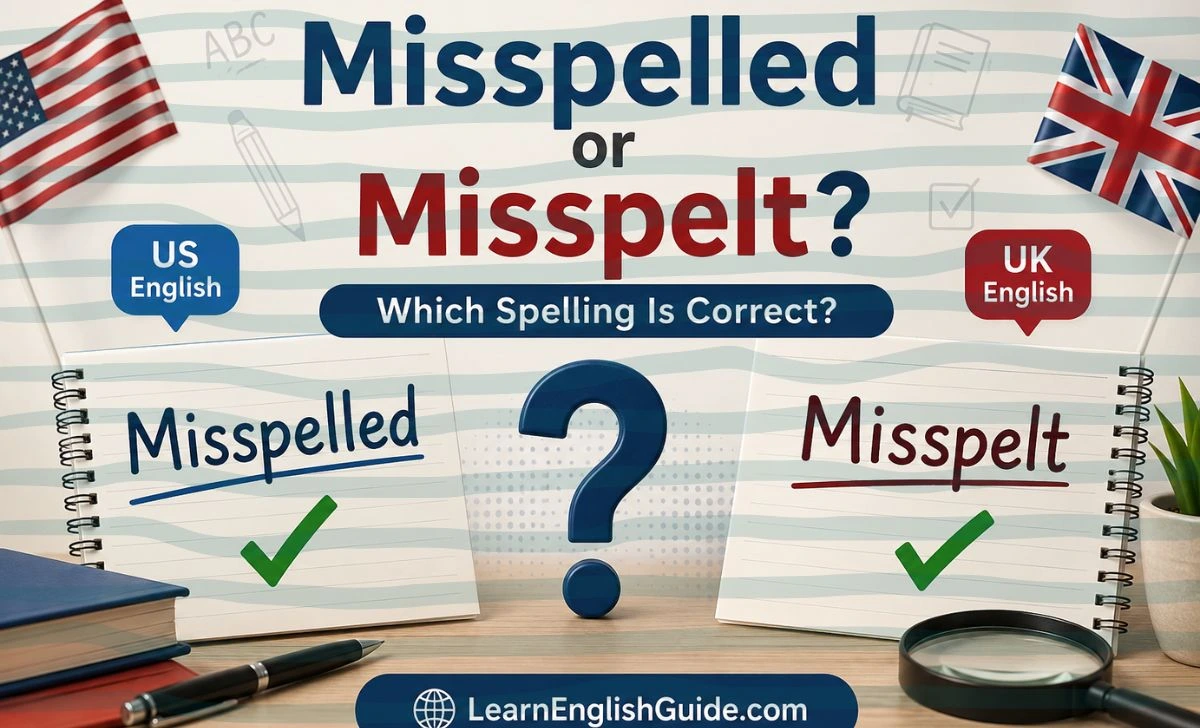
Misspelled or misspelt are both correct spellings of the past tense and past participle of misspell. The difference depends on the type of English you use. Misspelled is the preferred spelling in American English, while misspelt is common in British English and many Commonwealth countries.
This difference often confuses writers because both versions appear in dictionaries, grammar tools, and online content. In this guide, you’ll learn the origin of both spellings, their pronunciation, regional usage, common mistakes, practical examples, and tips to help you choose the right spelling with confidence.
Quick Answer
| English Variant | Correct Spelling | Example |
| American English | Misspelled | I misspelled your name in the email. |
| British English | Misspelt | The surname was misspelt on the certificate. |
Both words have the same meaning. They describe a word that has been written with the incorrect spelling.
Examples:
- I misspelled the customer’s address in the report.
- Her last name was misspelt in the newspaper article.
- The student realized he had misspelled several words during the exam.
Both forms are accepted by major dictionaries, but choosing the correct one depends on your audience.
The Origin of Misspelled or Misspelt
The words misspelled and misspelt come from the verb misspell, which combines two simple parts:
- Miss- = to do something incorrectly or wrongly.
- Spell = to write or arrange letters correctly to form a word.
Together, misspell means to spell a word incorrectly.
The spelling difference developed because British English and American English often form the past tense of verbs differently.
- American English usually adds -ed, creating misspelled.
- British English sometimes prefers -t, creating misspelt, just as it does with words like learnt, dreamt, and spoilt.
This pattern has existed for centuries and reflects the natural evolution of the English language rather than a grammar mistake.
Here are similar examples:
| Base Verb | American English | British English |
| Spell | Spelled | Spelt |
| Learn | Learned | Learnt |
| Dream | Dreamed | Dreamt |
| Spoil | Spoiled | Spoilt |
| Smell | Smelled | Smelt |
Modern style guides generally recommend staying consistent throughout your writing. If you’re writing for an American audience, use misspelled. If your audience is in the UK or other Commonwealth countries, misspelt is the more natural choice.
British English vs American English Spelling
The biggest difference between misspelled and misspelt is regional preference—not meaning.
American English strongly favors misspelled, and you’ll commonly see it in:
- Academic writing
- Business communication
- Professional writing
- News articles
- Government documents
- SEO content
- Content writing
British English usually prefers misspelt, although misspelled is also understood and accepted.
Comparison Table
| Feature | Misspelled | Misspelt |
| Preferred in | American English | British English |
| Meaning | Spelled incorrectly | Spelled incorrectly |
| Grammar | Past tense & past participle | Past tense & past participle |
| Formal writing | Yes | Yes |
| Academic writing | Very common in the US | Common in the UK |
| Business communication | Standard in the US | Standard in the UK |
| Accepted by dictionaries | Yes | Yes |
Examples
American English
- The report was misspelled before publication.
- I accidentally misspelled the client’s name.
- The grammar checker found three misspelled words.
British English
- The address was misspelt on the envelope.
- His surname was misspelt in the official letter.
- The editor corrected every misspelt word before printing.
Whether you use Oxford English Dictionary, Cambridge Dictionary, or Merriam-Webster, you’ll find that both spellings are recognized. The important thing is to match the spelling to your target audience and remain consistent throughout your document.
Pronunciation of Misspelled or Misspelt
Although misspelled and misspelt have different spellings, they are pronounced almost the same. The only noticeable difference is the ending sound.
| Word | IPA Pronunciation | Sounds Like |
| Misspelled | /mɪsˈspeld/ | miss-SPELD |
| Misspelt | /mɪsˈspelt/ | miss-SPELT |
The first part (miss-) and the main verb (spell) sound the same in both words. Only the final -ed and -t endings differ slightly.
Pronunciation Tips
- Stress falls on the second syllable: miss-SPELD or miss-SPELT.
- In everyday conversation, many native speakers pronounce both words so similarly that the difference is difficult to hear.
- Your pronunciation will not usually cause confusion because both words carry the same meaning.
Spoken Examples
- “I misspelled your email address.”
- “The headline was misspelt in yesterday’s newspaper.”
- “Several words were misspelled in the report.”
- “The student’s name was misspelt on the certificate.”
Whether you’re speaking with American or British English speakers, both pronunciations are widely understood.
Why People Confuse Misspelled or Misspelt
Many English language learners—and even experienced writers—wonder whether misspelled or misspelt is correct. The truth is that both are correct, but they belong to different regional writing styles.
Here are the main reasons people mix them up:
1. British vs American English
This is the biggest reason for the confusion.
- Americans usually write misspelled.
- British writers usually write misspelt.
People often see both online and assume one must be a spelling mistake, when in fact both are standard.
2. Similar Pronunciation
Both words sound almost identical in everyday speech. Because there is little difference in pronunciation, many writers are unsure which spelling to use.
3. Different Dictionary Preferences
Major dictionaries recognize both forms, but they prioritize them differently.
- Merriam-Webster lists misspelled as the standard American form.
- Oxford English Dictionary and Cambridge Dictionary recognize both, with misspelt being more common in British English.
4. Grammar and Spell Checkers
Different spell check and grammar checker tools follow different language settings.
For example:
- A US English setting may underline misspelt.
- A UK English setting may suggest misspelt instead of misspelled.
This often makes writers think one version is incorrect.
5. Other Similar Word Pairs
The same pattern appears in many English verbs.
| American English | British English |
| Spelled | Spelt |
| Learned | Learnt |
| Burned | Burnt |
| Dreamed | Dreamt |
| Spoiled | Spoilt |
| Smelled | Smelt |
| Leaped | Leapt |
| Kneeled | Knelt |
Understanding these regional spelling patterns makes it much easier to choose the correct form for your audience.
Which Spelling Should You Use?
The right choice depends on who will read your writing. Both misspelled and misspelt are correct, but using the spelling that matches your audience makes your writing look more professional and consistent.
| Audience | Recommended Spelling | Why |
| United States | Misspelled | Standard in American English |
| United Kingdom | Misspelt | Preferred in British English |
| Canada | Either (follow your style guide) | Both are understood |
| Australia & New Zealand | Misspelt | More common in Commonwealth English |
| International audience | Misspelled | More widely recognized worldwide |
Use Misspelled if you are writing:
- Academic papers for US schools or universities
- Business communication with American clients
- SEO articles for a global audience
- Website content targeting US readers
- Professional reports using American English
Examples
- I misspelled the product name on the website.
- The editor corrected every misspelled word before publishing.
- Our proofreading team found several misspelled terms.
Use Misspelt if you are writing:
- UK newspapers or magazines
- British academic writing
- Government documents in the UK
- Content for readers in the UK, Australia, or New Zealand
- Publications following British style guides
Examples
- The company name was misspelt in the announcement.
- His surname was misspelt on the official certificate.
- The editor fixed each misspelt word before printing.
Professional Advice
No matter which spelling you choose:
- Stay consistent throughout the document.
- Match your English language setting in your word processor or grammar checker.
- Follow your organization’s style guide if one is provided.
- When working with copy editing or proofreading, check that all spellings follow the same regional standard.
Choosing the correct regional spelling improves readability, builds credibility, and helps your written communication look polished.
Common Mistakes with Misspelled or Misspelt
Writers often make mistakes not because they don’t know the meaning, but because they mix spelling styles or confuse similar words.
| Mistake | Correct Form | Explanation |
| Using misspelt in US English documents | Misspelled | American English prefers -ed. |
| Using misspelled in British publications | Misspelt | British English commonly prefers -t. |
| Mixing both spellings in one article | Choose one style | Keep the same regional spelling throughout. |
| Writing miss-spelled | Misspelled | The word is written as one word, not hyphenated. |
| Confusing misspelled with misspelled word | Use according to context | One is a verb form, the other is part of a phrase. |
Incorrect vs Correct Examples
❌ The student’s name was miss-spelled.
✅ The student’s name was misspelled.
❌ Several words were misspelt in an article written entirely in American English.
✅ Several words were misspelled in the article.
❌ The report uses misspelled in one paragraph and misspelt in another.
✅ Use the same spelling consistently throughout the report.
Avoiding these common spelling mistakes and checking your work with a reliable spell checker or proofreading tool will help you produce clear, accurate, and professional writing.
Misspelled or Misspelt in Everyday Examples
Both misspelled and misspelt appear in everyday writing. The only difference is the regional spelling you choose. Here are examples from common situations.
American English
I misspelled your last name in my previous email. I apologize for the mistake.
British English
I misspelt your surname in my earlier email. Thank you for pointing it out.
News
- The newspaper misspelled the athlete’s name in the headline.
- The local paper misspelt the town’s name in today’s edition.
Social Media
- I can’t believe I misspelled that simple word!
- Oops! I misspelt my friend’s username in the post.
Academic Writing
- The professor highlighted every misspelled word in the assignment.
- The examiner noted that one technical term was misspelt throughout the essay.
Business Communication
- The client’s company name was misspelled in the contract.
- The employee noticed the address had been misspelt before the document was printed.
Formal Writing
- The editor corrected every misspelled word during copy editing.
- Careful proofreading helps remove spelling errors before publication.
These examples show that both spellings work perfectly when they match the intended audience and regional writing conventions.
Easy Trick to Remember Misspelled or Misspelt
A simple memory trick can help you choose the correct spelling every time.
Memory Trick
Think of the country you’re writing for.
- 🇺🇸 America = -ED → MisspellED
- 🇬🇧 Britain = -T → MisspelT
If your document follows American English, use misspelled.
If it follows British English, use misspelt.
Another Easy Way
Remember these matching pairs:
| American English | British English |
| Misspelled | Misspelt |
| Learned | Learnt |
| Burned | Burnt |
| Dreamed | Dreamt |
| Spoiled | Spoilt |
When you see one -ed word, you’ll usually find a matching -t version in British English.
This quick trick helps English learners, content writers, students, and professionals avoid common spelling mistakes and choose the right form with confidence.
Comparison Table
| Feature | Misspelled | Misspelt |
| English Variety | American English | British English |
| Meaning | Spelled incorrectly | Spelled incorrectly |
| Pronunciation | Almost identical | Almost identical |
| Formal Writing | Yes | Yes |
| Dictionary Acceptance | Yes | Yes |
| Best For | US & global audiences | UK & Commonwealth audiences |
The popularity of misspelled does not make misspelt incorrect. Both forms are accepted by trusted dictionaries and grammar references. The best choice depends on your readers, your style guide, and the regional variety of English you are using.
FAQs
Is misspelled or misspelt correct?
Yes. Both misspelled and misspelt are correct. Misspelled is the standard spelling in American English, while misspelt is more common in British English.
What is the difference between misspelled and misspelt?
There is no difference in meaning. The only difference is regional usage. Both words mean that something was written with the incorrect spelling.
Should I use misspelled in academic writing?
If you are writing for a US school, university, or publication, use misspelled. If you are writing for a UK institution, misspelt is usually the preferred choice.
Do dictionaries accept both spellings?
Yes. Major dictionaries such as Merriam-Webster, Oxford English Dictionary, and Cambridge Dictionary recognize both spellings. They simply recommend different forms based on regional English.
Why does my spell checker say misspelt is wrong?
Your spell checker follows your selected language settings. If it is set to US English, it will usually suggest misspelled. If it is set to UK English, it may recommend misspelt instead.
Is misspelt old-fashioned?
No. Misspelt is still widely used in the United Kingdom, Australia, New Zealand, and other Commonwealth countries. It is a modern and accepted British spelling.
Which spelling is better for SEO content?
If your audience is primarily in the United States or worldwide, misspelled is generally the better choice because it has broader recognition. If your website targets British readers, misspelt is the more natural option.
Conclusion
The choice between misspelled or misspelt comes down to regional English, not correctness. Misspelled is the preferred form in American English, while misspelt is commonly used in British English and many Commonwealth countries.
Both spellings have the same meaning, the same pronunciation, and are accepted by leading dictionaries. The most important rule is to stay consistent throughout your writing.
Whether you’re creating academic writing, business communication, content writing, or everyday emails, using the spelling that matches your audience will make your work look professional, polished, and easy to understand.
Read More Blogs:
- Likable or Likeable: British vs American English
- Licence or License: What’s the Difference and Which Is Correct?

Hi, I am Bill Walsh, and I write clear and practical grammar blogs on Syntaxiffy.com.
I focus on English grammar, pair of words, and spelling differences to help readers improve their writing skills.