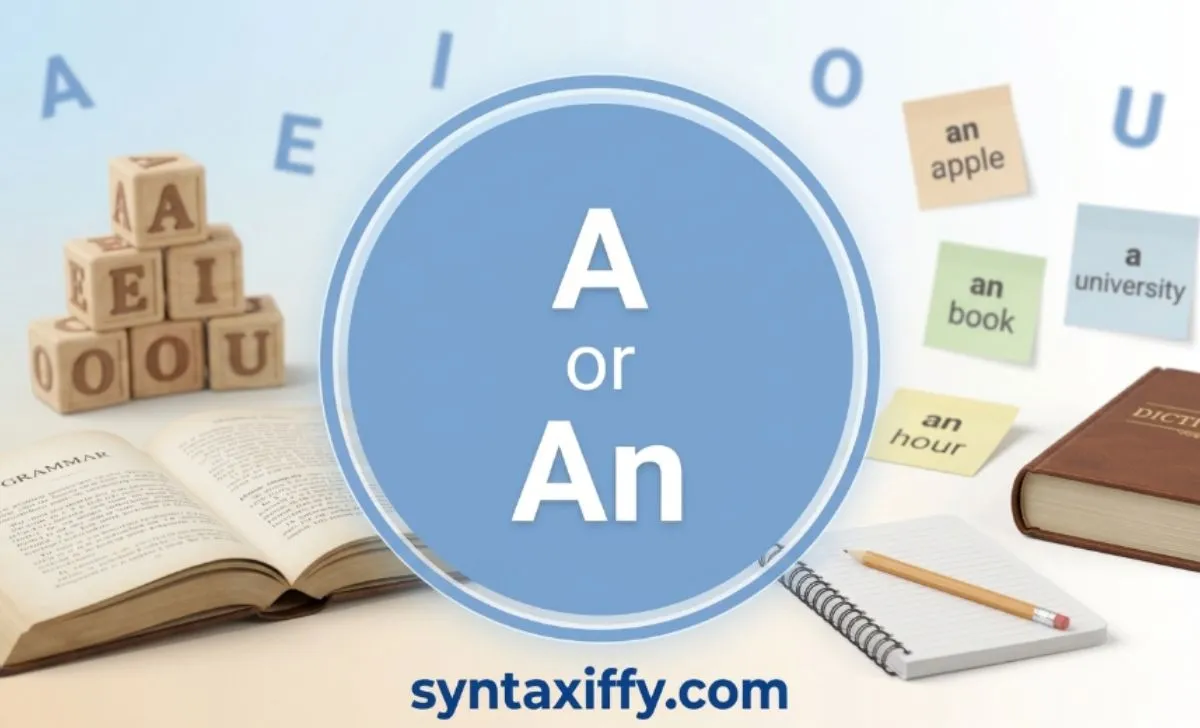
Choosing a or an is one of the first English grammar rules that every learner studies, yet it still causes confusion. The quick answer is simple: use a before a consonant sound and an before a vowel sound. The choice depends on pronunciation, not just spelling. Words like a university and an hour prove this rule.
Many English learners, ESL students, writers, and professionals make mistakes because some words begin with silent letters or unusual sounds. In this guide, you’ll learn the grammar rules, pronunciation, history, and real-life examples to use indefinite articles correctly in academic, business, and everyday writing.
Quick Answer
A and an are indefinite articles in English grammar. They come before a singular countable noun when you are talking about something for the first time or when it is not specific.
- Use a before a consonant sound.
- Use an before a vowel sound.
Remember, the rule is based on how the word sounds, not how it is spelled.
Examples
| Correct Usage | Why It Is Correct |
| a book | Book starts with the /b/ consonant sound. |
| a university | University begins with the /y/ sound, which is a consonant sound. |
| a European country | European starts with the /y/ sound. |
| a user | User begins with the /y/ sound. |
| an apple | Apple starts with a vowel sound. |
| an orange | Orange starts with a vowel sound. |
| an umbrella | Umbrella starts with a vowel sound. |
| an elephant | Elephant starts with a vowel sound. |
| an hour | The h is silent, so the word begins with a vowel sound. |
| an honest person | Honest has a silent h. |
| an heir | Heir begins with a vowel sound because the h is silent. |
| an MBA graduate | MBA starts with the spoken sound “em.” |
| an FBI agent | FBI starts with the spoken sound “ef.” |
| an X-ray | X is pronounced “ex.” |
| a UFO | UFO starts with the spoken sound “you.” |
| a one-time event | One starts with the /w/ sound. |
Quick Rule
| Use A | Use An |
| Before a consonant sound | Before a vowel sound |
| a house | an idea |
| a cat | an email |
| a unique plan | an umbrella |
| a uniform | an hour |
Whether you’re writing an essay, email, report, social media post, or business document, following this simple rule improves your writing skills, readability, and communication.
The Origin of A or An
The articles a and an have existed in the English language for hundreds of years. They developed from the Old English word ān, meaning one. As English changed over time, the word became shorter and easier to say.
The form an was originally used before many words because it made speech flow more smoothly. Later, speakers naturally shortened an to a before consonant sounds, while keeping an before vowel sounds. This pronunciation-based change helped create clearer and more natural speech.
Today, both a and an are known as indefinite articles. They are an important part of sentence structure, English composition, and standard English. Unlike the definite article the, these articles refer to a person, place, or thing that is not specific.
There are no spelling differences between a and an. They are different grammatical forms chosen according to pronunciation, not regional spelling.
British English vs American English Spelling
Many learners wonder whether British English and American English use different rules for a or an. The answer is no.
Both varieties of English use exactly the same indefinite articles and follow the same pronunciation-based grammar rule.
For example:
- British English: a university, an hour
- American English: a university, an hour
The only differences may appear in pronunciation or vocabulary, but the rule for choosing a or an never changes.
Comparison Table
| Feature | British English | American English |
| Article before consonant sound | a | a |
| Article before vowel sound | an | an |
| a university | ✓ Correct | ✓ Correct |
| an umbrella | ✓ Correct | ✓ Correct |
| an honest person | ✓ Correct | ✓ Correct |
| a European city | ✓ Correct | ✓ Correct |
| Grammar rule | Same | Same |
| Standard spelling | Same | Same |
Whether you are learning ESL, EFL, academic English, or business communication, you can confidently apply the same article rules in both British and American English.
Pronunciation of A or An
The correct choice between a and an depends on phonetics and pronunciation, not simply on the first letter of a word.
Pronunciation
- A → /ə/ or /eɪ/
- An → /ən/ or /æn/
The Golden Rule
Think about the first sound you hear.
If the word begins with a consonant sound, use a.
Examples:
- a house
- a university
- a user
- a European holiday
- a one-time event
If the word begins with a vowel sound, use an.
Examples:
- an apple
- an elephant
- an hour
- an honest person
- an MBA graduate
- an FBI officer
- an SOS call
This is why spoken English is more important than spelling when choosing the correct article. Understanding the first sound helps you write naturally and speak more fluently.
Why People Confuse A or An
Many learners confuse a and an because they focus on the first letter instead of the first sound. English spelling and pronunciation do not always match, which makes article usage challenging.
Common reasons include:
- They believe vowels always require an.
- They forget that silent letters change pronunciation.
- They do not know that acronyms and initialisms follow spoken sounds.
- They rely on spelling instead of phonetics.
- They translate directly from another language instead of following English grammar rules.
For example:
- ❌ an university
- ✅ a university
- ❌ a hour
- ✅ an hour
- ❌ an user
- ✅ a user
- ❌ an one-time event
- ✅ a one-time event
The easiest way to avoid mistakes is to listen to the word. If it starts with a vowel sound, use an. If it starts with a consonant sound, use a. This simple habit improves proofreading, editing, and overall writing accuracy in essays, emails, reports, and everyday communication.
Which Should You Use?
The choice between a and an never depends on where you live. Whether you write in the United States, the United Kingdom, Canada, Australia, New Zealand, or any other English-speaking country, the rule is the same.
Choose the article by listening to the first sound of the next word.
Use a before a consonant sound
Examples:
- a book
- a house
- a university
- a European country
- a user
- a uniform
- a one-time event
- a useful tool
- a unique idea
- a UFO
Use an before a vowel sound
Examples:
- an apple
- an orange
- an elephant
- an umbrella
- an hour
- an honest person
- an heir
- an MBA graduate
- an FBI agent
- an X-ray
Audience-Based Advice
| Audience | Best Practice |
| Students | Learn the pronunciation rule instead of memorizing spellings. |
| ESL & EFL learners | Listen to the first sound before choosing the article. |
| Academic writers | Always proofread article usage before submitting essays. |
| Business professionals | Correct articles make reports and emails look professional. |
| Content writers & bloggers | Proper article usage improves readability and credibility. |
No matter your audience, using the correct indefinite article makes your English grammar, sentence structure, and communication skills stronger.
Common Mistakes with A or An
Many grammar mistakes happen because writers follow the first letter instead of the first sound.
Common Errors and Corrections
| Incorrect | Correct | Reason |
| an university | a university | University starts with the /y/ sound. |
| a hour | an hour | H is silent. |
| an user | a user | User starts with the /y/ sound. |
| an European country | a European country | European begins with the /y/ sound. |
| a umbrella | an umbrella | Umbrella begins with a vowel sound. |
| a honest person | an honest person | Honest has a silent h. |
| an one-time event | a one-time event | One starts with the /w/ sound. |
| a MBA graduate | an MBA graduate | MBA begins with the spoken sound “em.” |
| a FBI officer | an FBI officer | FBI begins with the spoken sound “ef.” |
| a X-ray | an X-ray | X is pronounced “ex.” |
Tips to Avoid Mistakes
- Think about the sound, not the spelling.
- Read the sentence aloud.
- Use a grammar checker while proofreading.
- Practice with real sentence examples.
- Learn common exceptions with silent letters and abbreviations.
These habits improve editing, proofreading, and writing accuracy in both formal and informal writing.
A or An in Everyday Examples
Correct article usage is important in everyday communication. Here are examples from different writing situations.
Please bring a notebook and an ID card to tomorrow’s meeting.
Business Writing
We hired an experienced accountant for a growing company.
Academic Writing
She wrote an excellent essay about climate change.
News
Police rescued an injured hiker after a difficult search.
Social Media
I had an amazing day at a beautiful beach!
Conversation
I saw a cat chasing an insect.
Technical Writing
Install a new battery before using an electric device.
Using the correct article makes your writing sound natural in emails, reports, essays, social media posts, news articles, and professional communication.
Easy Trick to Remember A or An
You do not need to memorize hundreds of words. Just remember one simple rule.
Memory Trick
A = Consonant Sound
An = Vowel Sound
Ask yourself:
“What sound do I hear first?”
If you hear a consonant sound, use a.
If you hear a vowel sound, use an.
Easy Examples
| First Sound | Correct Article |
| Book | a book |
| House | a house |
| User | a user |
| University | a university |
| Apple | an apple |
| Orange | an orange |
| Hour | an hour |
| Honest | an honest person |
| MBA | an MBA graduate |
| FBI | an FBI agent |
Quick Mnemonic
Hear the sound before you write the article.
If you follow this rule every time, you’ll rarely make mistakes with a and an.
A or An – Google Trends & Usage Data
The keyword “a or an” is searched by millions of learners because English articles are one of the most common grammar topics. Students, teachers, bloggers, content writers, and professionals often search for simple rules and examples.
Countries with high search interest include:
- United States
- United Kingdom
- India
- Pakistan
- Canada
- Australia
- Philippines
Popular related searches include:
- a vs an
- when to use a and an
- a or an rules
- a or an examples
- indefinite articles
- article usage in English
- vowel sound vs consonant sound
- English grammar articles
- a or an worksheet
- a or an quiz
Search interest usually increases during school terms, exam seasons, and English language courses because learners want to improve grammar, writing skills, pronunciation, and academic writing.
Comparison Table
| Feature | A | An |
| Article Type | Indefinite Article | Indefinite Article |
| Used Before | Consonant Sound | Vowel Sound |
| Based On | Pronunciation | Pronunciation |
| Example 1 | a book | an apple |
| Example 2 | a university | an hour |
| Example 3 | a user | an honest person |
| Example 4 | a European country | an MBA graduate |
| Example 5 | a UFO | an X-ray |
| Common Mistake | an university | a hour |
| Correct Rule | Listen to the first sound | Listen to the first sound |
FAQs
Is it a or an before a vowel?
Use an before a vowel sound, not simply a vowel letter.
Examples:
- an apple
- an orange
- an elephant
- an umbrella
Is it a university or an university?
The correct form is a university because university begins with the /y/ sound, which is a consonant sound.
✅ a university
❌ an university
Why do we say an hour instead of a hour?
The h in hour is silent. Since the word begins with the vowel sound /aʊ/, the correct article is an.
✅ an hour
❌ a hour
Is it a European or an European?
Use a European because European starts with the /y/ sound.
✅ a European country
❌ an European country
Is the rule based on spelling or pronunciation?
The rule is based on pronunciation (the first sound you hear), not the first letter you see.
For example:
- a user
- a one-time event
- an honest person
- an MBA graduate
Can I use a before a vowel?
Yes, if the word starts with a consonant sound.
Examples:
- a university
- a user
- a unique opportunity
- a European city
- a one-way street
Although these words begin with vowels, their pronunciation starts with a consonant sound.
What are indefinite articles?
A and an are indefinite articles in English grammar. They are used before singular countable nouns when referring to something that is not specific.
Examples:
- I bought a book.
- She ate an apple.
The article the is the definite article because it refers to a specific person, place, or thing.
Conclusion
Choosing between a or an is easy once you remember one important rule: always listen to the first sound, not the first letter. Use a before a consonant sound and an before a vowel sound.
This simple rule works in British English, American English, academic writing, business communication, content writing, and everyday conversations.
Understanding indefinite articles, pronunciation, and sentence structure will improve your English grammar, writing skills, and readability. Practice with real examples, proofread your work, and soon using a and an correctly will become a natural habit.
Read More Blogs:
- Anyway or Any Way: What’s the Difference and Which Is Correct?
- Today or To Day: The Right Spelling You Should Use

Hi, I am Roy Peter Clark, and I write clear and practical grammar and writing blogs.
On Syntaxiffy.com, I focus on English grammar, style, and writing techniques to help readers improve clarity and communication.