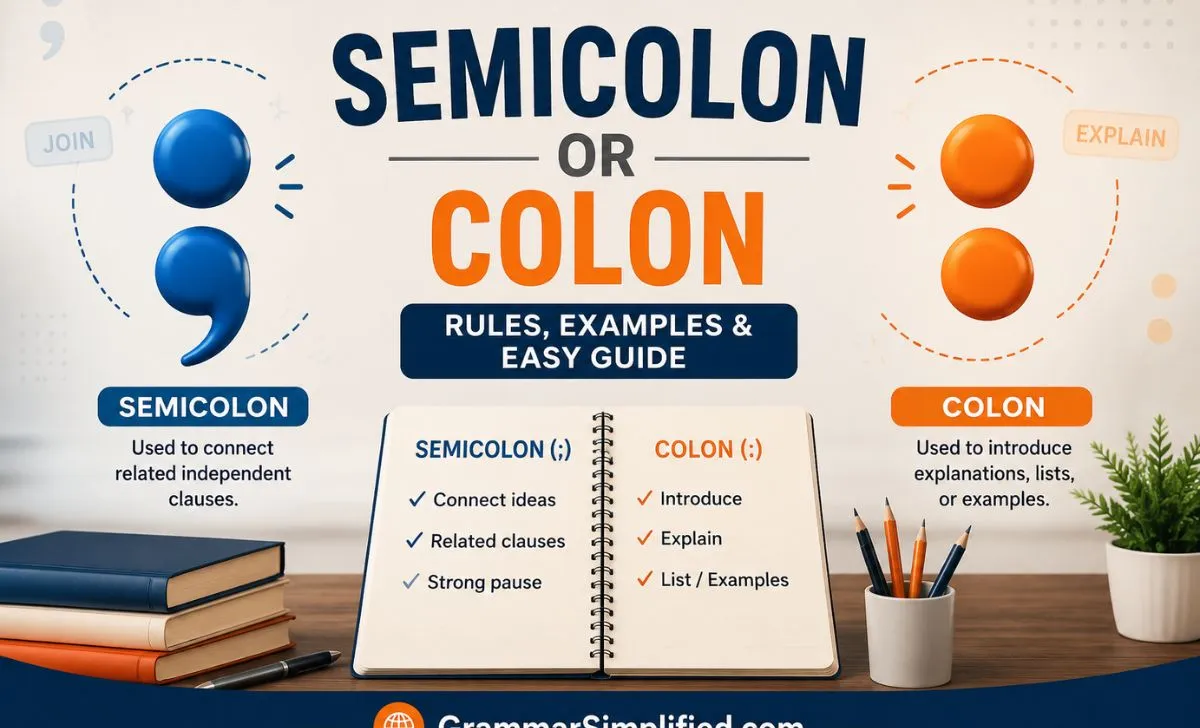
Learning when to use a semicolon or colon is one of the biggest challenges in English grammar. Both punctuation marks connect ideas, but they do different jobs.
A semicolon (;) joins two closely related independent clauses, while a colon (:) introduces a list, explanation, example, quotation, or emphasis. Many writers confuse them because both create a pause in a sentence.
This guide explains the differences with simple rules, examples, comparison tables, pronunciation, usage tips, and common mistakes so you can use each punctuation mark with confidence in academic, professional, and everyday writing.
Quick Answer
A semicolon (;) connects two related complete sentences without using a coordinating conjunction.
Example:
The meeting ended early; everyone went home.
A colon (:) introduces information such as a list, explanation, quotation, or example.
Example:
Bring these items: a notebook, a pen, and your laptop.
Quick Comparison
| Semicolon (;) | Colon (:) |
| Joins related independent clauses | Introduces lists or explanations |
| Connects complete sentences | Comes after a complete sentence |
| Often replaces a period | Adds extra information |
The Origin of Semicolon or Colon
The colon is much older than the semicolon. Ancient Greek scholars used the colon to mark pauses while reading aloud. Over time, it became a punctuation mark for introducing information.
The semicolon appeared later during the Renaissance. Italian printer Aldus Manutius introduced it in the late 15th century to connect closely related ideas without ending the sentence.
These punctuation marks are not spelling variations. They are different punctuation symbols with different grammar rules and purposes.
British English vs American English Spelling
Unlike words such as colour and color, there is no spelling difference between semicolon and colon in British English and American English.
Both varieties of English use the same punctuation marks and follow nearly identical punctuation rules.
Comparison Table
| Feature | British English | American English |
| Semicolon | ✓ Semicolon | ✓ Semicolon |
| Colon | ✓ Colon | ✓ Colon |
| Meaning | Same | Same |
| Usage | Nearly identical | Nearly identical |
The only minor differences may appear in some style guides, but the punctuation marks themselves never change.
Pronunciation of Semicolon or Colon
Semicolon
Pronunciation: SEM-ee-koh-luhn
IPA: /ˌsem.iˈkoʊ.lən/
Colon
Pronunciation: KOH-luhn
IPA: /ˈkoʊ.lən/
Although the words sound different, beginners sometimes confuse them because they often appear in the same grammar lessons about punctuation marks.
Why People Confuse Semicolon or Colon
Many English learners mix them up because both punctuation marks connect ideas.
Common reasons include:
- Both create a pause.
- Both appear between parts of a sentence.
- Both are taught in English grammar classes.
- Many writers think they are interchangeable.
- Grammar checkers may not explain the difference clearly.
Remember:
- Use a semicolon to connect related complete sentences.
- Use a colon to introduce something.
Which Spelling Should You Use?
Since there are no spelling variations, simply use the standard forms:
- Semicolon
- Colon
Whether you write for:
- Academic writing
- Professional writing
- Business communication
- Technical writing
- Creative writing
- Content writing
- Social media
- Email writing
…the spelling remains exactly the same worldwide.
Common Mistakes with Semicolon or Colon
| Incorrect | Correct | Why |
| I bought: apples and bananas yesterday. | I bought apples and bananas yesterday. | No colon before a simple object. |
| She was tired: she went to bed. | She was tired; she went to bed. | Two independent clauses need a semicolon. |
| My favorite colors are blue; green; red. | My favorite colors are: blue, green, and red. | A colon introduces the list. |
| The answer is; yes. | The answer is: yes. | Colon introduces the answer. |
| I studied hard; and I passed. | I studied hard, and I passed. | Don’t combine a semicolon with a coordinating conjunction in this structure. |
Semicolon or Colon in Everyday Examples
Please send the following documents: your résumé, portfolio, and references.
News
The storm caused major damage; emergency crews responded immediately.
Social Media
Today’s goal: stay positive.
Business Writing
Sales increased by 20%; profits also improved.
Academic Writing
The experiment produced one clear result: students learned faster with regular practice.
Easy Trick to Remember Semicolon or Colon
Use this simple memory trick:
Semicolon = Same Level
Think of the semicolon as connecting two complete sentences that are closely related.
The rain stopped; the sun appeared.
Colon = Coming Next
Think of the colon as saying:
“Here comes more information.”
Examples:
- Here are my goals: learn, practice, improve.
- She had one dream: becoming a doctor.
Semicolon or Colon – Google Trends & Usage Data
Both punctuation marks are searched worldwide because students, writers, bloggers, and professionals want to improve their writing skills.
Semicolon
Popular searches often come from:
- United States
- United Kingdom
- Canada
- Australia
- India
People usually search:
- When to use a semicolon
- Semicolon examples
- Semicolon rules
- Semicolon before however
Colon
Popular searches include:
- Colon punctuation
- Colon before a list
- Colon examples
- Colon grammar rules
- Colon vs semicolon
Search interest increases during school terms, exam seasons, and professional writing courses.
Comparison Table
| Feature | Semicolon | Colon |
| Symbol | ; | : |
| Main Purpose | Connect related independent clauses | Introduce information |
| Before Lists | No | Yes |
| Before Explanation | Sometimes | Yes |
| Before Quotation | Rarely | Yes |
| In Time | No | Yes (10:30) |
| In Ratios | No | Yes (2:1) |
| Common in Academic Writing | Yes | Yes |
| Common in Professional Writing | Yes | Yes |
FAQs
What is the difference between a semicolon and a colon?
A semicolon joins closely related independent clauses, while a colon introduces a list, explanation, quotation, or example.
Can a semicolon replace a colon?
No. They have different grammar rules and should not normally replace each other.
Can I use a colon before a list?
Yes. Use a colon after a complete sentence when introducing a list.
Can a semicolon join two complete sentences?
Yes. That is one of its primary uses.
Do you capitalize after a colon?
Usually not, unless the next word is a proper noun or your style guide requires capitalization before a complete quotation or sentence.
Is a semicolon stronger than a comma?
Yes. A semicolon creates a stronger separation than a comma but a weaker one than a period.
Which punctuation mark should I use in formal writing?
Use the punctuation mark that matches your sentence structure. Both semicolons and colons are appropriate in academic, technical, business, and professional writing when used correctly.
Conclusion
Understanding semicolon or colon becomes easy once you know their different purposes. A semicolon connects two closely related independent clauses, while a colon introduces information such as lists, explanations, quotations, or examples.
Neither punctuation mark has British or American spelling variations, making them universal across English. Whether you are writing essays, emails, reports, news articles, or social media posts, choosing the correct punctuation improves readability, clarity, and professionalism.
Practice with real examples, remember the simple memory trick, and you’ll use semicolons and colons confidently in every type of writing.
Read More Blogs:
- Meantime or Mean Time: Learn the Right Usage With Examples
- For Sale or Forsale: Which Spelling Is Correct?

Hi, I am Mary Norris, and I write clear and insightful grammar blogs on Syntaxiffy.com.
On Syntaxiffy.com, I focus on English grammar, usage, and writing accuracy to help readers improve their language skills.