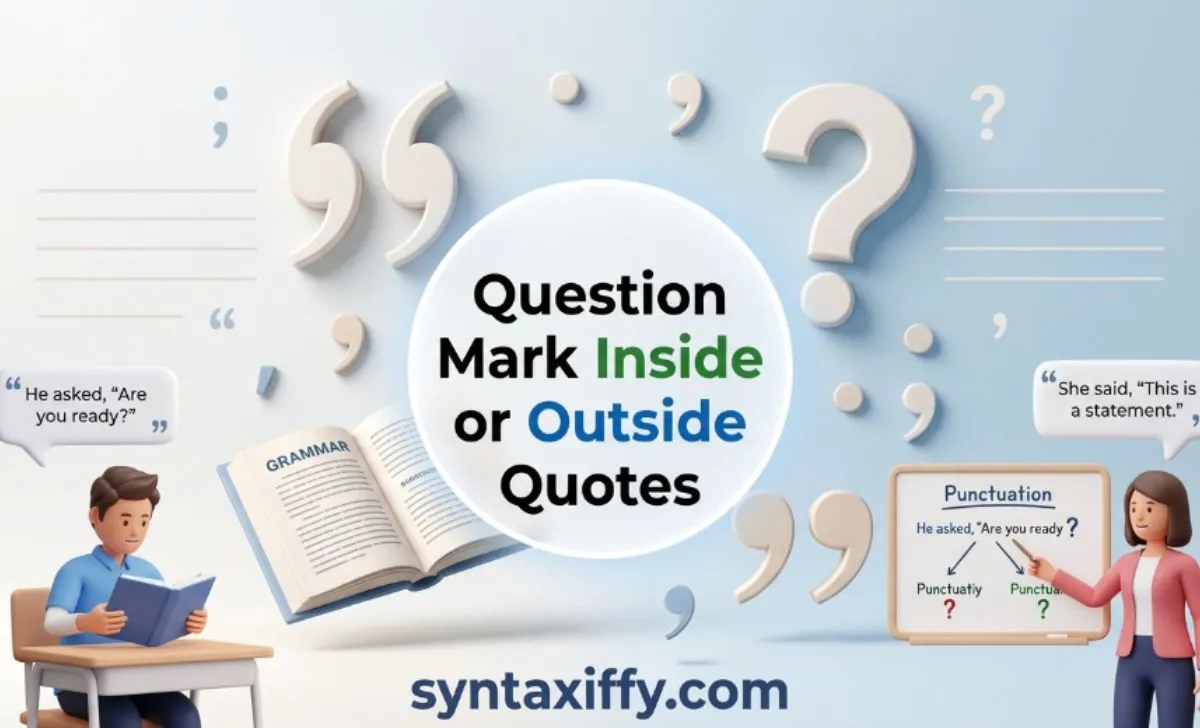
Many writers wonder whether a question mark inside or outside quotes is the correct choice. The answer depends on whether the question mark belongs to the quoted words or the whole sentence.
This rule often confuses students, bloggers, business professionals, and English learners because American English and British English follow slightly different punctuation conventions.
In this guide, you’ll learn the correct grammar rules, see clear examples, compare UK and US styles, and discover simple tricks to remember the right punctuation every time.
Quick Answer
The question mark inside or outside quotes depends on what is actually being questioned.
- Put the question mark inside the quotation marks if the quoted words are themselves a question.
- Put the question mark outside the quotation marks if the entire sentence is a question but the quoted words are not.
Examples
✅ She asked, “Where are you going?”
(The quoted sentence is a question.)
✅ Did he really say, “I will arrive tomorrow”?
(The whole sentence is asking a question, but the quoted words are a statement.)
Quick Rule Table
| Situation | Correct Example |
| Quoted words are a question | “Are you ready?” she asked. |
| Whole sentence is a question | Did she say, “The meeting starts at nine”? |
| Direct quotation | “Who called?” asked Sarah. |
| Quoted statement inside a question | Have you read “The Great Gatsby”? |
Remember, the question mark belongs to the part that asks the question, not automatically to the quotation marks.
The Origin of Question Mark Inside or Outside Quotes
The rule about placing a question mark inside or outside quotation marks comes from the history of English punctuation and the development of different editorial style guides.
Early English printers did not follow one universal punctuation system. Over time, publishers and editors created standard writing conventions to make books, newspapers, and official documents easier to read.
As English spread around the world, two major punctuation traditions developed:
- American English usually places periods and commas inside quotation marks as a matter of style, while question marks depend on meaning.
- British English focuses more on logical punctuation, placing punctuation according to whether it belongs to the quoted material.
Despite these differences, both styles agree on one important rule:
A question mark goes inside quotation marks only if the quoted words are themselves a question.
This logical approach is used in:
- Academic writing
- Professional writing
- Business communication
- Technical writing
- Content writing
- Copy editing
- Proofreading
- Dialogue in fiction
- News reporting
Modern style guides such as the Chicago Manual of Style, APA Style, MLA Handbook, Associated Press Stylebook, and Oxford Style Manual all explain that question marks depend on meaning rather than a fixed placement rule.
Understanding this principle makes punctuation much easier than memorizing dozens of separate rules.
British English vs American English Spelling
Unlike words such as color/colour or organize/organise, there is no spelling difference for the question mark or quotation marks. The difference is in punctuation style, not spelling.
Both American English and British English use the same question mark (?) and quotation marks (” “ or ‘ ‘), but they sometimes differ in punctuation conventions.
Comparison Table
| Feature | American English | British English |
| Spelling | Question mark | Question mark |
| Quotation marks | Usually double quotation marks | Often single quotation marks in publishing |
| Question mark with quotations | Depends on meaning | Depends on meaning |
| Direct question in quotes | “Where are you?” | ‘Where are you?’ |
| Statement inside a question | Did she say, “I’m ready”? | Did she say, ‘I’m ready’? |
| Academic writing | Follows APA, MLA, Chicago | Often follows Oxford or publisher style |
| Business writing | Common in the US | Common in the UK and Commonwealth |
Examples
American English
- “Are you coming?” asked Emma.
- Did John say, “I’ll call later”?
British English
- ‘Are you coming?’ asked Emma.
- Did John say, ‘I’ll call later’?
Although the quotation mark style may differ, the placement of the question mark follows the same logical rule in both varieties of English: it stays with the words that form the actual question.
Pronunciation of Question Mark Inside or Outside Quotes
The phrase question mark inside or outside quotes is pronounced the same in both American English and British English. There are no alternative spellings or different spoken forms to remember.
Pronunciation
| Word | Pronunciation |
| Question | KWES-chun |
| Mark | Mark |
| Inside | in-SIDE |
| Outside | out-SIDE |
| Quotes | KWOHTS |
How It Sounds
Say the phrase naturally:
“Question mark inside or outside quotes?”
When speaking, people usually focus on the meaning rather than the punctuation. The confusion appears in writing, where the position of the question mark and quotation marks matters.
Whether you are giving a presentation, teaching English grammar, or discussing writing mechanics, the pronunciation remains the same.
Why People Confuse Question Mark Inside or Outside Quotes
Many English learners—and even experienced writers—are unsure where to place a question mark when quotation marks are involved.
Here are the most common reasons for the confusion.
1. The Rule Depends on Meaning
Many punctuation rules are fixed, but this one changes depending on whether the quoted words are asking the question.
For example:
✅ “Who is calling?”
✅ Did she say, “The train is late”?
The first question belongs to the quotation. The second belongs to the entire sentence.
2. American and British Writing Look Different
People often notice different quotation styles in books and online articles.
For example:
American English
“Where are you?”
British English
‘Where are you?’
Although the quotation marks may look different, the question mark still follows the same logical rule.
3. People Apply the Comma Rule
In American English, periods and commas are usually placed inside quotation marks. Many writers mistakenly think question marks always follow the same rule.
They do not.
Question marks depend on the meaning of the sentence.
4. Dialogue and Direct Speech Can Be Tricky
In direct speech, writers often focus on the dialogue and forget to check whether the quotation itself is a question.
Correct:
Sarah asked, “Are you ready?”
Correct:
Did Sarah say, “I am ready”?
5. Different Style Guides
Writers may use different style guides, such as:
- Chicago Manual of Style
- APA Style
- MLA Handbook
- Associated Press Stylebook
- Oxford Style Manual
These guides have small differences in punctuation conventions, but they all agree that the question mark belongs with the actual question.
Which Rule Should You Use?
The best choice depends on your audience and the type of writing.
| Audience | Recommended Style |
| American readers | Follow American punctuation conventions |
| British readers | Follow British punctuation conventions |
| Academic writing | Follow your required style guide (APA, MLA, Chicago, etc.) |
| Business writing | Use one style consistently throughout the document |
| Global audience | Use logical punctuation that clearly shows what is being questioned |
For American English
- Use double quotation marks in most writing.
- Place the question mark inside only when the quoted words are a question.
- Place it outside when the whole sentence asks the question.
For British English
- Single quotation marks are often preferred in published writing.
- Follow logical punctuation.
- Keep the question mark with the part that asks the question.
Professional Advice
Whether you are writing:
- emails
- reports
- blog posts
- academic assignments
- news articles
- business documents
- social media content
always ask yourself one question:
Who is asking the question—the quotation or the entire sentence?
Answering that question will help you place the punctuation correctly every time.
Common Mistakes with Question Mark Inside or Outside Quotes
Even experienced writers make punctuation mistakes when using quotation marks and question marks. Most errors happen because writers focus on the quotation marks instead of asking where the actual question belongs.
Common Errors and Corrections
| Incorrect | Correct | Why? |
| Did she say, “I am ready?” | Did she say, “I am ready”? | The quoted words are a statement, but the whole sentence is a question. |
| “Where are you”? | “Where are you?” | The quoted words are a direct question, so the question mark belongs inside the quotation marks. |
| Did he ask “Where are you”? | Did he ask, “Where are you?” | The quoted words form the question, so the punctuation stays inside. |
| “Can you help me”? she asked. | “Can you help me?” she asked. | A direct quotation that asks a question ends with a question mark inside the quotes. |
| Have you read “Who Moved My Cheese?”? | Have you read Who Moved My Cheese? | If the title itself is a question, one question mark is enough. Avoid using two question marks together. |
Tips to Avoid These Mistakes
- Decide whether the quotation or the whole sentence asks the question.
- Read the sentence aloud to check its meaning.
- Be consistent with your chosen style guide.
- Proofread carefully before publishing or submitting your writing.
- Use a trusted grammar checker or ask an editor to review important documents.
Question Mark Inside or Outside Quotes in Everyday Examples
Understanding the rule becomes much easier when you see it in real-life writing. Below are examples from common situations.
Emails
✅ Correct
Did you write, “The report is complete”?
✅ Correct
She asked, “Can you send the report today?”
News Writing
✅ Correct
The spokesperson asked, “Who released the information?”
✅ Correct
Did the minister really say, “Taxes will not increase”?
Social Media
✅ Correct
She posted, “Who’s joining us tonight?”
✅ Correct
Did he really tweet, “I’m leaving tomorrow”?
Academic Writing
✅ Correct
The researcher asked, “What factors affect learning?”
✅ Correct
Did the author write, “Language shapes thought”?
Business Writing
✅ Correct
The manager asked, “Have you finished the presentation?”
✅ Correct
Did the client write, “The proposal looks good”?
These examples show the same rule in different types of professional writing, academic writing, business communication, news reporting, and social media: the question mark belongs to the actual question.
Easy Trick to Remember Question Mark Inside or Outside Quotes
You don’t need to memorize dozens of punctuation rules. Just remember this simple trick.
The “Who Is Asking?” Trick
Ask yourself:
Who is asking the question?
- If the quoted words ask the question, put the question mark inside the quotation marks.
- If the entire sentence asks the question, put the question mark outside the quotation marks.
Memory Formula
Question inside the quote = Question mark inside the quotes.
Question outside the quote = Question mark outside the quotes.
Quick Examples
| Sentence | Correct Placement |
| “Are you ready?” | Inside the quotation marks |
| Did she say, “I am ready”? | Outside the quotation marks |
| “Who called?” | Inside the quotation marks |
| Did they write, “Meeting at noon”? | Outside the quotation marks |
Whenever you’re unsure, ignore the quotation marks for a moment and identify where the question is actually being asked. That simple habit will help you use question marks correctly in almost every situation.
Comparison Table
| Situation | Question Mark Inside Quotes | Question Mark Outside Quotes |
| The quoted words are a question | ✅ Yes | ❌ No |
| The whole sentence is a question | ❌ No | ✅ Yes |
| Direct speech | ✅ Usually | ❌ Rarely |
| Quoted statement inside a question | ❌ No | ✅ Yes |
| American English | Follows the meaning | Follows the meaning |
| British English | Follows the meaning | Follows the meaning |
Quick Examples
| Sentence | Correct? |
| “What time is it?” | ✅ Correct |
| Did she say, “I’ll be late”? | ✅ Correct |
| “I’ll be late?” | ❌ Incorrect (unless the speaker is expressing surprise or uncertainty) |
| Did he ask, “Where are you?” | ✅ Correct |
FAQs
1. Does the question mark go inside or outside quotation marks?
It depends on the meaning. If the quoted words are the question, place the question mark inside the quotation marks. If the entire sentence asks the question, place it outside.
2. What is the rule in American English?
In American English, question marks follow the meaning of the sentence. They are not automatically placed inside quotation marks.
3. Is the rule different in British English?
No. Although British English often uses single quotation marks instead of double quotation marks, the placement of the question mark follows the same logical rule.
4. Can I put a question mark outside quotation marks?
Yes. If the quoted words are a statement but the entire sentence is a question, the question mark should be outside the quotation marks.
Example:
Did she say, “The meeting starts at ten”?
5. Do style guides agree on this rule?
Yes. Major style guides such as the Chicago Manual of Style, APA Style, MLA Handbook, Associated Press Stylebook, and Oxford Style Manual all place the question mark according to the meaning of the sentence.
6. Does this rule apply to titles of books and movies?
Yes. If the title itself is a question, keep the question mark as part of the title.
Example:
Have you read Who Moved My Cheese?
7. How can I remember this punctuation rule?
Ask yourself one simple question:
Who is asking the question?
If the quotation asks it, place the question mark inside. If the sentence asks it, place it outside.
Conclusion
Knowing whether to use a question mark inside or outside quotes is easier than it first appears. The key is to identify where the actual question is being asked.
If the quoted words form a question, the question mark belongs inside the quotation marks. If the entire sentence asks the question, place it outside.
This logical rule works in both American English and British English, even though their quotation mark styles may differ.
By understanding the grammar, following your preferred style guide, and proofreading carefully, you can use quotation marks and question marks confidently in academic, professional, and everyday writing.
Read More Blogs:
- Semicolon or Colon: Learn the Difference in Minutes
- A or An: Simple Rules, Examples, and Common Mistakes

Hi, I am Bill Walsh, and I write clear and practical grammar blogs on Syntaxiffy.com.
I focus on English grammar, pair of words, and spelling differences to help readers improve their writing skills.