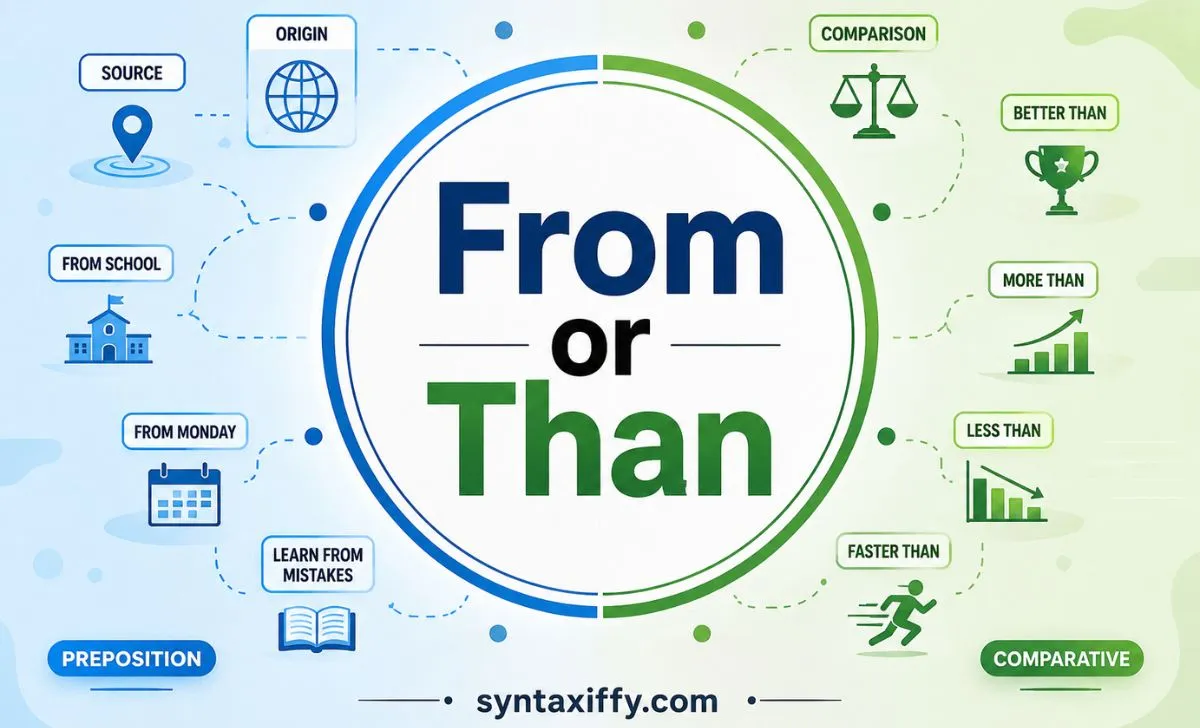
From or than is a common grammar question, but these two words are not interchangeable. From is a preposition that shows a starting point, source, place, time, distance, or origin.
Than is mainly used as a conjunction (and sometimes a preposition in modern usage) to make a comparison. Many English learners, students, and even native speakers confuse them because both appear in similar-looking sentences.
This guide explains the difference in simple English, covers grammar rules, pronunciation, usage, common mistakes, and real-life examples so you can choose the correct word with confidence in academic writing, emails, business communication, and everyday English.
From or Than – Quick Answer

Use from when talking about a starting point, source, place, time, direction, distance, separation, or origin.
Use than when making a comparison between two or more people, things, ideas, or actions.
Quick Examples
| Correct Sentence | Why It Is Correct |
| She came from Canada. | From shows the place of origin. |
| This laptop is better than mine. | Than introduces a comparison. |
| We work from Monday to Friday. | From shows the beginning of a time period. |
| Ali is taller than Ahmed. | Than compares two people. |
| I learned a lot from my teacher. | From shows the source of learning. |
| Walking is healthier than driving. | Than compares two activities. |
The Basic Grammar Rule
- From = Preposition
- Shows origin, source, movement, distance, material, time, or separation.
- Examples:
- Come from school.
- Recover from illness.
- Different from the original.
- Escape from danger.
- Than = Comparative word
- Used with comparative adjectives and comparative adverbs.
- Examples:
- More than
- Less than
- Better than
- Faster than
- Rather than
Remember this simple rule:
From tells where something starts. Than tells how two things compare.
The Origin of From or Than
Understanding the history of these words makes their meanings easier to remember.
The Origin of From
The word from comes from Old English fram, meaning forward, away, or out of. Over time, it became one of the most common prepositions in the English language. Today, it expresses ideas such as:
- Origin
- Source
- Beginning
- Direction
- Distance
- Separation
- Time
- Material
Examples:
- A gift from my friend.
- Water flows from the mountains.
- The table is made from wood.
The Origin of Than
The word than comes from Old English þonne (thonne), which was used to introduce comparisons. As English evolved, than became the standard word used after comparative adjectives and comparative adverbs.
Examples include:
- Bigger than
- Smaller than
- More intelligent than
- Earlier than
- Higher than
Why These Words Are Different
Although from and than are both common words in English grammar, they have always served different purposes.
| Word | Part of Speech | Main Function |
| From | Preposition | Shows origin, source, movement, time, place, or separation |
| Than | Conjunction (and sometimes a preposition in modern English) | Introduces a comparison between two or more things |
There is no British English vs American English spelling difference between from and than. Both spellings are identical worldwide. The confusion comes from grammar usage, sentence structure, and context—not spelling.
British English vs American English Spelling

Unlike many English words, from and than have the same spelling in both British English and American English. There are no alternative spellings such as colour/color or traveller/traveler. Whether you are writing for the UK, the US, Canada, Australia, or any other English-speaking country, you should always write from and than exactly the same way.
The real difference is how the words are used in a sentence, not how they are spelled. Following the correct grammar rules and sentence structure is much more important than worrying about regional spelling.
British vs American Usage
| Feature | British English | American English |
| Spelling of from | from | from |
| Spelling of than | than | than |
| Meaning | Same | Same |
| Grammar rules | Same | Same |
| Comparative expressions | Same | Same |
| Formal writing | Same | Same |
Examples Used in Both British and American English
| Correct Sentence | Explanation |
| She moved from London to Manchester. | From shows the starting place. |
| This phone is cheaper than that one. | Than compares two phones. |
| We are open from 9 a.m. to 5 p.m. | From marks the beginning of a time period. |
| Writing by hand is slower than typing. | Than introduces a comparison. |
| He learned English from online courses. | From shows the source of learning. |
| This solution is more effective than the previous one. | Than compares two solutions. |
A Note About “Different From” and “Different Than”
One small usage difference sometimes appears in regional English.
- Different from is the standard choice in both British English and formal writing.
- Different than is more common in American English, especially in informal writing or when followed by a complete clause.
Examples:
- Your answer is different from mine. ✅
- Today’s weather is different than it was yesterday. ✅ (Common in American English)
If you are writing for an international audience, in academic writing, business communication, or professional writing, different from is usually the safest and most widely accepted option.
Pronunciation of From or Than
Although these words look very different, some English learners confuse them because they are both short, unstressed function words that often appear quickly in spoken English. Learning their pronunciation helps improve both listening and speaking.
How to Pronounce From
IPA: /frəm/ or /frɒm/ (UK), /frəm/ or /frʌm/ (US)
It begins with the “fr” sound and ends with “m.”
Examples:
- From home
- From school
- From Pakistan
- From Monday
How to Pronounce Than
IPA: /ðæn/ or /ðən/
It starts with the voiced “th” sound, the same sound heard in this, that, and those.
Examples:
- Better than
- More than
- Less than
- Older than
Pronunciation Comparison
| Word | IPA | Sounds Like | Main Use |
| From | /frəm/ | “fruhm” | Shows origin, source, place, or time |
| Than | /ðæn/ | “than” | Makes a comparison |
Common Speaking Confusion
In fast conversation, both words may sound softer because native speakers reduce unstressed words. However, their meanings remain completely different.
For example:
- I learned it from my teacher. ✅
- I learned it than my teacher. ❌
- She is taller than her brother. ✅
- She is taller from her brother. ❌
The easiest way to avoid mistakes is to remember the purpose of each word:
- From answers questions like Where?, When?, Who from?, or What is the source?
- Than answers the question Compared with what? and is used after comparative adjectives or comparative adverbs such as better, more, less, faster, and higher.
Why People Confuse From or Than
Many people search for from or than because both words are short, common, and appear in everyday English. However, they have completely different grammar functions. From is a preposition that shows a source, origin, place, time, direction, or separation. Than is used in comparative expressions to compare two people, things, ideas, or actions.
The confusion usually happens because learners focus on the sentence instead of the grammar rule. Once you know whether you are showing a starting point or making a comparison, choosing the correct word becomes easy.
1. They Are Both High-Frequency Words
Both from and than appear in conversations, emails, books, news articles, and social media every day. Because people see them so often, they may accidentally type one instead of the other.
Incorrect: She is smarter from me. ❌
Correct: She is smarter than me. ✅
2. People Forget the Part of Speech
The biggest mistake is forgetting each word’s role in English grammar.
| Word | Part of Speech | Purpose |
| From | Preposition | Shows source, origin, place, time, movement, or separation |
| Than | Comparative conjunction | Compares two things |
If you identify the grammar function first, the correct word becomes obvious.
3. Comparison Sentences Cause Confusion
Whenever a sentence compares two things, many learners accidentally use from instead of than.
Correct Examples
- This car is faster than that one.
- Coffee costs more than tea.
- My sister is younger than I am.
- Today’s meeting was shorter than yesterday’s.
Notice that than follows comparative adjectives and comparative adverbs, such as:
- Better than
- Worse than
- More than
- Less than
- Higher than
- Lower than
- Earlier than
- Later than
4. “Different From” Creates Doubt
Many learners wonder whether they should write different from or different than.
The safest choice is:
- Different from ✅ (preferred in formal and international English)
Example:
- My opinion is different from yours.
In American English, you may also see:
- The movie was different than I expected.
Although this usage is accepted in many informal situations, different from remains the better choice for academic writing, professional communication, and business writing.
5. Fast Speech Makes Them Hard to Notice
In natural conversation, native speakers often pronounce short function words quickly. English learners may hear the sentence correctly but remember the wrong word when writing.
Listening carefully and reading complete sentences helps improve language proficiency, writing accuracy, and English usage.
6. Translation from Other Languages
Many languages use a single word for both source and comparison, so learners may transfer those patterns into English.
For example:
- I learned English from online videos. ✅
- I learned English than online videos. ❌
- This lesson is easier than the last one. ✅
- This lesson is easier from the last one. ❌
Learning English sentence structure instead of translating word for word helps avoid these errors.
Which Spelling Should You Use?
The answer is simple: always use the correct word for the meaning you want to express. There is no spelling choice between British and American English because both countries spell from and than exactly the same way.
Choose from when talking about:
- Origin
- Source
- Place
- Time
- Direction
- Distance
- Material
- Separation
Examples:
- I received a letter from my friend.
- We work from 8 a.m. to 4 p.m.
- This necklace is made from silver.
- She came from Australia.
Choose than when making a comparison.
Examples:
- Reading is better than watching TV.
- My house is bigger than yours.
- He arrived earlier than expected.
- Walking is healthier than driving.
Audience-Based Advice
| Audience | Recommended Usage |
| American English | Use from for source or origin, than for comparisons. “Different than” is sometimes acceptable in informal writing. |
| British English | Use from for source or origin and usually different from in both formal and informal writing. |
| Canada, Australia & Commonwealth | Follow the same grammar rules. Different from is generally preferred. |
| Academic Writing | Use from correctly as a preposition and prefer different from. Use than only for comparisons. |
| Business & Professional Writing | Follow standard grammar rules. Choose from for source and than for comparisons to keep your writing clear and professional. |
No matter where your audience lives, the grammar rule never changes:
- From = source, origin, place, time, or movement.
- Than = comparison.
Common Mistakes with From or Than
Even experienced writers sometimes confuse from and than because both words appear in short, everyday sentences. Most mistakes happen when someone uses a preposition instead of a comparative word, or vice versa.
The table below shows common errors and their correct forms.
| Incorrect | Correct | Why? |
| She is taller from me. | She is taller than me. | Than is used for comparisons. |
| This bag costs more from that one. | This bag costs more than that one. | Comparative expressions require than. |
| I received a gift than my friend. | I received a gift from my friend. | From shows the source. |
| We are open than Monday to Friday. | We are open from Monday to Friday. | From marks the beginning of a time period. |
| He came than Canada. | He came from Canada. | From shows origin or place. |
| She learned English than her teacher. | She learned English from her teacher. | From shows the source of learning. |
Tips to Avoid These Mistakes
- Ask yourself “Am I showing where something comes from?”
- If yes, use from.
- Ask yourself “Am I comparing two things?”
- If yes, use than.
- Proofread emails, essays, and reports before sending them.
- Use a grammar checker when writing important documents.
Following these simple steps will improve your writing skills, sentence accuracy, and professional communication.
From or Than in Everyday Examples
Knowing the grammar rule is helpful, but seeing the words in real-life situations makes them easier to remember. Here are examples from different types of writing.
Emails
- I received your message from the support team.
- Your latest proposal is better than the previous version.
- The meeting has been moved from Tuesday to Wednesday.
- This option is more affordable than the first one.
News Writing
- The train departed from the central station this morning.
- Inflation is higher than economists predicted.
- The rescue team received help from local volunteers.
- This year’s rainfall was lower than last year’s total.
Social Media
- Greetings from Dubai! 🌍
- Nothing feels better than a weekend with family.
- Learning from your mistakes makes you stronger.
- Coffee is better than energy drinks for me!
Academic Writing
- The data were collected from three universities.
- Students performed better than expected in the final exam.
- Information was obtained from official government reports.
- The second method proved more effective than the first.
Business Communication
- We received the payment from the client yesterday.
- This solution is more efficient than our previous process.
- Feedback from customers helps improve our services.
- Sales were higher than forecast this quarter.
These examples show that from commonly introduces the source, origin, place, time, or direction, while than introduces a comparison.
Easy Trick to Remember From or Than
A simple memory trick can help you choose the correct word every time.
Remember This Rule
FROM = START
If something has a starting point, source, or origin, use from.
Examples:
- From school
- From Pakistan
- From Monday
- From my teacher
Think of from as answering:
- Where?
- Who from?
- Since where?
- What is the source?
Remember This Rule
THAN = COMPARE
If you are comparing two things, use than.
Examples:
- Better than
- More than
- Less than
- Faster than
- Older than
Think of than as answering:
“Compared with what?”
Quick Memory Chart
| Word | Easy Memory Trick | Use For |
| From | F = From = First place or source | Origin, place, time, movement, source |
| Than | T = Than = Two things compared | Comparisons |
If you can remember Start = From and Compare = Than, you’ll avoid this mistake in everyday conversations, essays, emails, and professional writing.
From or Than – Google Trends & Usage Data
Both from and than are among the most frequently used words in the English language. However, people rarely search for these words individually. Instead, they search for questions such as “from or than,” “difference between from and than,” “when to use from,” or “when to use than” because they want to improve their English grammar, writing skills, and language proficiency.
Search interest is highest among:
- Students learning English
- ESL and EFL learners
- Teachers and tutors
- Bloggers and content writers
- Business professionals
- People preparing for English exams
Countries with high search interest include:
- United States
- United Kingdom
- Canada
- Australia
- India
- Pakistan
- Philippines
Most users search this topic while writing emails, essays, reports, social media posts, or professional documents where correct English and writing accuracy are important.
Usage Comparison
| Word | Main Function | Common Contexts | Popular Expressions |
| From | Shows source, origin, place, time, direction, or separation | Emails, news, academic writing, business communication | From home, from school, from Monday, different from, learn from |
| Than | Introduces a comparison | Everyday English, essays, reviews, reports | Better than, more than, less than, rather than, other than |
From or Than Comparison Table
| Feature | From | Than |
| Part of Speech | Preposition | Conjunction (sometimes a preposition in modern English) |
| Primary Purpose | Shows source, origin, movement, place, time, or separation | Compares two or more people, things, or ideas |
| Used With | Places, people, time, materials, sources | Comparative adjectives and comparative adverbs |
| Common Examples | From Pakistan, from work, from Monday | Better than, faster than, more than |
| Answers | Where? Who from? Since where? | Compared with what? |
| Used in Comparisons | ❌ No | ✅ Yes |
| Used for Origin or Source | ✅ Yes | ❌ No |
FAQs
1. What is the difference between from and than?
From is a preposition used to show a source, origin, place, time, or direction. Than is used to make a comparison between two or more people, things, or ideas.
2. Can I use from instead of than?
No. These words have different meanings and grammar functions. Use from for a starting point or source, and than only when comparing.
3. Is different than correct?
Yes, it is acceptable in some forms of American English, especially in informal writing. However, different from is preferred in British English, academic writing, and international English.
4. Which is correct: “better from” or “better than”?
Better than is correct because better is a comparative adjective.
Correct: This phone is better than the old one. ✅
5. Which is correct: “learned from” or “learned than”?
Learned from is correct because from shows the source of learning.
Correct: I learned English from my teacher. ✅
6. Do British and American English spell these words differently?
No. Both British English and American English spell from and than exactly the same way.
7. How can I remember when to use from or than?
Remember this simple rule:
- From = Source or Starting Point
- Than = Comparison
If you’re comparing two things, choose than. If you’re showing where something begins or comes from, choose from.
Conclusion
The choice between from or than is simple once you understand their roles in English grammar. From is a preposition that shows a source, origin, place, time, direction, or separation, while than is used to make comparisons.
Although they appear in similar everyday sentences, they are never interchangeable. By learning the grammar rules, practicing with real-life examples, and using the memory trick “From = Start, Than = Compare,” you can avoid common mistakes and write with greater confidence in academic writing, business communication, emails, and daily conversations.
Read More Blogs:

Hi, I am Roy Peter Clark, and I write clear and practical grammar and writing blogs.
On Syntaxiffy.com, I focus on English grammar, style, and writing techniques to help readers improve clarity and communication.