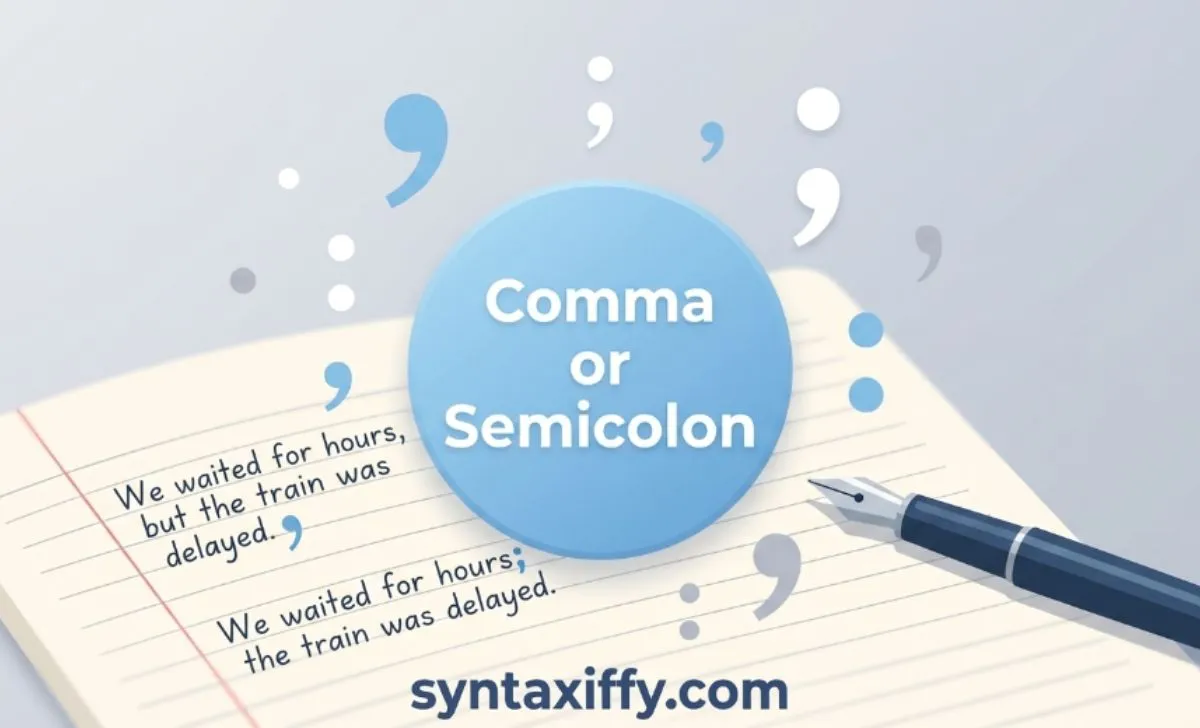
Many writers wonder whether they should use a comma or semicolon in a sentence. The quick answer is simple: use a comma to separate words, phrases, or clauses with a coordinating conjunction, and use a semicolon to connect closely related independent clauses or before a conjunctive adverb such as however or therefore.
This confusion often leads to comma splices, poor sentence structure, and grammar mistakes. In this guide, you’ll learn the correct punctuation rules, understand the differences, compare British and American English, and discover practical examples that will improve your writing in academic, business, and everyday communication.
Quick Answer
A comma (,) and a semicolon (;) are both important punctuation marks in English grammar, but they have different jobs.
- Use a comma to separate items in a list, introductory phrases, or two independent clauses joined by a coordinating conjunction (FANBOYS: for, and, nor, but, or, yet, so).
- Use a semicolon to connect two closely related independent clauses without a conjunction or before a conjunctive adverb like however, therefore, or moreover.
Examples
✅ Comma
Sarah finished the report, and she emailed it to the manager.
(The comma comes before the coordinating conjunction and.)
✅ Semicolon
Sarah finished the report; she emailed it to the manager.
(Both parts are complete sentences, so a semicolon correctly connects them.)
✅ Semicolon Before a Conjunctive Adverb
The weather changed suddenly; however, the match continued.
Quick Comparison
| Comma | Semicolon |
| Separates words, phrases, and clauses | Connects related independent clauses |
| Used before coordinating conjunctions | Used before conjunctive adverbs |
| Creates a short pause | Creates a stronger pause |
| Common in lists | Common in compound sentences |
| Cannot fix a comma splice alone | Helps avoid comma splices |
Quick Rule
Ask yourself one question:
Can both sides stand alone as complete sentences?
- Yes → A semicolon may be the correct choice.
- No → A comma is usually the correct punctuation mark.
The Origin of Comma or Semicolon
The comma and semicolon have a long history in written language. Both punctuation marks were developed to improve sentence structure, readability, and writing clarity.
The word comma comes from the Greek word komma, meaning a short clause or piece cut off. Ancient scholars used it to show a brief pause while reading aloud. As Standard English developed, the comma became an essential punctuation mark in both spoken English and written English.
The semicolon was introduced much later by the famous Italian printer Aldus Manutius in the late fifteenth century. He wanted a punctuation mark stronger than a comma but weaker than a period. The semicolon helped writers connect closely related ideas without ending the sentence.
Today, both punctuation marks are widely used in:
- Academic writing
- Business writing
- Professional writing
- Technical writing
- Creative writing
- Content writing
- Copy editing
- Proofreading
Major style guides, including the Chicago Manual of Style, APA Style, MLA Handbook, Associated Press Stylebook, and Oxford Style Manual, provide detailed rules for using commas and semicolons correctly.
Although writing styles continue to evolve, the main purpose of these punctuation marks remains unchanged: to improve sentence flow, readability, and clarity.
British English vs American English Spelling
There is no spelling difference between comma and semicolon in British English and American English.
Both varieties of English use the same punctuation marks and follow nearly identical grammar rules. Differences between the two styles are usually related to vocabulary or quotation mark conventions—not to the spelling or use of commas and semicolons.
Comparison Table
| Feature | American English | British English |
| Spelling | Comma | Comma |
| Spelling | Semicolon | Semicolon |
| Independent clauses | Uses semicolons | Uses semicolons |
| Lists | Uses commas (including the Oxford comma in some style guides) | Uses commas (Oxford comma depends on the publisher) |
| Academic writing | APA, MLA, Chicago | Oxford and publisher-specific styles |
| Business writing | Standard punctuation rules | Standard punctuation rules |
Examples
American English
We completed the project, and we celebrated together.
The project was successful; therefore, the team received recognition.
British English
We completed the project, and we celebrated together.
The project was successful; therefore, the team received recognition.
Whether you write for readers in the United States, the United Kingdom, Canada, Australia, or other English-speaking countries, the grammar rules for commas, semicolons, independent clauses, conjunctive adverbs, and coordinating conjunctions remain essentially the same.
Pronunciation of Comma or Semicolon
The words comma and semicolon are pronounced almost the same in American English and British English. There are no spelling variations that change their pronunciation.
Knowing how these words sound can help English learners (ESL) improve both spoken English and written English.
Pronunciation Guide
| Word | IPA Pronunciation | Simple Pronunciation |
| Comma | /ˈkɒmə/ (UK), /ˈkɑːmə/ (US) | KOM-uh |
| Semicolon | /ˌsemiˈkəʊlən/ (UK), /ˌsemiˈkoʊlən/ (US) | SEM-ee-KOH-lun |
How They Sound
- Comma has two syllables: KOM-uh.
- Semicolon has four syllables: SEM-ee-KOH-lun.
You may hear these words in grammar lessons, writing workshops, editing discussions, and classrooms, but their pronunciation stays almost the same across different English varieties.
Why People Confuse Comma or Semicolon
Many people confuse a comma with a semicolon because both punctuation marks connect ideas within a sentence. However, they are used in different situations.
1. Both Join Clauses
A comma and a semicolon can both appear between clauses, making them look similar.
Incorrect:
I finished my homework, I watched television.
Correct:
I finished my homework; I watched television.
The incorrect sentence contains a comma splice, which happens when two independent clauses are joined with only a comma.
2. Coordinating Conjunctions Cause Confusion
A comma joins two independent clauses only when it is followed by a coordinating conjunction.
These conjunctions are known as FANBOYS:
- For
- And
- Nor
- But
- Or
- Yet
- So
Example:
I was tired, but I finished the report.
Without the conjunction, use a semicolon instead.
I was tired; I finished the report.
3. Conjunctive Adverbs Are Often Misused
Words such as these usually require a semicolon before them:
- however
- therefore
- moreover
- consequently
- nevertheless
- meanwhile
Correct:
The report was complete; however, it still needed approval.
Incorrect:
The report was complete, however, it still needed approval.
4. Both Create a Pause
Many writers think punctuation is based only on pauses.
Actually:
- A comma creates a short pause.
- A semicolon creates a stronger pause and shows a closer relationship between two complete ideas.
5. School Grammar Rules Are Sometimes Too Simple
Many beginners learn:
“Use a comma where you pause.”
This advice is incomplete.
Correct punctuation depends on:
- sentence structure
- clauses
- grammar rules
- syntax
- writing mechanics
Understanding these concepts helps you choose the correct punctuation mark with confidence.
Which One Should You Use?
The correct choice depends on your sentence structure, not on whether you are writing in British English or American English.
Use a Comma When
- Separating items in a list.
- Separating introductory phrases.
- Joining two independent clauses with a coordinating conjunction.
- Adding nonessential information.
- Separating dates, addresses, and names.
Examples
- I bought apples, oranges, bananas, and grapes.
- After the meeting, everyone went home.
- She studied hard, so she passed the exam.
Use a Semicolon When
- Joining two closely related independent clauses.
- Before conjunctive adverbs.
- Separating complex list items that already contain commas.
Examples
- The meeting ended early; everyone was pleased.
- The weather improved; therefore, we continued our trip.
- We visited Paris, France; Rome, Italy; and Madrid, Spain.
Audience-Based Advice
| Audience | Recommended Usage |
| Students | Follow standard grammar rules. |
| Academic writers | Follow APA, MLA, or Chicago style guidelines. |
| Business professionals | Use punctuation that improves clarity and readability. |
| Bloggers | Avoid comma splices and keep sentences easy to read. |
| Global audience | Use clear, standard English punctuation. |
Professional Tip
Before choosing a punctuation mark, ask yourself:
Are both parts complete sentences?
- Yes → A semicolon may be the best choice.
- No → Use a comma if the sentence follows standard grammar rules.
This simple check will improve sentence flow, readability, and writing clarity while helping you avoid common punctuation mistakes.
Common Mistakes with Comma or Semicolon
Many grammar mistakes happen because writers use a comma when they need a semicolon, or they use a semicolon where a comma is the correct punctuation mark. Understanding these common errors will improve your writing mechanics, sentence structure, and overall readability.
Common Errors and Corrections
| Incorrect | Correct | Why? |
| I was tired, I went to bed. | I was tired; I went to bed. | Two independent clauses cannot be joined with only a comma. This is a comma splice. |
| I was tired; and I went to bed. | I was tired, and I went to bed. | Use a comma before a coordinating conjunction, not a semicolon. |
| She studied hard, however, she failed the test. | She studied hard; however, she failed the test. | A conjunctive adverb like however usually follows a semicolon. |
| We bought apples; bananas; oranges. | We bought apples, bananas, and oranges. | Use commas to separate a simple list. |
| Because it was raining; we stayed inside. | Because it was raining, we stayed inside. | A dependent clause should not be separated from an independent clause with a semicolon. |
Tips to Avoid These Mistakes
- Check whether both parts are independent clauses.
- Use FANBOYS with a comma to join complete sentences.
- Use a semicolon before however, therefore, moreover, and similar transition words.
- Avoid comma splices by reviewing sentence structure.
- Proofread your work, especially in academic and professional writing.
Comma or Semicolon in Everyday Examples
Understanding punctuation is easier when you see it in real-life situations.
Emails
✅ Comma
I reviewed the proposal, and I sent it to the client.
✅ Semicolon
I reviewed the proposal; however, I found two errors.
News Writing
✅ Comma
The mayor announced the project, and residents welcomed the decision.
✅ Semicolon
The investigation continued; officials promised to release more details s
Social Media
✅ Comma
I packed my bags, and I’m ready for vacation!
✅ Semicolon
I planned everything; now it’s time to enjoy the trip.
Academic Writing
✅ Comma
The experiment was successful, but more research is needed.
✅ Semicolon
The experiment produced positive results; therefore, the researchers expanded the study.
Business Writing
✅ Comma
The meeting ended, and everyone returned to work.
✅ Semicolon
Sales increased this quarter; moreover, customer satisfaction reached a record high.
Whether you’re writing a report, blog post, email, or research paper, using the correct punctuation improves clarity, sentence flow, and professionalism.
Easy Trick to Remember Comma or Semicolon
You don’t have to memorize every punctuation rule. This simple trick will help you choose the right mark.
The “Complete Sentence Test”
Ask yourself:
Can each side stand alone as a complete sentence?
- Yes → Use a semicolon if there is no coordinating conjunction.
- No → Use a comma according to the grammar rule.
Memory Formula
- Comma = Short Connection
- Semicolon = Strong Connection
Quick Examples
| Sentence | Correct Punctuation |
| She smiled, and he laughed. | Comma |
| She smiled; he laughed. | Semicolon |
| It was raining; therefore, we stayed inside. | Semicolon |
| After dinner, we watched a movie. | Comma |
| I enjoy reading, writing, and traveling. | Comma |
One-Minute Rule
Before adding punctuation, ask yourself these three questions:
- Are both parts independent clauses?
- Is there a coordinating conjunction like and, but, or so?
- Is there a conjunctive adverb such as however or therefore?
Answering these questions will help you avoid comma splices, improve English grammar, and write clear, professional sentences every time.
Comparison Table
| Feature | Comma (,) | Semicolon (;) |
| Main Purpose | Separates words, phrases, and clauses | Connects closely related independent clauses |
| Pause Length | Short pause | Longer pause than a comma |
| Used Before Coordinating Conjunctions | ✅ Yes | ❌ No |
| Used Before Conjunctive Adverbs | ❌ No | ✅ Yes |
| Joins Independent Clauses | With a coordinating conjunction | Without a coordinating conjunction |
| Used in Simple Lists | ✅ Yes | ❌ No |
| Used in Complex Lists | Sometimes | ✅ Yes |
| Prevents Comma Splices | ❌ No | ✅ Yes |
Quick Examples
| Sentence | Correct Punctuation |
| I called my friend, but she was busy. | Comma |
| I called my friend; she was busy. | Semicolon |
| The task was difficult; however, we finished it. | Semicolon |
| We bought bread, milk, eggs, and cheese. | Comma |
FAQs
1. What is the difference between a comma and a semicolon?
A comma separates words, phrases, or clauses joined by a coordinating conjunction, while a semicolon connects closely related independent clauses without a coordinating conjunction.
2. When should I use a semicolon instead of a comma?
Use a semicolon when both parts of the sentence are complete sentences and closely related.
Example:
The meeting ended early; everyone went home.
3. Can a semicolon replace a comma?
Sometimes. A semicolon can replace a comma only when joining two independent clauses. It cannot replace commas used in simple lists or introductory phrases.
4. Can I use a semicolon before “however”?
Yes. Place a semicolon before however when it connects two independent clauses.
Example:
She studied hard; however, she was still nervous.
5. What is a comma splice?
A comma splice is a grammar mistake where two independent clauses are joined using only a comma.
❌ I was hungry, I made lunch.
✅ I was hungry; I made lunch.
✅ I was hungry, so I made lunch.
6. What is the Oxford comma?
The Oxford comma, also called the serial comma, is the comma placed before the final and or or in a list.
Example:
We invited Tom, Sarah, and Ali.
Some style guides recommend it, while others make it optional.
7. Do British English and American English use commas and semicolons differently?
No. Both follow almost identical grammar rules. The main differences between the two varieties of English involve spelling, vocabulary, and quotation mark style—not comma and semicolon usage.
Conclusion
Knowing when to use a comma or semicolon makes your writing clearer, more professional, and easier to read. Use a comma for lists, introductory phrases, and independent clauses joined by a coordinating conjunction.
Use a semicolon to connect closely related independent clauses or before conjunctive adverbs such as however, therefore, and moreover.
Understanding these punctuation rules will help you avoid comma splices, improve sentence flow, and write confidently in academic, business, and everyday communication. With regular practice, choosing between a comma and a semicolon will become natural.
Read More Blogs:

Hi, I am Mary Norris, and I write clear and insightful grammar blogs on Syntaxiffy.com.
On Syntaxiffy.com, I focus on English grammar, usage, and writing accuracy to help readers improve their language skills.