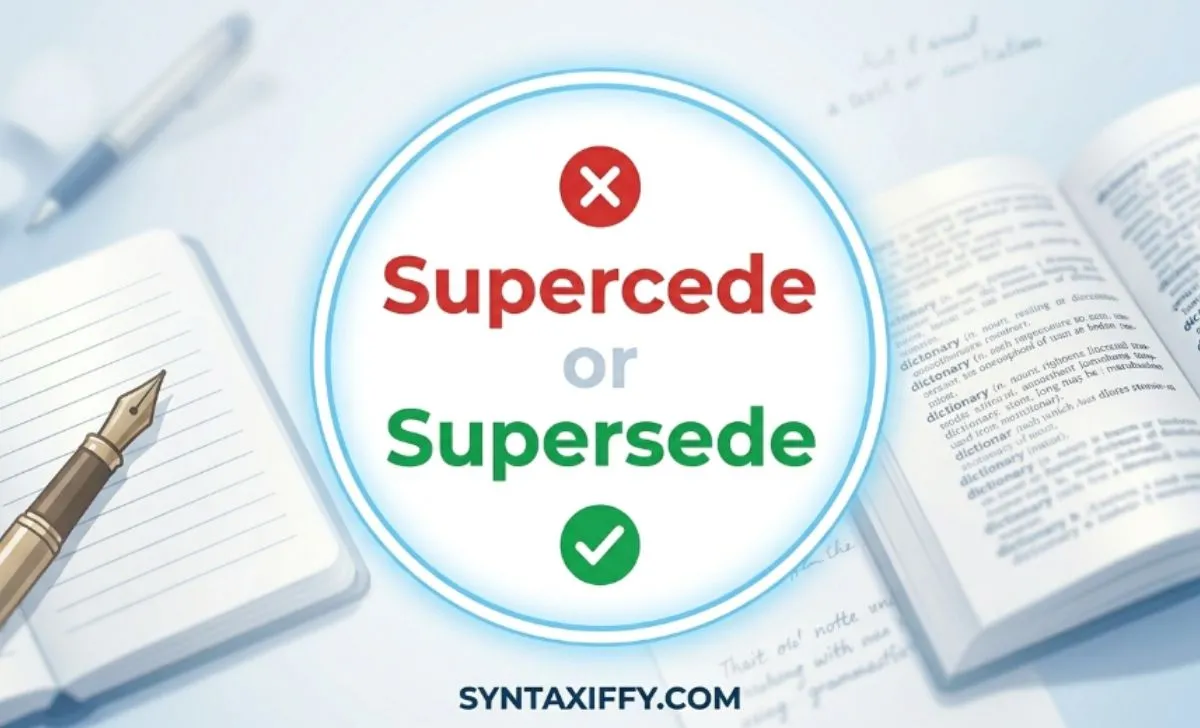
Supercede or Supersede is a common English grammar confusion that many learners, bloggers, and professionals encounter.
People often search for this keyword because both words look similar, but only one spelling is accepted in the English language.
This mistake frequently appears in emails, academic writing, professional writing, business communication, and even social media posts.
Since spelling accuracy affects writing skills and proofreading quality, understanding the difference is important.
In this guide, you’ll learn the correct spelling, meanings, usage rules, examples, origin, and practical memory tricks to avoid this common mistake.
Quick Answer
Supersede is the correct spelling.
Supercede is a common misspelling and is considered incorrect in standard English grammar.
Example:
The new policy will supersede the previous rule.
| Word | Correct? | Meaning |
|---|---|---|
| Supersede | ✅ Yes | To replace or take the place of something |
| Supercede | ❌ No | Common spelling mistake |
Difference Between Supercede and Supersede
Although these words look similar, only supersede is recognized in dictionaries and official writing.
Supersede
- Grammar Role: Verb
- Meaning: To replace, override, or take the place of something.
- Example: The revised edition superseded the older version.
Supercede
- Grammar Role: None (Incorrect spelling)
- Meaning: No accepted meaning in standard English.
- Example: Avoid using supercede in formal writing.
Why Do People Confuse Supercede or Supersede?
Many writers assume that the word should follow the pattern of words ending in -cede, such as:
- proceed
- recede
- concede
Because of this pattern, people naturally write supercede. However, supersede is an exception to common spelling rules.
Real-Life Example
Incorrect email:
“The latest guidelines will supercede the old instructions.”
Correct email:
“The latest guidelines will supersede the old instructions.”
The Origin of Supercede and Supersede
The word supersede comes from the Latin word supersedere, meaning “to sit above” or “to refrain from.”
Over time, the spelling remained supersede, making it one of the unusual exceptions in English vocabulary. This historical origin explains why the word does not follow the common -cede spelling pattern.
Supercede or Supersede Comparison Table
| Feature | Supercede | Supersede |
|---|---|---|
| Meaning | No accepted meaning | Replace or take the place of something |
| Grammar Role | Incorrect spelling | Verb |
| Usage | Should be avoided | Standard English usage |
| Memory Tip | Common mistake | Correct spelling ends in “-sede” |
| Example | ❌ The update will supercede the rule. | ✅ The update will supersede the rule. |
When Should You Use Supersede?
Use supersede whenever something replaces, overrides, or makes another thing outdated.
Examples:
- The new software version supersedes the old release.
- Updated policies supersede previous guidelines.
- New regulations supersede earlier laws.
- A revised edition may supersede an older book.
This word is commonly used in:
- Academic writing
- Professional writing
- Business communication
- Legal documents
- Proofreading and editing
- Technical documentation
When Should You Use Supercede?
You should not use supercede.
Although many English learners and native speakers accidentally write it, dictionaries and grammar guides recognize it as a spelling mistake.
Whenever you write supercede, replace it with supersede.
Supercede or Supersede Examples
Understanding Supercede or Supersede becomes easier when you see how the correct word is used in different situations.
Emails
- The updated schedule will supersede the previous version.
- This notice supersedes our earlier email.
Academic Writing
- Recent research supersedes older theories.
- The revised edition supersedes the original publication.
Professional Writing
- Company guidelines supersede departmental procedures.
- The new manual supersedes all previous instructions.
Business Communication
- The latest agreement supersedes the earlier contract.
- These policies supersede outdated regulations.
Social Media
- The new feature update supersedes the previous design.
- Today’s announcement supersedes yesterday’s statement.
Everyday Conversations
- This phone model supersedes the older one.
- New rules usually supersede old rules.
Supercede or Supersede in One Sentence
Here are examples showing both terms together:
- Although many people write supercede, the correct spelling is supersede.
- Writers often confuse supercede with supersede, but dictionaries recognize only supersede.
- In English grammar, supercede is considered incorrect, while supersede is the accepted form.
- Proofreading can help you replace supercede with supersede before publishing.
Common Mistakes with Supercede or Supersede
| Incorrect | Correct |
|---|---|
| The update will supercede the rule. | The update will supersede the rule. |
| New laws supercede old laws. | New laws supersede old laws. |
| This edition supercedes the previous one. | This edition supersedes the previous one. |
| The email superceded the earlier notice. | The email superseded the earlier notice. |
| The software has superceded the old version. | The software has superseded the old version. |
Why Supercede or Supersede Still Confuses Writers in 2026
Many people continue searching for Supercede or Supersede because the spelling seems inconsistent with similar words like proceed, concede, and recede.
This confusion affects students, bloggers, and professionals involved in language learning and writing skills.
Common challenges include:
- Typing mistakes.
- Lack of proofreading.
- Dependence on autocorrect.
- Confusing spelling patterns.
- Limited knowledge of word origin.
Because of these issues, Supercede vs Supersede remains one of the most searched spelling topics in English grammar.
Quick Memory Trick
Remember this simple rule:
Supersede sits above the rest, so it ends with “sede,” not “cede.”
Another easy trick:
- Supersede = Correct
- Supercede = Common spelling mistake
Whenever you see supercede, replace it with supersede.
FAQs
Which is correct, Supercede or Supersede?
Supersede is the correct spelling. Supercede is considered a misspelling.
Is supercede a real word?
No. It appears because of common spelling confusion, but standard dictionaries recognize only supersede.
What does supersede mean?
It means to replace, override, or take the place of something older.
Why do people spell supersede as supercede?
People often follow the spelling pattern of words ending in -cede, such as concede and recede.
Is supersede a verb or a noun?
Supersede is a verb.
How do you use supersede in a sentence?
Example:
“The updated policy supersedes all previous guidelines.”
Why is supersede an exception to spelling rules?
Its spelling comes from the Latin word supersedere, which explains why it ends with -sede.
Can I use supercede in formal writing?
No. In academic writing, professional writing, business communication, and proofreading, you should always use supersede.
Conclusion
Understanding Supercede or Supersede is essential for improving writing skills and avoiding one of the most common spelling mistakes in the English language.
Although many people mistakenly write supercede, the correct spelling is always supersede. Remember the simple memory trick that supersede ends with “sede,” not “cede.”
Whether you’re writing emails, academic papers, business documents, or social media posts, using the correct word will make your communication clearer and more professional.
Mastering small grammar rules like this can greatly improve your language learning and proofreading accuracy.
Read More Blogs:
- Blanky or Blankie: What’s the Correct Word in English?
- Excited or Exited – Avoid This Common English Mistake

Hi, I am Bill Walsh, and I write clear and practical grammar blogs on Syntaxiffy.com.
I focus on English grammar, pair of words, and spelling differences to help readers improve their writing skills.