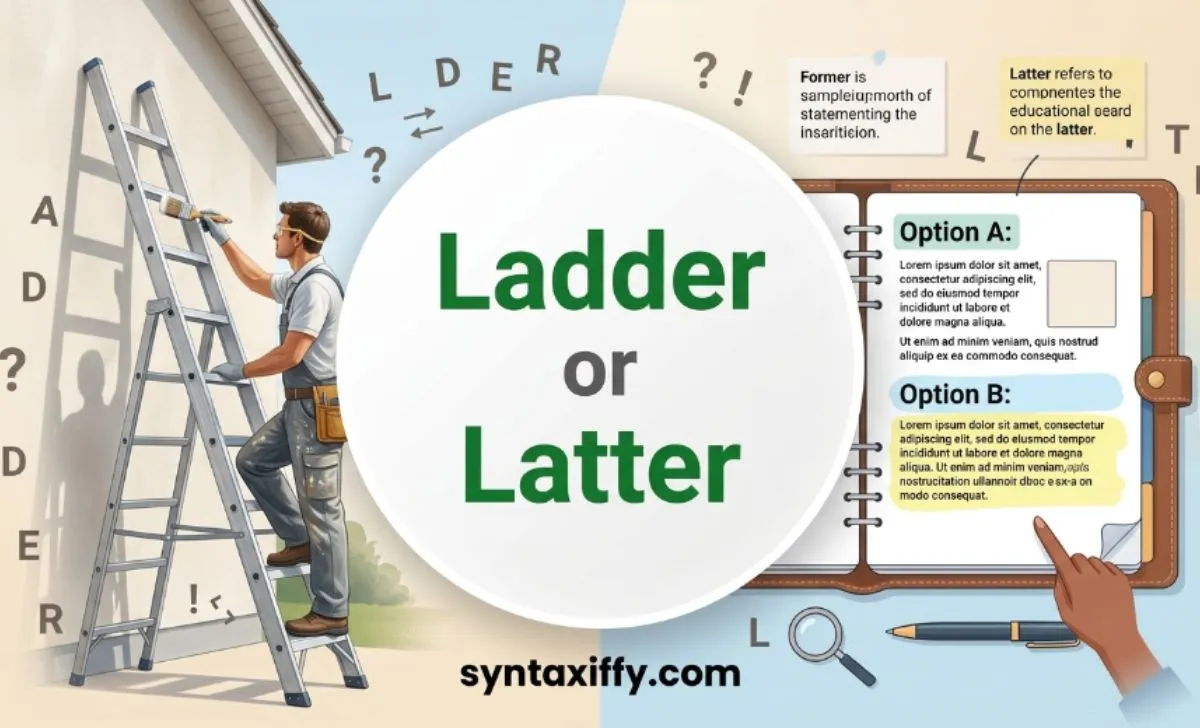
Ladder or latter is a common English grammar question because these two words look and sound similar but have completely different meanings. The quick answer is simple: ladder is a noun that refers to a tool used for climbing, while latter is an adjective or pronoun that refers to the second of two people or things.
Many English learners confuse them because only one letter is different. In this guide, you’ll learn the meaning of each word, their origins, pronunciation, spelling, common mistakes, real-life examples, and easy memory tricks so you can choose the correct word with confidence in everyday writing and speech.
Quick Answer

Although ladder and latter look alike, they have different meanings and cannot be used interchangeably.
- Ladder is a noun. It is a piece of equipment with rungs used for climbing to a higher place.
- Latter is an adjective or pronoun. It refers to the second of two people, ideas, or things that were mentioned.
Correct examples
✅ He climbed the ladder to clean the roof.
✅ Please hold the ladder steady while I paint.
✅ Between coffee and tea, I prefer the latter.
✅ We discussed two plans, and the latter seemed more practical.
Incorrect examples
❌ He climbed the latter to fix the roof.
❌ Between the two options, I chose the ladder.
Quick comparison
| Word | Part of Speech | Meaning | Example |
| Ladder | Noun | A climbing tool with steps or rungs | She carried a ladder into the garden. |
| Latter | Adjective/Pronoun | The second of two mentioned items | Of the two books, I liked the latter. |
The Origin of Ladder or Latter
Although these words look similar, they come from different origins.
Ladder
The word ladder comes from the Old English word hlæder, meaning a structure with rungs used for climbing. Over time, the spelling became ladder, but its meaning has remained the same. Today, ladders are commonly used in construction, home improvement, maintenance, and by firefighters. Common types include step ladders, extension ladders, rope ladders, and folding ladders.
Latter
The word latter comes from the Old English word lætra, meaning later or more recent. In Modern English, it is used to refer to the second of two people, objects, or ideas that have already been mentioned. It is especially common in academic writing, business communication, and formal writing because it avoids repeating the second noun.
Even though ladder and latter differ by only one letter, they developed from completely different words and have unrelated meanings.
British English vs American English Spelling

Unlike many English words, ladder and latter have the same spelling in both British English and American English. There are no regional spelling differences.
The only difference is their meaning and usage, not the spelling.
| Feature | British English | American English |
| Ladder | ✅ Ladder | ✅ Ladder |
| Latter | ✅ Latter | ✅ Latter |
| Meaning | Same | Same |
| Grammar Rule | Same | Same |
| Pronunciation | Nearly identical | Nearly identical |
Whether you’re writing for readers in the United States, United Kingdom, Canada, Australia, or another English-speaking country, you should use the same spellings.
The key is remembering the context:
- Use ladder when talking about a climbing tool.
- Use latter when referring to the second of two choices, people, or ideas.
Pronunciation of Ladder or Latter
The words ladder and latter are pronounced very similarly, which is one reason people confuse them. In many American accents, they may even sound almost identical because the t is pronounced as a soft d sound.
| Word | IPA (UK) | IPA (US) | Sounds Like |
| Ladder | /ˈlæd.ə(r)/ | /ˈlæd.ɚ/ | LAD-er |
| Latter | /ˈlæt.ə(r)/ | /ˈlæɾ.ɚ/ | LAT-er |
Pronunciation tips
- Ladder has a clear “d” sound in most accents.
- Latter has a “t” sound in British English, but in American English it often sounds like a soft d.
- Because they can sound alike, always use the sentence context to choose the correct word.
Practice sentences
- He climbed the ladder carefully.
- Please bring the ladder from the garage.
- Of the two proposals, I prefer the latter.
- We discussed two solutions, and the latter was more practical.
Why People Confuse Ladder or Latter
Many English learners mix up ladder and latter because they are nearly identical in spelling and pronunciation. However, they belong to different parts of speech and have completely different meanings.
Here are the main reasons for the confusion:
- Only one letter is different.
- Their pronunciation is very similar, especially in American English.
- Fast speech makes the words sound almost the same.
- Writers sometimes choose the wrong word because of spelling similarity.
- English learners may not know that ladder is a noun, while latter is an adjective or pronoun.
Remember the difference
Use ladder when talking about climbing or height.
Examples:
- The painter carried a ladder.
- The firefighter used a long ladder.
- We bought an aluminum step ladder for home maintenance.
Use latter when referring to the second of two choices.
Examples:
- Between tea and coffee, I chose the latter.
- We considered two plans, but the latter was more affordable.
- The first report was detailed, but the latter was easier to understand.
Whether you’re writing an email, academic paper, news article, or social media post, choosing the correct word improves clarity and professionalism.
Which Spelling Should You Use?
The answer depends on what you want to say, not where you live. Both British English and American English use the same spellings.
Use Ladder when:
- Talking about a climbing tool.
- Referring to equipment used in construction or home improvement.
- Describing something with steps or rungs.
Examples:
- He placed the ladder against the wall.
- The electrician climbed the ladder to repair the lights.
- Always check the ladder for safety before climbing.
Use Latter when:
- Referring to the second of two people or things.
- Comparing two ideas or choices.
- Writing formal or academic English.
Examples:
- I liked both books, but I preferred the latter.
- We discussed two options, and the latter was more practical.
- Between working from home and commuting, she chose the latter.
Quick decision guide
| If your sentence is about… | Use |
| A climbing tool | Ladder |
| Steps or rungs | Ladder |
| Construction or maintenance | Ladder |
| The second of two choices | Latter |
| Comparing two people or ideas | Latter |
| Formal writing | Latter |
Common Mistakes with Ladder or Latter
Because ladder and latter look and sound similar, writers sometimes use the wrong word. The easiest way to avoid mistakes is to remember that ladder is a noun (a climbing tool), while latter refers to the second of two people or things.
| Incorrect | Correct | Why? |
| I chose the ladder of the two options. | I chose the latter of the two options. | Latter means the second of two choices. |
| He climbed the latter to clean the roof. | He climbed the ladder to clean the roof. | A ladder is climbing equipment. |
| The ladder proposal was more practical. | The latter proposal was more practical. | Latter refers to the second proposal. |
| Please hold the latter while I paint. | Please hold the ladder while I paint. | You hold a ladder, not a latter. |
| Between the two cars, the ladder is cheaper. | Between the two cars, the latter is cheaper. | Latter refers to the second car. |
| The firefighter carried a latter. | The firefighter carried a ladder. | Firefighters use ladders. |
Tips to avoid mistakes
- Think of ladder whenever you’re talking about climbing, rungs, height, or equipment.
- Think of latter whenever you’re referring to the second item in a comparison.
- Read your sentence again. If it’s about an object, ladder is probably correct. If it’s about comparing two things, use latter.
Ladder or Latter in Everyday Examples
Understanding the difference becomes much easier when you see these words in real-life situations.
In emails
- Please bring the ladder before you start the repairs.
- We reviewed two proposals, and I recommend the latter.
In news writing
- Firefighters used a long ladder to rescue the family.
- The committee discussed two policies and approved the latter.
On social media
- I finally bought a new step ladder for painting my house.
- Between the two vacation spots, I’d definitely choose the latter.
In academic writing
- The researchers compared two methods and found the latter more effective.
- Safety training includes the proper use of a ladder.
In business communication
- The maintenance team replaced the old extension ladder.
- We considered two marketing strategies, and the latter produced better results.
More everyday examples
- He climbed the ladder to pick apples.
- The painter leaned the ladder against the wall.
- Of the two job offers, she accepted the latter.
- We discussed two solutions, and the latter saved more money.
- Always inspect a ladder before using it.
- Between tea and coffee, I prefer the latter.
These examples show how ladder is used for physical objects, while latter is used in comparisons across spoken English, written English, academic writing, professional communication, and everyday conversations.
Easy Trick to Remember Ladder or Latter
A simple memory trick can help you choose the correct word every time.
The “D = Device” Trick
- LaDDer has DD, just like Device.
- A ladder is a device used for climbing.
The “T = Two” Trick
- LaTTer has TT.
- Think of T = Two.
- Latter always refers to the second of two people, ideas, or things.
Easy examples
- He climbed the ladder. ✅
- Between the two choices, I picked the latter. ✅
Quick memory sentence
Ladder helps you climb. Latter helps you choose the second option.
This simple mnemonic makes it easier for English learners, students, and professionals to remember the correct word and avoid common vocabulary mistakes.
Comparison Table
| Feature | Ladder | Latter |
| Part of Speech | Noun | Adjective / Pronoun |
| Meaning | A tool used for climbing | The second of two people or things |
| Used for | Construction, maintenance, home improvement, safety | Comparisons, formal writing, academic writing |
| Refers to a physical object? | ✅ Yes | ❌ No |
| Refers to the second item? | ❌ No | ✅ Yes |
| Example | He climbed the ladder. | I preferred the latter option. |
FAQs
Is it ladder or latter?
It depends on the meaning. Use ladder when referring to a climbing tool. Use latter when referring to the second of two people, ideas, or things.
What does ladder mean?
A ladder is a piece of climbing equipment with rungs. It is commonly used in construction, home improvement, painting, maintenance, and by firefighters.
What does latter mean?
Latter means the second of two people, objects, or ideas that have already been mentioned.
Can ladder and latter be used interchangeably?
No. They have completely different meanings and belong to different parts of speech.
Why do people confuse ladder and latter?
People confuse them because they have similar spellings and nearly identical pronunciation, especially in American English.
How can I remember the difference?
Remember:
- Ladder = climbing device.
- Latter = the second of two choices.
Which word is more common in formal writing?
Both words appear in formal writing, but latter is especially common in academic papers, reports, and business communication when referring to the second of two options.
Conclusion
Although ladder and latter differ by only one letter, they have completely different meanings. Ladder is a noun that refers to a climbing tool with steps or rungs, while latter is an adjective or pronoun used for the second of two people, ideas, or things. Their spelling is the same in British and American English, so the correct choice depends entirely on the context.
By understanding their meanings, practicing real-life examples, and using the simple memory tricks in this guide, you can avoid common mistakes and use both words confidently in everyday conversations, academic writing, emails, and professional communication.
Read More Blogs:

Hi, I am Roy Peter Clark, and I write clear and practical grammar and writing blogs.
On Syntaxiffy.com, I focus on English grammar, style, and writing techniques to help readers improve clarity and communication.