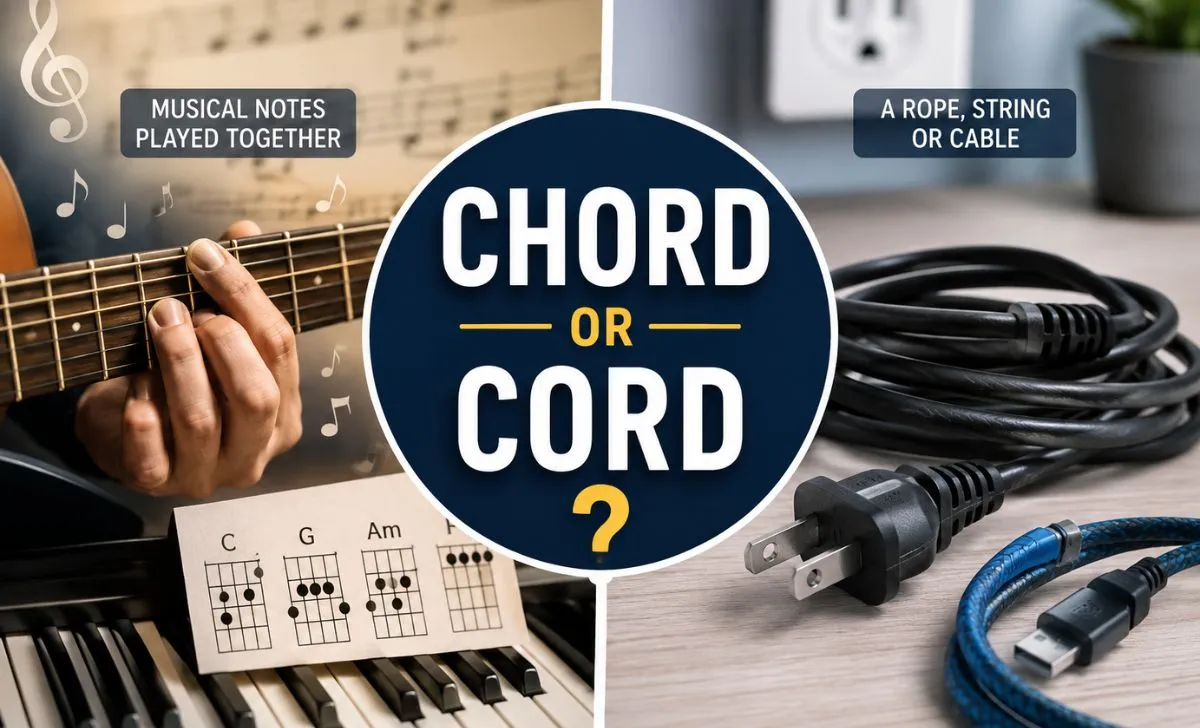
If you are wondering about chord or cord, both spellings are correct, but they have different meanings. Chord is mainly used in music for two or more musical notes played together, such as a guitar chord or piano chord.
Cord usually means a thick string, rope, or flexible cable, such as an electrical cord or extension cord. The two words sound alike in most forms of English, which makes them easy to confuse.
This guide explains their meanings, origins, pronunciation, usage, common mistakes, and differences between British and American English. You will also learn simple ways to remember which word to use.
Quick Answer
Chord and cord are both correct English words, but they mean different things.
- Chord = a group of musical notes played together.
- Cord = a string, rope, or flexible cable.
Examples:
- She played a beautiful chord on the piano.
- I need a new power cord for my computer.
The key difference is meaning, not pronunciation. In most English accents, chord and cord are pronounced the same.
The Origin of Chord or Cord
The words chord and cord have different histories.
Chord comes from the Greek word chordē, meaning “string.” It entered English through Latin and French and became connected with music. In music theory, a chord refers to several notes sounding together.
Cord also has an old history. It comes from Latin chorda, meaning “string,” and passed into English through French. Over time, its meaning expanded to include rope, string, and flexible electrical cables.
Their similar history helps explain why the words look and sound so much alike. However, modern English uses them for different ideas.
British English vs American English Spelling

There is no major British English vs American English spelling difference between chord and cord.
Both varieties use:
| Meaning | British English | American English |
| Musical notes played together | chord | chord |
| Rope or string | cord | cord |
| Electrical cable | cord | cord |
| Extension cable | extension cord | extension cord |
For example:
- British English: “He played a guitar chord.”
- American English: “He played a guitar chord.”
- British English: “The power cord is damaged.”
- American English: “The power cord is damaged.”
So, you do not need to choose one spelling based on whether your audience uses British or American English.
Pronunciation of Chord or Cord
Chord and cord are homophones. This means they have the same pronunciation but different spellings and meanings.
Both are usually pronounced:
/kɔːrd/ in many varieties of English.
They sound similar to the word “cord.”
For example:
- Chord → sounds like “cord”
- Cord → sounds like “cord”
This creates confusion in spoken English because listeners cannot always know which spelling you mean without context.
If someone says, “I learned a new chord,” you understand the intended spelling from the word learned and the musical context.
Why People Confuse Chord or Cord
People often confuse these words for several reasons.
First, they sound the same. When speaking, there is usually no pronunciation clue to tell them apart.
Second, their spellings differ by only one letter. The extra h in chord is easy to forget.
Third, both words can relate to strings. A musical chord historically relates to strings, while a cord can literally be a string or cable.
Fourth, autocorrect does not always understand context. A phone or computer may accept both spellings as real English words.
The best solution is to focus on meaning rather than sound.
Which Spelling Should You Use?
Your choice depends on what you mean.
Use chord when talking about:
- Music
- Guitar
- Piano
- Harmony
- Musical notes
- Chord progressions
- Music theory
Example:
“I know how to play the basic guitar chords.”
Use cord when talking about:
- Rope
- String
- Cable
- Power cord
- Extension cord
- Charging cord
- Electrical equipment
Example:
“Please unplug the power cord.”
This rule works for American English, British English, and most other varieties of standard English.
Common Mistakes with Chord or Cord
Because these words are homophones, spelling mistakes are common.
| Incorrect Usage | Correct Usage | Why |
| She played a guitar cord. | She played a guitar chord. | Music uses chord. |
| Plug in the power chord. | Plug in the power cord. | A cable is a cord. |
| He learned three new cords. | He learned three new chords. | Musical notes are chords. |
| The electrical chord is broken. | The electrical cord is broken. | Electrical cables are cords. |
| This chord is very long. | This cord is very long. | A physical string is a cord. |
A simple question can prevent most errors:
“Am I talking about music?”
If yes, choose chord.
If not, and you mean a cable, rope, or string, cord is usually correct.
Chord or Cord in Everyday Examples
These words appear in many types of writing.
In Emails
Chord:
“Could you send me the guitar chords for the song?”
Cord:
“The replacement power cord has arrived.”
In News
Chord:
“The musician played the final chord before leaving the stage.”
Cord:
“The damaged electrical cord was replaced.”
On Social Media
Chord:
“That final chord sounded amazing!”
Cord:
“My laptop cord finally stopped working.”
In Formal Writing
Chord:
“The composition uses a repeated chord progression.”
Cord:
“The equipment must be connected with the correct electrical cord.”
The context makes the intended meaning clear.
Easy Trick to Remember Chord or Cord
Use this simple mnemonic:
CHORD has H for Harmony.
The word chord contains H, and harmony is strongly connected with music.
CHORD → H → Harmony → Music
For cord, think about a physical cord such as a rope, wire, or cable.
You can also remember:
Music = chord
Cable or rope = cord
This quick rule works well for students, writers, and English learners.
Chord or Cord – Google Trends & Usage Data
Search interest for chord and cord varies by context because they belong to different vocabulary areas.
Chord is strongly connected with music searches. People may search for guitar chords, piano chords, chord progressions, music theory, and song chords.
Cord is more common in everyday and technical contexts. Searches may involve power cords, extension cords, charging cords, electrical cords, and cables.
There is also an important difference in search intent. Someone searching for “guitar chord” almost certainly wants music information, while someone searching for “power cord” is looking for a cable or electrical connection.
Google Trends can change over time and by country, so exact popularity should be checked for a specific date range and location rather than treated as a permanent ranking.
Chord vs Cord – Comparison Table
| Feature | Chord | Cord |
| Main meaning | Musical notes played together | Rope, string, or cable |
| Common field | Music | Everyday and technical use |
| Pronunciation | Usually /kɔːrd/ | Usually /kɔːrd/ |
| Homophone | Yes | Yes |
| Related word | Harmony | Cable |
| Example | Play a chord | Plug in the cord |
| British spelling | Chord | Cord |
| American spelling | Chord | Cord |
| Common phrase | Guitar chord | Power cord |
FAQs
Is “chord” or “cord” correct?
Both are correct. Chord refers mainly to music, while cord refers to a rope, string, or cable.
Is a guitar cord or chord?
The correct spelling is guitar chord. A chord is a group of musical notes played together.
Is it power chord or power cord?
Both phrases exist, but they have different meanings. A power cord is an electrical cable. A power chord is a type of musical chord commonly used in rock music.
Are chord and cord pronounced the same?
Yes. In most standard English accents, chord and cord are homophones and sound the same.
Is “extension chord” correct?
No, when you mean an electrical cable, the standard term is extension cord.
What is the easiest way to remember chord and cord?
Remember CHORD = H for Harmony. If the context is music, use chord. If it means a cable, rope, or string, use cord.
Is there a British vs American difference between chord and cord?
No. Both British and American English use chord for the musical meaning and cord for a rope, string, or cable.
Conclusion
The difference between chord or cord is simple once you focus on meaning. Chord is the correct word for music, including guitar chords, piano chords, harmony, and musical notes.
Cord refers to a rope, string, cable, or electrical connection. Both words usually have the same pronunciation, so context is important when speaking.
There is also no meaningful British English vs American English spelling difference here. When you see chord, think H for harmony. When you see cord, think of a cable or physical string.
Read More Blogs:
- Trunk or Treat: Meaning, Origin, Spelling, and Usage
- Too Late or To Late: Which Spelling Is Correct?

Hi, I am Bill Walsh, and I write clear and practical grammar blogs on Syntaxiffy.com.
I focus on English grammar, pair of words, and spelling differences to help readers improve their writing skills.