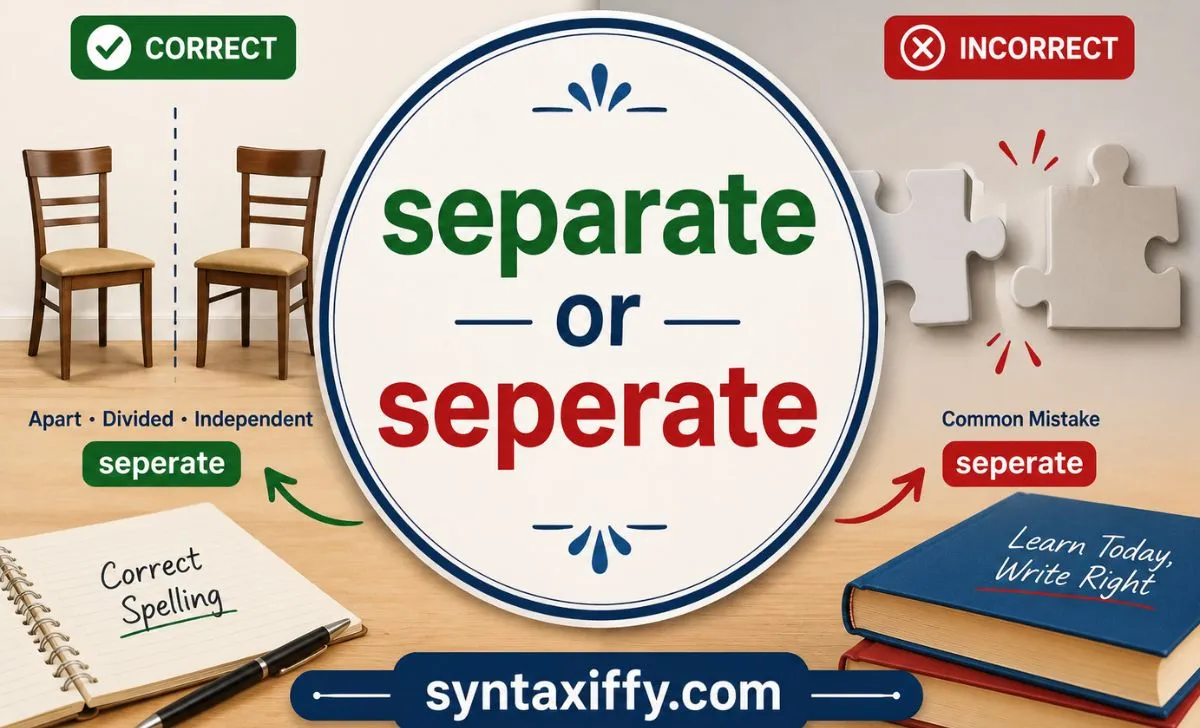
The correct spelling is separate, not seperate. “Separate” is a standard English word used as both a verb and an adjective, while “seperate” is a common spelling mistake.
The confusion usually happens because the middle vowel is weak in normal speech, making the word sound closer to “seper-ate.” This can cause writers to choose e instead of a when spelling it.
In this guide, you will learn the meaning, origin, pronunciation, British and American usage, common mistakes, everyday examples, and an easy memory trick. Whether you are a student, teacher, writer, or professional, this guide will help you use the correct form confidently.
Quick Answer
Separate is the correct spelling.
Seperate is a common misspelling and should not be used in standard modern English. The correct word is spelled:
S-E-P-A-R-A-T-E
“Separate” can work as an adjective or a verb.
| Word | Correct? | Use |
| separate | Yes | Standard English spelling |
| seperate | No | Common misspelling |
| separated | Yes | Correct past form |
| seperated | No | Common misspelling |
| separately | Yes | Correct adverb |
| seperately | No | Common misspelling |
| separation | Yes | Correct noun |
| seperation | No | Common misspelling |
For example:
- Please keep the documents separate.
- We need to separate the white clothes from the dark clothes.
- The students worked in separate groups.
- Send the files separately.
Major dictionaries list separate as the standard spelling and define it as something that is apart, independent, or divided. (Merriam-Webster)
The Origin of Separate or Seperate
The correct word separate has a long history. Merriam-Webster traces it through Middle English to Latin separatus, the past participle of separare. The Latin parts relate to the idea of being apart or preparing separately. (Merriam-Webster)
Oxford also traces the word to Latin separare, with the sense of dividing or disjoining. (oxfordlearnersdictionaries.com)
The word entered English centuries ago and became established with the spelling separate.
The form seperate is different. In modern English, it is generally a misspelling of separate, not a normal alternative spelling. Dictionary.com specifically identifies “seperate” as a common misspelling and explains that the correct spelling contains two a letters. (Dictionary.com)
Historically, older texts can contain unusual spellings, but that does not make seperate an accepted modern spelling.
So, for modern English writing, remember:
separate = correct
seperate = incorrect
British English vs American English Spelling
There is no British-American spelling difference between these two forms.
British English uses:
separate
American English also uses:
separate
Canadian, Australian, and other standard varieties of English likewise use separate.
| English variety | Correct spelling | Incorrect form |
| British English | separate | seperate |
| American English | separate | seperate |
| Canadian English | separate | seperate |
| Australian English | separate | seperate |
| International English | separate | seperate |
Some English words have genuine regional spelling differences, such as colour/color and centre/center. However, separate/seperate is not one of them.
Therefore, changing from British English to American English does not justify writing “seperate.”
Pronunciation of Separate or Seperate
Pronunciation is one of the main reasons people make this spelling mistake.
As an adjective, Cambridge gives the pronunciation as approximately:
UK: /ˈsep.ər.ət/
US: /ˈsep.ɚ.ət/
As a verb, the pronunciation changes:
UK: /ˈsep.ər.eɪt/
US: /ˈsep.ə.reɪt/
The adjective can sound roughly like:
SEP-uh-rət
The verb sounds roughly like:
SEP-uh-rate
The weak middle vowel can make writers hear an e sound. As a result, they may write seperate instead of separate.
For example:
- Adjective: They live in separate houses.
- Verb: Please separate the two lists.
Cambridge distinguishes these pronunciations according to the word’s grammatical use. (Cambridge Dictionary)
Why People Confuse Separate or Seperate
The main problem is that English spelling does not always match pronunciation perfectly.
When people say separate naturally, the middle vowel is not strongly pronounced. It can sound like an unstressed “uh” sound. This makes the spelling less obvious.
There are several reasons for the confusion:
- The middle vowel is weak in normal speech.
- People often spell words according to how they sound.
- Separate contains several vowels close together.
- The incorrect form seperate looks natural at first glance.
- Fast typing can cause people to substitute e for a.
- Students may remember the pronunciation but not the written form.
Dictionary.com also notes that the pronunciation can make people expect an e in the middle. (Dictionary.com)
The same problem can affect related words.
| Correct | Incorrect |
| separate | seperate |
| separated | seperated |
| separately | seperately |
| separation | seperation |
The important point is that the a in the spelling must be retained.
Which Spelling Should You Use?
Use separate in every form of standard modern English.
For students
Use separate in:
- Homework
- Essays
- Exams
- School assignments
- Academic writing
Example:
The teacher placed the students in separate groups.
For professionals
Use separate in:
- Emails
- Reports
- Business documents
- Presentations
- Resumes
- Formal communication
Example:
Please send the documents as separate attachments.
For bloggers and content writers
Use separate in:
- Blog posts
- Articles
- Website content
- Social media posts
- News writing
There is no situation in modern standard English where you should intentionally use seperate as the normal spelling.
Common Mistakes with Separate or Seperate
The most common error is simply replacing the second a with e.
| Incorrect | Correct |
| seperate | separate |
| seperated | separated |
| seperately | separately |
| seperation | separation |
| seperates | separates |
| seperating | separating |
Mistake 1: Seperate
❌ Please keep the files seperate.
✅ Please keep the files separate.
Mistake 2: Seperately
❌ The students completed the assignments seperately.
✅ The students completed the assignments separately.
Mistake 3: Seperation
❌ The seperation of the two groups was necessary.
✅ The separation of the two groups was necessary.
A useful rule is to remember that the core spelling contains:
PAR
not:
PER
So:
sep + ar + ate = separate
Separate or Seperate in Everyday Examples
“Separate” appears frequently in everyday English, academic writing, professional communication, news, and social media.
In emails
Please save each document as a separate file.
I will send the invoices in separate emails.
In academic writing
The researchers examined the two groups in separate studies.
Each variable was analyzed separately.
In business writing
The company maintains separate accounts for each department.
These issues should be treated as separate matters.
In news writing
The incidents occurred on three separate occasions.
On social media
I try to keep my work and personal life separate.
In everyday conversation
Please put the clean clothes in a separate basket.
The children sat at separate tables.
These examples reflect the normal meanings of the word: being apart, not shared, independent, or causing things to divide. (Merriam-Webster)
Easy Trick to Remember Separate or Seperate
One of the easiest memory tricks is:
There is A RAT in sepARATe.
Look closely:
sep + A R A + te
The middle letters are:
A-R-A
Think:
A RAT is in separate.
This helps you remember that the middle should contain a, not e.
Another simple trick is:
Separate has “PAR” — think “apart.”
The word apart means away from or separated from something.
So remember:
separate → apart → A
You can also break the word into parts:
SEP + AR + ATE
Whenever you hesitate between separate and seperate, look for the A after p.
Separate or Seperate – Google Trends & Usage Data
Search behavior around spelling questions shows why this topic remains useful for English learners and writers. People commonly search for phrases such as “separate or seperate,” “separate spelling,” “how to spell separate,” and “is seperate a word?”
However, Google Trends does not provide a fixed worldwide number of searches for a spelling question unless a specific date range, location, and search category are selected.
Search interest also changes over time, so it is better not to present an unsupported global search volume as a permanent statistic.
The practical usage pattern is clear: separate is the established standard spelling in dictionaries, while seperate is treated as a misspelling. (Dictionary.com)
The word also appears across many contexts:
- Education and schoolwork
- Academic writing
- Business communication
- Emails
- News articles
- Websites and blogs
- Social media
- General conversation
Dictionary sources show that separate is used both as an adjective and a verb, while related forms include separated, separately, separation, and separateness. (Merriam-Webster)
Comparison Table
| Feature | Separate | Seperate |
| Spelling | Correct | Incorrect |
| Standard English | Yes | No |
| British English | Yes | No |
| American English | Yes | No |
| Adjective | Yes | No |
| Verb | Yes | No |
| Pronunciation | /ˈsep.ər.ət/ or /ˈsep.ər.eɪt/ | Not a standard word |
| Meaning | Apart, divided, or to divide | No standard modern meaning |
| Professional writing | Recommended | Avoid |
| Academic writing | Recommended | Avoid |
| Common usage | Standard | Common misspelling |
Merriam-Webster lists separate as a verb, adjective, and noun, while Cambridge also provides separate adjective and verb definitions. (Merriam-Webster)
FAQs
1. Is it separate or seperate?
The correct spelling is separate. Seperate is a common misspelling.
2. Is “seperate” a word?
In modern standard English, seperate is not the correct spelling of the word. It is generally identified as a misspelling of separate. (Dictionary.com)
3. Why is separate spelled with an “a”?
The spelling comes from the historical development of the word through Latin separare. The established English spelling is separate. (Merriam-Webster)
4. Is separate spelled differently in British and American English?
No. Both British and American English use separate.
5. How do you pronounce separate?
As an adjective, it is commonly pronounced roughly SEP-uh-rət. As a verb, it is roughly SEP-uh-rate. (Cambridge Dictionary)
6. What is the correct spelling of separately?
The correct spelling is separately, with an a after the p. Oxford lists separately as the adverbial form of separate. (oxfordlearnersdictionaries.com)
7. What is an easy way to remember separate?
Remember: “There is A RAT in sepARATe.” The letters A-R-A help you remember the correct spelling.
Conclusion: Separate or Seperate
The answer is simple: separate is the correct spelling, while seperate is a common spelling mistake. The word separate can function as both an adjective and a verb, and its related forms include separated, separately, and separation.
The confusion mainly comes from pronunciation because the middle vowel can sound weak in natural speech. British and American English use the same spelling.
For schoolwork, emails, professional documents, academic writing, websites, and social media, always choose separate. When in doubt, remember the A-R-A pattern in “sepARATe.”
Read More Blogs:
- Indexes or Indices: Which Word Is Correct and When to Use It?
- Cannon or Canon: Which One is Correct and Why?

Hi, I am Mary Norris, and I write clear and insightful grammar blogs on Syntaxiffy.com.
On Syntaxiffy.com, I focus on English grammar, usage, and writing accuracy to help readers improve their language skills.