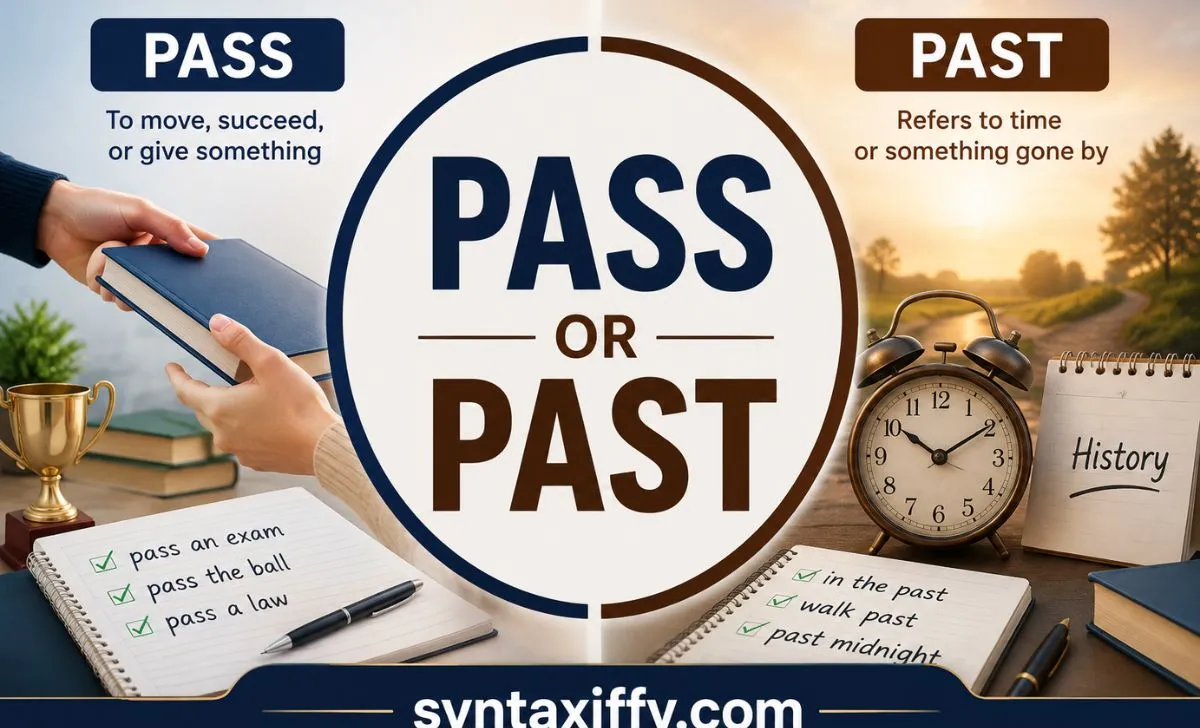
Choosing between pass or past can be confusing because the two words look and sound similar. The short answer is this: pass is usually a verb or noun that means to move, succeed, or give something to someone, while past is most often a noun, adjective, adverb, or preposition that refers to time or movement beyond something.
People often mix them up because they have similar pronunciation and spelling. In this guide, you’ll learn the difference between pass and past, their meanings, pronunciation, grammar rules, British and American English usage, and simple examples so you can use the correct word with confidence.
Quick Answer
The difference between pass and past is simple once you know their jobs in a sentence.
| Word | Correct Use | Part of Speech | Meaning |
| Pass | ✅ Yes | Verb / Noun | To move, succeed, hand over, or be accepted |
| Past | ✅ Yes | Noun / Adjective / Adverb / Preposition | Refers to an earlier time or movement beyond something |
Examples
Pass
- Please pass the salt.
- She will pass the driving test.
- We watched the train pass.
Past
- We walked past the school.
- Learn from the past.
- It is past midnight.
Quick Tip
- Use pass when talking about an action.
- Use past when talking about time or position.
The Origin of Pass or Past
The words pass and past share a long history but developed different meanings over time.
Origin of Pass
The word pass comes from the Old French word passer, meaning to go, move, or travel. It later entered Middle English and became one of the most common English verbs.
Today, pass has many meanings, including:
- Move by something
- Hand an object to someone
- Succeed in an exam
- Approve a law
- Complete a stage or level
Examples
- Please pass the book.
- She passed the exam.
- The government will pass a new law.
Origin of Past
The word past comes from the Old English and Latin roots related to something that has already gone by. Over time, it became associated with previous time and movement beyond a place.
Today, past can refer to:
- Earlier time
- Previous experiences
- Movement beyond an object
- Something no longer present
Examples
- Forget the past.
- We drove past the museum.
- The meeting lasted past noon.
Why Are They Confused?
People often confuse pass and past because:
- They look almost identical.
- Their pronunciation is very similar.
- Both are used in everyday English.
- The difference depends on grammar and context, not spelling alone.
British English vs American English Spelling
Unlike words such as colour/color or centre/center, there is no spelling difference between British English and American English.
Both countries use pass and past in exactly the same way.
| Feature | British English | American English |
| Pass | ✅ Pass | ✅ Pass |
| Past | ✅ Past | ✅ Past |
| Spelling Difference | None | None |
| Grammar Rule | Same | Same |
British English Examples
- Please pass the butter.
- We walked past the old church.
- She passed her English exam.
American English Examples
- Please pass the remote.
- We drove past the hospital.
- He passed the driving test.
Whether you’re writing in the UK, the United States, Canada, Australia, or New Zealand, the spelling and grammar remain the same. The only challenge is choosing the correct word based on its meaning and function in the sentence.
Pronunciation of Pass or Past
Although pass and past look similar, their pronunciation has a small but important difference.
| Word | Pronunciation | Sounds Like |
| Pass | /pæs/ (US), /pɑːs/ (UK) | “pass” |
| Past | /pæst/ (US), /pɑːst/ (UK) | “past” |
Notice that past ends with a clear “t” sound, while pass ends with an “s” sound.
Does Pronunciation Cause Confusion?
Yes. In fast conversations, the final “t” in past may sound very soft. Because of this, many English learners accidentally write pass instead of past, or vice versa.
Pronunciation Examples
- Pass the ball to me.
- We walked past the library.
- Did you pass the interview?
- Leave the past behind.
Remember, pronunciation alone cannot tell you which word to write. Always check the meaning and grammar in the sentence.
Why People Confuse Pass or Past
Many English learners confuse pass and past because they are spelled almost the same and sound very similar. However, they have different meanings and grammar functions.
1. Similar Spelling
The only difference is the last letter.
- Pass
- Past
This small spelling difference often causes writing mistakes.
2. Similar Pronunciation
In fast speech, the “t” in past is sometimes difficult to hear. As a result, many people write pass when they actually mean past.
3. Different Parts of Speech
Another reason for confusion is that the words belong to different parts of speech.
- Pass is mainly a verb or noun.
- Past is a noun, adjective, adverb, or preposition.
Understanding the grammar role makes choosing the correct word much easier.
4. Confusing Similar Expressions
Many learners struggle with expressions like:
- Walk past the building. ✅
- Walk pass the building. ❌
- It is past midnight. ✅
- It is pass midnight. ❌
- Please pass the sugar. ✅
- Please past the sugar. ❌
Which Spelling Should You Use?
The correct choice depends on what you want to say.
Use Pass When Talking About an Action
Choose pass when someone or something performs an action.
Use it for:
- Passing an exam
- Passing a ball
- Passing a law
- Passing through a place
- Passing information to someone
Examples
- Please pass the salt.
- She hopes to pass the final exam.
- The players passed the ball quickly.
- The train will pass through the station.
Use Past When Talking About Time or Position
Choose past when referring to time or movement beyond something.
Use it for:
- Past events
- Past experience
- Past midnight
- Walk past
- Drive past
- Move past a problem
Examples
- We walked past the museum.
- Learn from the past.
- It is past bedtime.
- She drove past our house.
Around the World
Whether you write in:
- United States
- United Kingdom
- Canada
- Australia
- New Zealand
the grammar rule is exactly the same.
Best Choice for Global Writing
Always ask yourself one question:
- Is it an action? → Use pass.
- Is it about time or position? → Use past.
This simple rule works in:
- Academic writing
- Business writing
- Emails
- Reports
- News articles
- Social media
- Everyday conversations
Common Mistakes with Pass or Past
Because these words are closely related in spelling and pronunciation, writers often use the wrong one.
Mistake 1: Using “Pass” Instead of “Past”
❌ We walked pass the park.
✅ We walked past the park.
Mistake 2: Using “Past” Instead of “Pass”
❌ Please past me the notebook.
✅ Please pass me the notebook.
Mistake 3: Confusing Time with Action
❌ It is pass midnight.
✅ It is past midnight.
Mistake 4: Confusing “Passed” with “Past”
Many learners also confuse passed (the past tense of pass) with past.
| Incorrect | Correct |
| I past the exam. ❌ | I passed the exam. ✅ |
| We passed the station. ✅ | We walked past the station. ✅ |
Remember:
- Passed = past tense of the verb pass.
- Past = refers to time or position.
Pass or Past in Everyday Examples
Seeing real-life examples makes the difference much easier to remember.
In Emails
✅ Please pass this message to the sales team.
✅ The deadline is now past, so we cannot accept new applications.
In News Writing
The new education bill passed Parliament yesterday.
The storm moved past the coastline overnight.
On Social Media
I finally passed my driving test today!
Time flies so fast—the best memories are now in the past.
In Formal Writing
Researchers examined records from the past decade.
Students must pass the final assessment to receive certification.
In Everyday Conversation
- Can you pass me the water?
- We drove past the airport.
- She hopes to pass the interview.
- Leave the past behind and focus on the future.
- The runner passed everyone near the finish line.
- It was past noon when we arrived.
These examples show that pass is used for actions, while past refers to time or movement beyond something.
Easy Trick to Remember Pass or Past
A simple memory trick can help you choose the correct word every time.
Remember This Rule
- Pass = Action
- Past = Time or Position
Think of it this way:
- If someone is doing something, use pass.
- If you’re talking about something already gone or beyond a place, use past.
Memory Sentence
“You pass a test, but the test is in the past.”
This one sentence helps many English learners remember the difference.
Another Easy Trick
Ask yourself:
Is it an action?
➡ Use pass.
Is it about time or moving beyond something?
➡ Use past.
Practice Examples
- Please pass the pen.
- We walked past the library.
- She wants to pass the interview.
- Forget the past and move forward.
The more you practice this rule, the easier it becomes to avoid mistakes.
Pass or Past – Google Trends & Usage Data
Both pass and past are among the most frequently used English words because they appear in everyday conversations, education, business writing, and news articles.
Where Is “Pass” More Common?
The word pass is commonly searched in countries where English is widely spoken, including:
- United States
- United Kingdom
- Canada
- Australia
- India
Popular searches include:
- Pass meaning
- Pass an exam
- Pass away meaning
- Pass in a sentence
- Pass vs past
Where Is “Past” More Common?
The word past is frequently searched by people learning English grammar and writing.
Common searches include:
- Past meaning
- Past tense
- Past participle
- Past vs passed
- Walk past or walk pass
Why Are These Words Popular?
People search pass and past because:
- They look similar.
- They sound almost the same.
- They have different grammar functions.
- They are commonly confused in exams, emails, and professional writing.
Understanding the context helps you choose the correct word every time.
Comparison Table
| Feature | Pass | Past |
| Correct spelling | ✅ Yes | ✅ Yes |
| Part of speech | Verb, Noun | Noun, Adjective, Adverb, Preposition |
| Refers to action | ✅ Yes | ❌ No |
| Refers to time | ❌ No | ✅ Yes |
| Refers to position | ❌ No | ✅ Yes |
| Used in “pass an exam” | ✅ Yes | ❌ No |
| Used in “past midnight” | ❌ No | ✅ Yes |
| Used in “walk past” | ❌ No | ✅ Yes |
| Used in business writing | ✅ Yes | ✅ Yes |
| Used in academic writing | ✅ Yes | ✅ Yes |
FAQs
Is it pass or past?
Both words are correct, but they have different meanings. Pass usually describes an action, while past refers to time or movement beyond something.
What is the difference between pass and past?
Pass means to move, hand over, or succeed. Past refers to an earlier time or a position beyond something.
Is it walk pass or walk past?
The correct phrase is walk past because past acts as a preposition showing movement beyond a place.
✅ We walked past the school.
❌ We walked pass the school.
Is it pass the exam or past the exam?
The correct phrase is pass the exam because pass is the verb meaning to succeed.
✅ She passed the exam.
❌ She past the exam.
Is past a verb?
No. Past is not usually used as a verb. It functions as a noun, adjective, adverb, or preposition.
What is the past tense of pass?
The past tense and past participle of pass are both passed.
Example:
- She passed her driving test yesterday.
Is there a spelling difference between British and American English?
No. Both British English and American English use the same spellings: pass, passed, and past.
Conclusion
Understanding the difference between pass or past becomes easy once you know their purpose in a sentence. Use pass when talking about an action, such as handing something over, moving, or succeeding in an exam.
Use past when referring to an earlier time or movement beyond a person or place. Although the words look and sound similar, their meanings and grammar are different.
By remembering the simple rule “Pass is an action, Past is time or position,” you can avoid common mistakes and write more confidently in emails, academic assignments, business communication, and everyday English.
Read More blogs:
- Meantime or Mean Time: Learn the Right Usage With Examples
- A or An: Simple Rules, Examples, and Common Mistakes

Hi, I am Roy Peter Clark, and I write clear and practical grammar and writing blogs.
On Syntaxiffy.com, I focus on English grammar, style, and writing techniques to help readers improve clarity and communication.