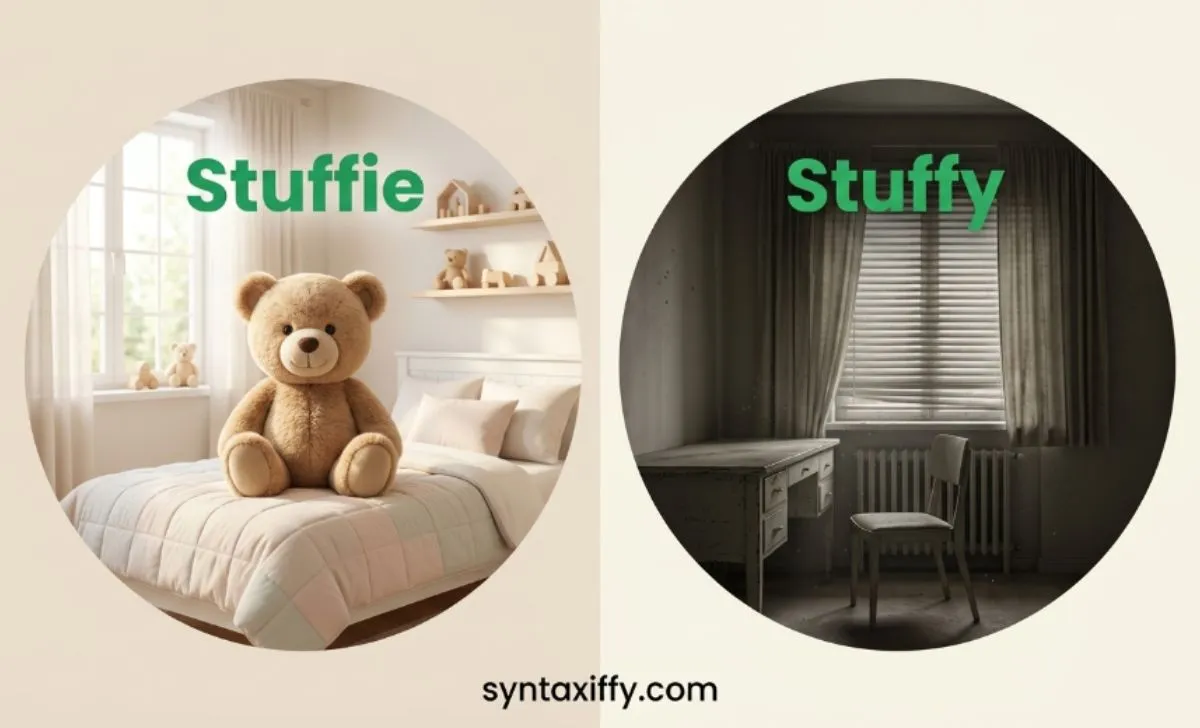
Have you ever wondered whether stuffie or stuffy is the correct word? Although they look and sound similar, they have completely different meanings.
This often confuses English learners, parents, writers, and even native speakers, especially when reading social media posts or casual conversations.
The good news is that both words are correct, but they are used in different situations. Stuffy is a standard English adjective used to describe something airless, congested, or overly formal, while stuffie is an informal noun that usually refers to a stuffed toy or plush animal.
In this guide, you’ll learn the difference between stuffie and stuffy, their meanings, pronunciation, grammar, real-life examples, and common mistakes.
By the end, you’ll know exactly which word to use in every situation.
Stuffie or Stuffy – Quick Answer
If you’re looking for a quick answer, here it is:
✅ Stuffy is a standard English word used to describe something that feels airless, blocked, or overly formal.
✅ Stuffie is an informal word, mainly used in North America, that refers to a stuffed toy or plush animal.
Although both words are real, they are not interchangeable because they have different meanings and are used in different contexts.
Quick Examples
✅ The classroom feels stuffy because the windows are closed.
✅ My daughter never sleeps without her favorite stuffie.
❌ The classroom feels stuffie.
❌ My daughter loves her favorite stuffy. (unless you’re describing the toy as formal or airless, which doesn’t make sense)
Stuffie vs Stuffy Comparison Table
| Feature | Stuffie | Stuffy |
| Correct Word | ✅ Yes (Informal) | ✅ Yes (Standard English) |
| Part of Speech | Noun | Adjective |
| Meaning | Stuffed toy or plush animal | Airless, congested, or overly formal |
| Formal Writing | ❌ Not recommended | ✅ Yes |
| Everyday Conversation | ✅ Common | ✅ Common |
| British English | Rare | Common |
| American English | Common | Common |
Difference Between Stuffie and Stuffy
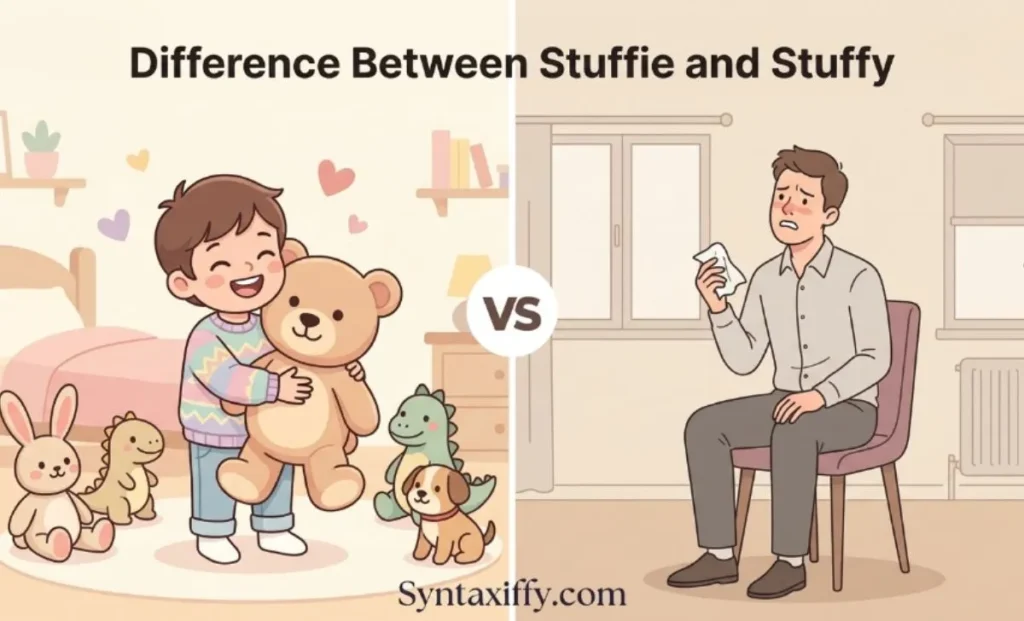
Even though stuffie and stuffy differ by only one letter, they have completely different meanings. Understanding the difference will help you choose the right word and avoid confusing your readers.
What Does Stuffy Mean?
Stuffy is a standard English adjective. It is commonly used to describe a room with little fresh air, a blocked nose caused by a cold or allergy, or a person who behaves in a very formal, serious, or old-fashioned way.
Examples
- The meeting room became stuffy after several hours.
- I couldn’t sleep because my nose was stuffy.
- Some people think the company’s dress code is too stuffy.
- Open a window—the office feels really stuffy today.
In each example, stuffy describes a condition, feeling, or atmosphere rather than an object.
What Does Stuffie Mean?
Stuffie is an informal noun that usually means a stuffed toy, plush toy, or stuffed animal. The word is especially popular among children, parents, and childcare professionals.
Although many people use it in everyday conversation, it is generally considered informal and is less common in formal writing.
Examples
- My son takes his favorite stuffie everywhere.
- She bought a new dinosaur stuffie for her nephew.
- Every child in the daycare has a special stuffie.
- The little girl hugged her stuffie before bedtime.
Unlike stuffy, which describes a condition or feeling, stuffie refers to a physical object that provides comfort or entertainment.
Is Stuffie a Real Word?
Yes. Stuffie is a real word, but it is informal rather than standard English.
The word is widely used in everyday conversations, parenting blogs, children’s books, and social media to describe stuffed toys. Although you may not see it as often in academic writing or professional documents, native English speakers—especially in the United States and Canada—commonly use stuffie when talking to young children.
Common names for the same type of toy include:
- Stuffie
- Plush toy
- Plushie
- Stuffed toy
- Stuffed animal
- Teddy bear (for bear-shaped toys)
Because stuffie is informal, it’s perfectly acceptable in casual conversations, but it’s usually better to use terms like stuffed toy or plush toy in formal or educational writing.
Why Do People Confuse Stuffie and Stuffy?
The confusion between stuffie and stuffy is understandable because the two words look almost identical and are pronounced almost the same. However, they belong to different parts of speech and have completely different meanings.
Here are the most common reasons why people mix them up.
They Have Similar Spellings
The only visible difference between the two words is the ending:
- Stuffie
- Stuffy
Since both words share the same root word stuff, many learners assume they have the same meaning. In reality, they are used in completely different contexts.
They Sound Almost the Same
When spoken quickly, stuffie and stuffy have very similar pronunciations. Without enough context, it can be difficult to know which word the speaker means.
For example:
“She loves her stuffie.”
“The room feels stuffy.”
Although they sound alike, the surrounding words make the meaning clear.
Social Media Has Popularized “Stuffie”
The word stuffie has become increasingly common on social media, parenting blogs, and online stores that sell plush toys. As a result, many people assume it’s the standard English word for every situation.
However, stuffie should only be used when referring to a stuffed toy or plush animal.
Multiple Meanings of “Stuffy”
Another reason for the confusion is that stuffy has several meanings. It can describe:
- A room with little fresh air.
- A blocked nose caused by a cold or allergies.
- A person who is very formal or old-fashioned.
Because one word has several meanings while the other has only one common meaning, learners often become unsure about which word to choose.
Grammar Rule Explained
Understanding the grammar behind these words makes the difference much easier to remember.
Stuffy Is an Adjective
An adjective describes a noun by giving more information about it.
Examples:
- The classroom is stuffy.
- I have a stuffy nose.
- The hotel lobby felt stuffy.
In each sentence, stuffy describes the noun.
Stuffie Is a Noun
A noun names a person, place, thing, or idea.
Since stuffie refers to a stuffed toy, it functions as a noun.
Examples:
- Her stuffie is on the bed.
- Every child brought a favorite stuffie.
- He received a dinosaur stuffie for his birthday.
Easy Grammar Tip
Ask yourself this question:
Are you describing something?
If yes, use stuffy.
Are you naming a stuffed toy?
If yes, use stuffie.
This simple question helps you choose the correct word every time.
The Origin of Stuffie and Stuffy
Although these words look similar, they developed differently over time.
Origin of Stuffy
The word stuffy comes from the verb stuff, which originally meant to fill something tightly. Over time, English speakers began using stuffy to describe places that felt filled with warm, stale air.
Later, its meaning expanded to include:
- A blocked nose.
- Someone with a formal or rigid personality.
Today, stuffy is a well-established word in standard English.
Origin of Stuffie
The word stuffie is much newer. It developed as an affectionate nickname for a stuffed toy or stuffed animal.
Parents and young children shortened expressions like:
- stuffed toy
- stuffed animal
into the simpler and cuter word:
stuffie
This informal word became especially popular in North America and is now widely used in parenting communities, toy stores, and children’s books.
British vs American English
Many English words have different spellings depending on whether you use British or American English. However, stuffie and stuffy are different because the spelling doesn’t change—the usage does.
Stuffy
The word stuffy is used in both British English and American English.
Examples:
- UK: The office feels stuffy today.
- US: My nose is stuffy because of allergies.
The meaning remains exactly the same in both regions.
Stuffie
The word stuffie is much more common in American and Canadian English, especially among parents and children.
In British English, people are more likely to say:
- stuffed toy
- soft toy
- cuddly toy
- teddy bear
instead of stuffie.
Regional Comparison
| Variety of English | Stuffy | Stuffie |
| British English | ✅ Common | Rare |
| American English | ✅ Common | ✅ Common (Informal) |
| Canadian English | ✅ Common | ✅ Common (Informal) |
| Australian English | ✅ Common | Less Common |
So, if you’re writing for an international audience, stuffy is universally understood, while stuffie may be more familiar to North American readers.
How to Pronounce Stuffie and Stuffy
Correct pronunciation can also help you remember these words.
Stuffy
Pronunciation:
/ˈstʌf.i/
Sounds like:
STUF-ee
Stuffie
Pronunciation:
/ˈstʌf.i/
It is pronounced almost exactly the same as stuffy.
Since both words sound nearly identical, listeners usually understand the correct meaning from the surrounding context rather than pronunciation alone.
Example
Stuffy:
The classroom feels stuffy after the windows stay closed all day.
Stuffie:
Emma takes her favorite stuffie everywhere she goes.
Even though both sentences sound similar when spoken, their meanings are completely different because of the context.
When Should You Use Stuffy?
Use stuffy whenever you’re describing a place, a person’s behavior, or a physical condition. Since stuffy is an adjective, it describes a noun rather than naming an object.
Here are the most common situations where stuffy is the correct choice.
1. To Describe a Room or Place
A room feels stuffy when it has little fresh air, poor ventilation, or feels hot and uncomfortable.
Examples:
- The bedroom became stuffy after the windows were closed.
- Please open the door—the office feels stuffy.
- The classroom was stuffy, so the teacher turned on the fan.
2. To Describe a Blocked Nose
In medical and everyday English, stuffy often describes a nose that is blocked because of a cold, flu, or allergies.
Examples:
- I woke up with a stuffy nose.
- My allergies always give me a stuffy nose in spring.
- She couldn’t sleep because her nose felt stuffy.
3. To Describe a Person or Atmosphere
Sometimes stuffy describes someone who is overly serious, formal, or unwilling to accept new ideas.
Examples:
- The manager seemed a bit stuffy during the meeting.
- Some people think the club is too stuffy.
- The event felt stuffy because everyone followed strict rules.
When Should You Use Stuffie?
Use stuffie when you’re talking about a stuffed toy or plush animal. This word is especially common in conversations with children and in parenting-related content.
Examples
- My daughter sleeps with her favorite stuffie every night.
- He won a dinosaur stuffie at the fair.
- Every child in the classroom brought a stuffie for story time.
- She collects cute animal stuffies from different countries.
Because stuffie is informal, it’s best suited for casual conversations rather than academic or professional writing.
Stuffie vs Plushie
Many people also wonder whether stuffie and plushie mean the same thing.
The answer is almost yes.
A stuffie is a stuffed toy that usually has sentimental or emotional value, especially for children.
A plushie is any toy made from soft plush fabric. The word is widely used by toy collectors, gamers, and anime communities.
Comparison
| Feature | Stuffie | Plushie |
| Meaning | Stuffed toy | Plush toy |
| Tone | Child-friendly | Modern and collectible |
| Common Users | Parents and children | Toy collectors and gamers |
| Formal Writing | Rare | Rare |
In everyday conversation, many people use these words interchangeably, but plushie is more common in collector communities.
Stuffie vs Stuffed Animal
Another common question is whether a stuffie is the same as a stuffed animal.
A stuffed animal is the standard and more formal term for a soft toy filled with stuffing.
A stuffie is simply an informal nickname for the same type of toy.
Examples
Formal:
The museum donated several stuffed animals to the children’s hospital.
Informal:
My nephew never travels without his favorite stuffie.
If you’re writing for schools, businesses, or educational materials, stuffed toy or stuffed animal is usually the better choice.
Can Stuffy Describe a Person?
Yes. This is one meaning that many English learners don’t know.
When stuffy describes a person, it doesn’t mean they have a blocked nose. Instead, it means they seem very formal, traditional, serious, or unwilling to accept new ideas.
Examples
- The professor seemed stuffy, but he was actually very kind.
- Some people think expensive restaurants can feel stuffy.
- His stuffy attitude made the meeting uncomfortable.
In this context, stuffy describes someone’s personality or behavior rather than a physical condition.
Stuffie and Stuffy in Real-Life Examples
Here are examples showing how both words are used in different situations.
Everyday Conversations
- My room feels stuffy after keeping the windows closed all day.
- Emma can’t sleep without her favorite stuffie.
Home
- The living room became stuffy during the summer afternoon.
- The baby hugged her stuffie before taking a nap.
School
- The classroom felt stuffy, so the teacher opened the windows.
- Students were asked to bring a stuffie for reading time.
Healthcare
- My doctor said my stuffy nose should improve in a few days.
- Steam can help relieve a stuffy nose.
Parenting
- My toddler carries her stuffie everywhere.
- He cried because he couldn’t find his favorite stuffie.
Travel
- The hotel room felt stuffy, so we turned on the air conditioner.
- Our daughter packed two stuffies for the trip.
Social Media
- “Meet my new panda stuffie!”
- “This office is so stuffy today.”
Workplace
- The conference room became stuffy after the presentation.
- Everyone agreed the company culture was becoming too stuffy.
These examples show that stuffy usually describes an environment, a feeling, or a personality, while stuffie always refers to a soft toy.
Common Mistakes with Stuffie and Stuffy
Although stuffie and stuffy are both real words, they are often used incorrectly because of their similar spelling and pronunciation. Here are some of the most common mistakes and the correct way to use each word.
| Incorrect | Correct |
| The room feels stuffie. | The room feels stuffy. |
| I have a stuffie nose. | I have a stuffy nose. |
| She bought a stuffy for her son. | She bought a stuffie for her son. |
| My favorite stuffy is a teddy bear. | My favorite stuffie is a teddy bear. |
| The office became stuffie. | The office became stuffy. |
Why Do These Mistakes Happen?
Most learners make these mistakes because:
- Both words have almost identical spelling.
- They are pronounced nearly the same.
- Stuffie is popular on social media and parenting websites.
- Many people don’t realize that stuffy is an adjective while stuffie is a noun.
- Writers often rely on pronunciation instead of checking the meaning.
The easiest way to avoid these errors is to remember what each word refers to:
- Stuffy = describes a condition, place, or person.
- Stuffie = names a stuffed toy.
Synonyms of Stuffy
Depending on the context, you can replace stuffy with several similar words.
When Talking About Air or a Room
- Airless
- Hot
- Close
- Poorly ventilated
- Suffocating
Example:
The room felt airless after the meeting.
When Talking About a Person
- Formal
- Rigid
- Traditional
- Conservative
- Serious
- Old-fashioned
Example:
Some employees thought the company’s rules were too formal.
Synonyms of Stuffie
Since stuffie is an informal word, similar alternatives include:
- Stuffed toy
- Stuffed animal
- Plush toy
- Plushie
- Teddy bear (when referring to a bear)
- Soft toy (common in British English)
Example:
My niece takes her favorite plush toy everywhere she goes.
Antonyms of Stuffy
The opposite of stuffy depends on its meaning.
For Air or Environment
- Fresh
- Airy
- Breezy
- Well-ventilated
- Comfortable
For Personality
- Relaxed
- Friendly
- Easygoing
- Casual
- Open-minded
Example:
The new office feels much more airy than the old one.
Since stuffie refers to a toy, it doesn’t have a direct opposite in everyday English.
Quick Memory Trick
Here’s an easy way to remember the difference forever.
Remember This Simple Rule
Stuffy = Situation
Think of:
- Stuffy room
- Stuffy nose
- Stuffy attitude
These all describe a condition or situation.
Stuffie = Soft Toy
Think of:
- Teddy bear
- Plush toy
- Stuffed animal
These are all objects, not descriptions.
Another Easy Trick
Y = “Why is this room so hot?”
➡️ Stuffy
IE = “I Enjoy my toy.”
➡️ Stuffie
These small memory tricks can help you choose the correct word instantly.
Quick Quiz
Test your understanding with this short quiz.
1. Which sentence is correct?
A. My room feels stuffie.
B. My room feels stuffy.
✅ Answer: B
2. Which word refers to a stuffed toy?
A. Stuffy
B. Stuffie
✅ Answer: B
3. Which sentence is correct?
A. My child sleeps with her favorite stuffie.
B. My child sleeps with her favorite stuffy.
✅ Answer: A
4. Which word is an adjective?
A. Stuffie
B. Stuffy
✅ Answer: B
5. Which word is better for formal writing?
A. Stuffie
B. Stuffy
✅ Answer: B
If you answered all five questions correctly, you’ve mastered the difference between stuffie and stuffy.
FAQs
Is stuffie a real English word?
Yes. Stuffie is a real but informal word that usually means a stuffed toy or plush animal.
What does stuffy mean?
Stuffy means lacking fresh air, having a blocked nose, or describing someone who is overly formal or traditional.
Are stuffie and stuffy interchangeable?
No. They have different meanings and belong to different parts of speech.
Is stuffie used in formal English?
No. In formal writing, it’s better to use stuffed toy, stuffed animal, or plush toy.
Is stuffy correct in British and American English?
Yes. Stuffy is standard in both British and American English.
Why do stuffie and stuffy sound the same?
They have almost identical pronunciation, which is why many English learners confuse them.
Can stuffy describe a person?
Yes. It can describe someone who is very formal, serious, or resistant to change.
What is a stuffy nose?
A stuffy nose is a blocked or congested nose, usually caused by a cold, allergies, or sinus problems.
Is stuffie another word for plushie?
Yes. In casual conversation, many people use stuffie and plushie to mean the same type of soft stuffed toy.
Which word should I use in an essay?
Use stuffy when appropriate. Avoid stuffie unless you’re specifically discussing children’s language or stuffed toys.
How can I remember the difference?
Remember:
- Stuffy = describes a condition.
- Stuffie = names a stuffed toy.
Which spelling is more common?
Stuffy is far more common because it is a standard English word used in many different situations. Stuffie is mainly used in informal conversations, especially in North America.
Conclusion
Although stuffie and stuffy look and sound similar, they have very different meanings. Stuffy is a standard English adjective used to describe an airless room, a blocked nose, or someone with a formal attitude. Stuffie, on the other hand, is an informal noun that refers to a stuffed toy or plush animal.
Understanding this difference will help you communicate more clearly and avoid common spelling and vocabulary mistakes.
Whether you’re writing an essay, sending an email, talking with friends, or reading children’s books, choosing the correct word makes your English more accurate and natural.
Whenever you’re unsure, remember this simple rule:
Stuffy describes. Stuffie is something you can hug.
Once you keep that distinction in mind, you’ll never confuse stuffie and stuffy again.
Related Articles
- Loses or Losses: How to Use Each Word Correctly
- Traveler or Traveller: Which Is Right in English Grammar?
- Cozy or Cosy: Correct Spelling, Meaning & Examples

Hi, I am Roy Peter Clark, and I write clear and practical grammar and writing blogs.
On Syntaxiffy.com, I focus on English grammar, style, and writing techniques to help readers improve clarity and communication.