
Cozy or cosy is a common spelling confusion in the English language. People often search this keyword because they are unsure whether to use “cozy” or “cosy” in writing.
This difference frequently appears in emails, academic writing, professional writing, business communication, and social media posts.
The confusion comes from the difference between American English and British English spelling rules. Both words are correct, but used in different regions.
In this article, you will learn the meaning, usage rules, differences, examples, and easy memory tricks for cozy or cosy in English grammar and writing skills.
Cozy or Cosy – Quick Answer

Cozy (American English) and cosy (British English) both mean warm, comfortable, and relaxing. The only difference is spelling style based on region, not meaning. “Cozy” is used in the US, while “cosy” is used in the UK and Commonwealth countries.
Example:
- The room feels cozy. (US)
- The room feels cosy. (UK)
| Feature | Cozy | Cosy |
| Meaning | Warm and comfortable | Warm and comfortable |
| English Type | American English | British English |
| Usage | US writing | UK writing |
Difference Between Cozy and Cosy
The main difference between cozy and cosy is regional spelling, not meaning.
- Cozy → American English adjective
- Cosy → British English adjective
Both describe something warm, soft, and comfortable.
Examples:
- I love my cozy room.
- I love my cosy room.
Both are correct depending on English style.
Why Do People Confuse Cozy and Cosy?
People confuse cozy and cosy because English has two major spelling systems: American English and British English. Learners often switch between them in reading and writing.
Example:
- A blogger reads “cozy home” in US content and “cosy home” in UK articles and thinks one is incorrect.
This creates confusion in proofreading and writing consistency.
The Origin of Cozy and Cosy
The word comes from Scots English “cosie,” meaning warm, comfortable, or snug. Over time, it entered standard English as “cosy.”
Later, American English simplified the spelling to “cozy” by replacing “s” with “z,” a common pattern in US spelling reforms.
Cozy vs Cosy Comparison Table
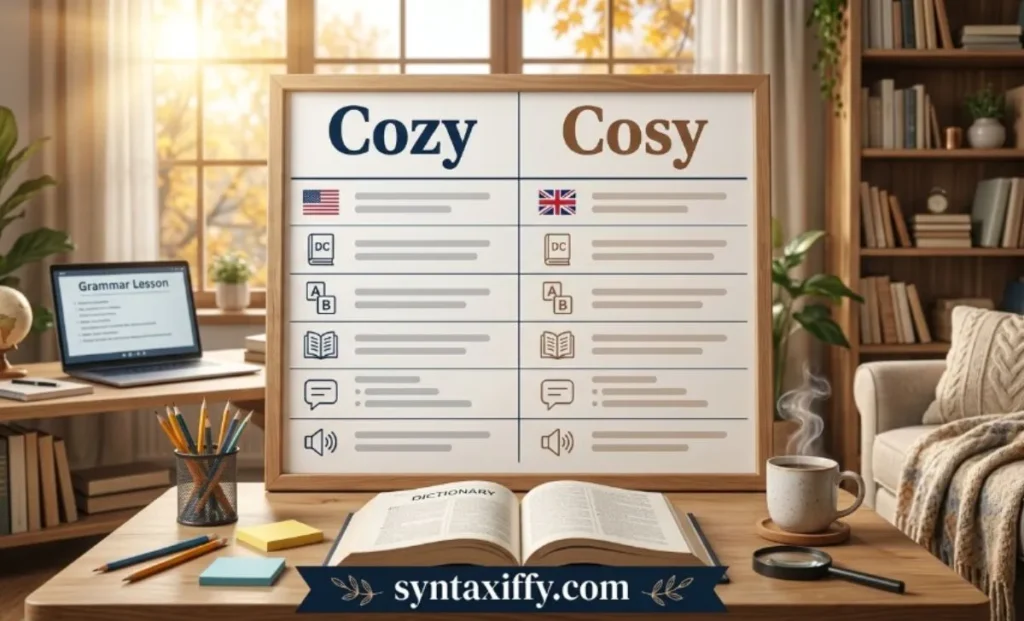
| Feature | Cozy | Cosy |
| Meaning | Comfortable, warm | Comfortable, warm |
| Grammar Role | Adjective | Adjective |
| Usage | American English | British English |
| Memory Tip | “Z = USA” | “S = UK” |
| Example | A cozy blanket | A cosy blanket |
When Should You Use Cozy?
Use cozy when writing in American English contexts:
Practical usage:
- US blogs and websites
- American academic writing
- International business with US audience
Examples:
- The cozy cafe was full of customers.
- She lives in a cozy apartment.
When Should You Use Cosy?
Use cosy when writing in British English contexts:
Practical usage:
- UK academic writing
- Commonwealth countries (Pakistan, UK, Australia, etc.)
- British publications
Examples:
- The cosy cottage was beautiful.
- They spent a cosy evening together.
Cozy or Cosy Examples
- Email: The office has a cozy atmosphere.
- Academic Writing: A cosy environment improves learning.
- Professional Writing: Cozy interiors increase customer satisfaction.
- Business Communication: Cosy design improves user experience.
- Social Media: I love this cozy vibe ✨
- Everyday Conversation: This place feels so cosy!
Cozy or Cosy in One Sentence
- The cozy/cosy room made everyone feel relaxed and comfortable.
- A cozy/cosy home is important for mental peace.
- She prefers a cozy/cosy environment for studying.
Common Mistakes with Cozy or Cosy
| Incorrect | Correct |
| cozey | cozy / cosy |
| cozi | cozy / cosy |
| cosi | cosy |
| cozzy | cozy / cosy |
| cozey room | cozy/cosy room |
Why Cozy or Cosy Still Confuses Writers in 2026
Even in 2026, learners still struggle with cozy or cosy because:
- Mixed exposure to American and British content
- Auto-correct inconsistencies
- Lack of awareness about regional spelling rules
- Frequent use in lifestyle and social media writing
This impacts English Grammar, Writing Skills, and Proofreading accuracy.
Quick Memory Trick
- Cozy = American English (Z = USA)
- Cosy = British English (S = Standard UK spelling)
Simple rule:
👉 “Z for USA, S for UK”
FAQs
1. Is cozy correct?
Yes, it is correct in American English.
2. Is cosy correct?
Yes, it is correct in British English.
3. What does cozy mean?
It means warm, comfortable, and relaxing.
4. What does cosy mean?
It has the same meaning as cozy.
5. Which is more common?
Cozy is more common globally due to US content.
6. Can I use both?
Yes, but stay consistent in one style.
7. Is cozy an adjective?
Yes, it is an adjective.
8. What is the British spelling?
Cosy is the British spelling.
Is cozy or cosy more formal?
Neither is more formal. Both are standard spellings, but cozy is used in American English, while cosy is preferred in British English.
Is cozy or cosy used in Canada?
Both spellings are accepted in Canada, although cozy is generally seen more often in modern Canadian writing.
How do you pronounce cozy and cosy?
Both words are pronounced the same: /ˈkoʊ.zi/. The spelling changes, but the pronunciation does not.
Is there any difference in meaning between cozy and cosy?
No. Cozy and cosy have exactly the same meaning. The only difference is the regional spelling.
Should I use cozy or cosy for SEO?
Use the spelling that matches your target audience. Choose cozy if you’re targeting readers in the United States.
Conclusion
Choosing between Cozy and Cosy is simple once you know the difference. Both spellings are 100% correct and have the same meaning—they describe something warm, comfortable, and inviting. The only difference is the regional spelling.
- Cozy is the preferred spelling in American English.
- Cosy is the preferred spelling in British English and other varieties such as Australian and Canadian English (though cozy is also common in Canada).
When writing, the most important rule is to stay consistent. If your content follows American English, use cozy throughout. If you’re writing in British English, use cosy consistently.
Whether you’re describing a cozy home, a cosy café, or a comfortable reading corner, both spellings are grammatically correct. Choosing the right one simply depends on your audience and the English style you’re using.
Read More Blogs:
- Excited or Exited – Avoid This Common English Mistake
- Supercede or Supersede: Which Spelling Is Correct?
- Todays or Today’s: Complete Usage Guide with Examples

Hi, I am Bill Walsh, and I write clear and practical grammar blogs on Syntaxiffy.com.
I focus on English grammar, pair of words, and spelling differences to help readers improve their writing skills.